Molybdenum spin-flip emitter hits 130% quantum yield
The 30-Second Skim
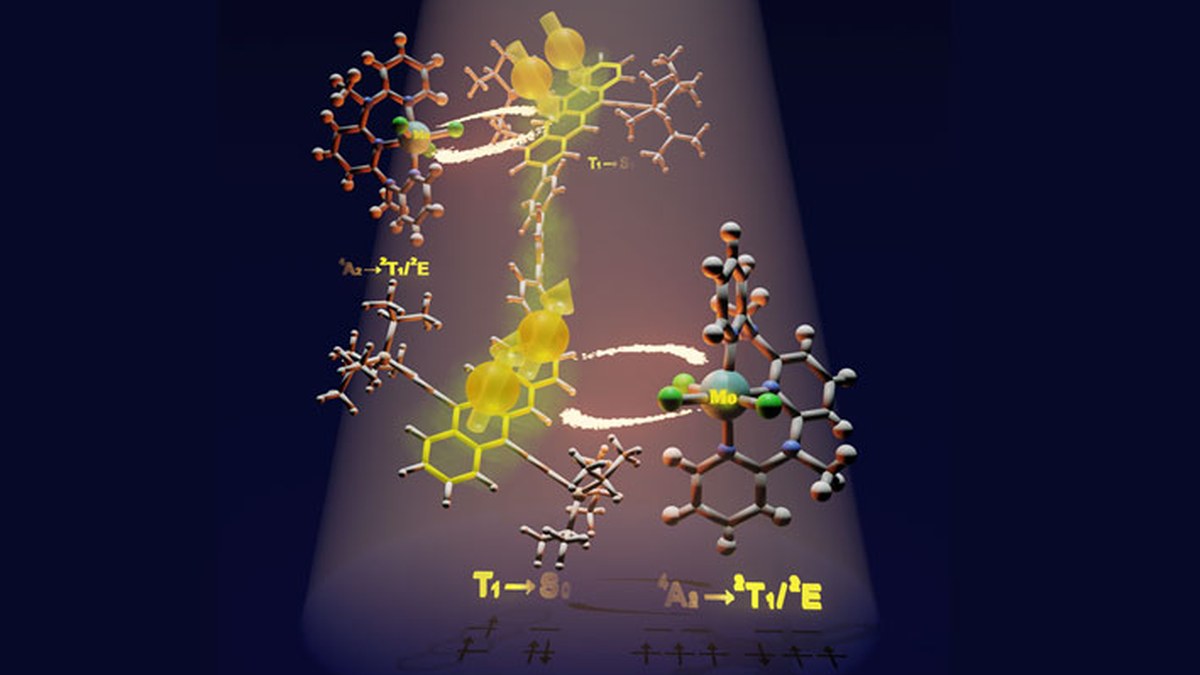
- What happened: Researchers at Kyushu University engineered a molybdenum-based spin-flip emitter that captures triplet excitons from singlet-fission tetracene dimers, achieving a 130% quantum yield and pointing to solar cells that exceed conventional efficiency ceilings.
- Key facts & numbers: Kyushu University researchers built a molybdenum-based spin-flip emitter that selectively captures triplet exciton energy from singlet-fission tetracene dimers before dissipation, hitting an effective quantum yield of approximately 130% in solution. The emitter works by allowing electron spin to flip during near-infrared light absorption or emission, converting otherwise "dark" excitons into usable light. Nobuo Kimizuka, lead author, told pv magazine that the next step is integrating singlet-fission materials with spin-flip emitters in solid-state systems, where he expects efficiency to surpass conventional singlet-fission technology alone.
- What happens next: The kicker buried in the quotes: silicon cells lose energy when SF molecules transfer via their excited singlet state — this design blocks that loss pathway specifically.
- Kyushu University researchers built a molybdenum-based spin-flip emitter that selectively captures triplet exciton energy from singlet-fission tetracene dimers before dissipation, hitting an effective quantum yield of approximately 130% in solution.
- The emitter works by allowing electron spin to flip during near-infrared light absorption or emission, converting otherwise "dark" excitons into usable light.
- Nobuo Kimizuka, lead author, told pv magazine that the next step is integrating singlet-fission materials with spin-flip emitters in solid-state systems, where he expects efficiency to surpass conventional singlet-fission technology alone.
- Sensitization efficiency depends heavily on the linker connecting tetracene units, with linker length, rigidity, and conjugation controlling electronic coupling, the exchange interaction within the correlated triplet pair, and the rate of triplet energy transfer.
Why It Matters
Singlet fission has been studied since the 1970s but translating it into working solar cells has stalled because the resulting triplet excitons are hard to harvest. By demonstrating a 130% quantum yield through a spin-flip emitter that converts dark triplets into near-infrared light, Kimizuka's group offers a concrete pathway to pair singlet fission with silicon cells — potentially breaking the single-junction efficiency ceiling that has capped conventional photovoltaics for decades.
Sources Cited
Related Coverage
Ask SkimNews