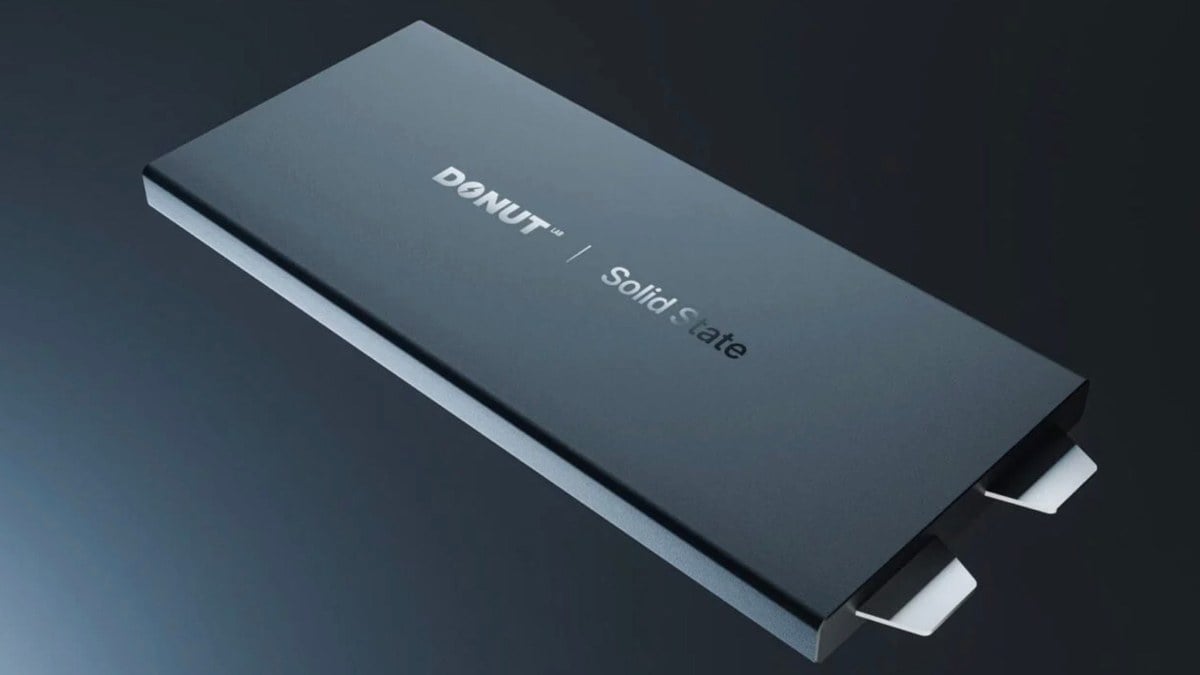
Donut Lab battery was lithium-ion, not solid-state
The 30-Second Skim7 points
- What happenedAn investigation by battery researcher Ziroth, backed by 20+ independent experts, found that Donut Lab's celebrated 'solid-state' battery is a conventional lithium-ion cell, validating earlier whistleblower complaints and contradicting the company's CES 2026 claims.
- Key facts & numbersZiroth's investigation consulted over 20 independent battery experts — including researchers from Fraunhofer, Justus-Liebig University, and Seinäjoki University — all of whom confirmed the tested cell was lithium-ion, not the sodium-ion solid-state chemistry Donut Lab had claimed. Electrochemical evidence proved the match: VTT voltage curves sat at 3.7–3.8V at 50% state of charge (NCM lithium-ion range), and cell expansion data showed a graphite-anode 'kink' at 50–70% SOC — a signature sodium ions are physically too large to produce. Calculated energy density came in at ~298 Wh/kg, not the claimed 400 Wh/kg. CT Coatings, the German company behind the technology, holds patents ranging from screen-printed paving slabs to menu folders and warning triangles; its representatives reportedly told a Fraunhofer expert they avoided lithium because it 'had nothing to do with rare earth minerals' — a basic chemistry error.
- What happens nextThe graphite 'kink' in the expansion curve is the smoking gun — sodium ions literally can't fit in graphite layers. Theranos vibes, but worse: the money came from regular people, not VCs.
- Ziroth's investigation consulted over 20 independent battery experts — including researchers from Fraunhofer, Justus-Liebig University, and Seinäjoki University — all of whom confirmed the tested cell was lithium-ion, not the sodium-ion solid-state chemistry Donut Lab had claimed.
- Electrochemical evidence proved the match: VTT voltage curves sat at 3.7–3.8V at 50% state of charge (NCM lithium-ion range), and cell expansion data showed a graphite-anode 'kink' at 50–70% SOC — a signature sodium ions are physically too large to produce. Calculated energy density came in at ~298 Wh/kg, not the claimed 400 Wh/kg.
- CT Coatings, the German company behind the technology, holds patents ranging from screen-printed paving slabs to menu folders and warning triangles; its representatives reportedly told a Fraunhofer expert they avoided lithium because it 'had nothing to do with rare earth minerals' — a basic chemistry error.
- Donut Lab raised approximately $25 million from over 1,300 shareholders — more than 900 of whom held 50 or fewer shares, representing investments of roughly $3,000 to $23,000 each — via Finland's Springvest crowdfunding platform, with CEO Marko Lehtimäki promising 'up to 10x return in 12 to 18 months.'
Why It Matters
More than 1,300 small investors — many putting in $3,000 to $23,000 based on promises of 10x returns — funded a company whose headline product did not exist, and Finnish financial and criminal authorities are now reportedly investigating. Donut Lab's $1.25 billion post-CES valuation was built on a lithium-ion cell misrepresented as a 400 Wh/kg sodium-ion solid-state battery, a gap the Ziroth investigation closed with 20 expert reviews and VTT's electrochemical data.
Sources Cited
Related Coverage
Ask SkimNews
The day’s news in one short email, every morning.
Free. One email a day. Unsubscribe in one click.