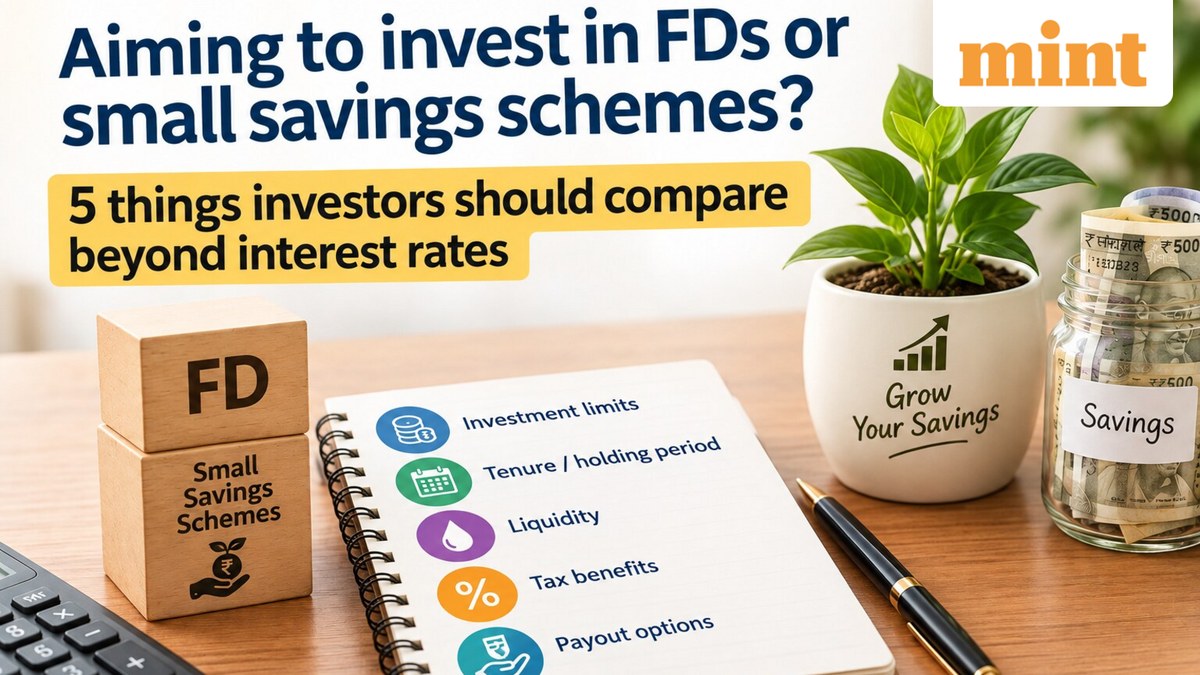
Investing in FDs or small savings schemes? 5 factors investors should compare beyond interest rates
The 30-Second Skim
- What happened: Investors weighing fixed deposits against government small savings schemes should look past headline interest rates to compare investment ceilings, liquidity, tenure, payout frequency, and tax treatment — differences that can materially change post-tax returns, especially for products like PPF's tax-exempt compounding versus fully taxable FD interest.
- Key facts & numbers: Government of India has kept small savings scheme interest rates unchanged for the July-September 2026 quarter, with SCSS and SSY offering the highest rate among major schemes at 8.2% and PPF at 7.1%. Axis Bank and ICICI Bank offer up to 6.50% on FDs across listed tenures, while HDFC Bank offers up to 6.45%, per the latest compilation. Bank of India offers up to 6.85% on FDs and Bank of Baroda up to 6.75% in the public-sector segment — generally below several small finance banks that exceed 8%, according to Paisabazaar data.
- What happens next: The FD-vs-small-savings pitch always starts with interest rate, but PPF's EEE status quietly makes 7.1% beat 8.2% post-tax for most people.
- Government of India has kept small savings scheme interest rates unchanged for the July-September 2026 quarter, with SCSS and SSY offering the highest rate among major schemes at 8.2% and PPF at 7.1%.
- Axis Bank and ICICI Bank offer up to 6.50% on FDs across listed tenures, while HDFC Bank offers up to 6.45%, per the latest compilation.
- Bank of India offers up to 6.85% on FDs and Bank of Baroda up to 6.75% in the public-sector segment — generally below several small finance banks that exceed 8%, according to Paisabazaar data.
- SCSS caps maximum investment at ₹30 lakh, while PPF permits up to ₹1.5 lakh per year, with bank FDs offering greater flexibility subject to the bank's terms.
Why It Matters
An investor choosing between an 8.2%-yielding SCSS and a 6.5% bank FD could see the post-tax gap flip sign entirely once Section 80C deductions, EEE status on PPF, and TDS rules on FD interest are factored in — meaning the headline-rate comparison many savers rely on systematically understates the value of tax-advantaged schemes for eligible investors.
Sources Cited
- Mint — Investing in FDs or small savings schemes? 5 factors investors should compare beyond interest rates
- Livemint — Investing in FDs or small savings schemes? 5 factors investors should compare beyond interest rates
- The Economic Times — RBI MPC Meeting 2026: Will FD interest rates increase as RBI holds repo rate?
- Business Today — Fixed deposits (FD) vs Post Office schemes: Where to earn more in 1–5 years
- Business Standard — Senior citizen saving scheme vs bank FD: What is the right strategy for you
Related Coverage
- Want better returns than FDs? Here are top five government-backed schemes you can considerMint
- FD returns: Your bank offers 6.35% interest, but how much do you actually earn after tax? Check returns across top banksMint
- Small Finance Bank FD rates beat big banks: Smart investment or risky bet? What should investors check?Mint
- SCSS 8.2% Fixed vs FDs: Senior Citizen Rate ComparisonMint
Ask SkimNews