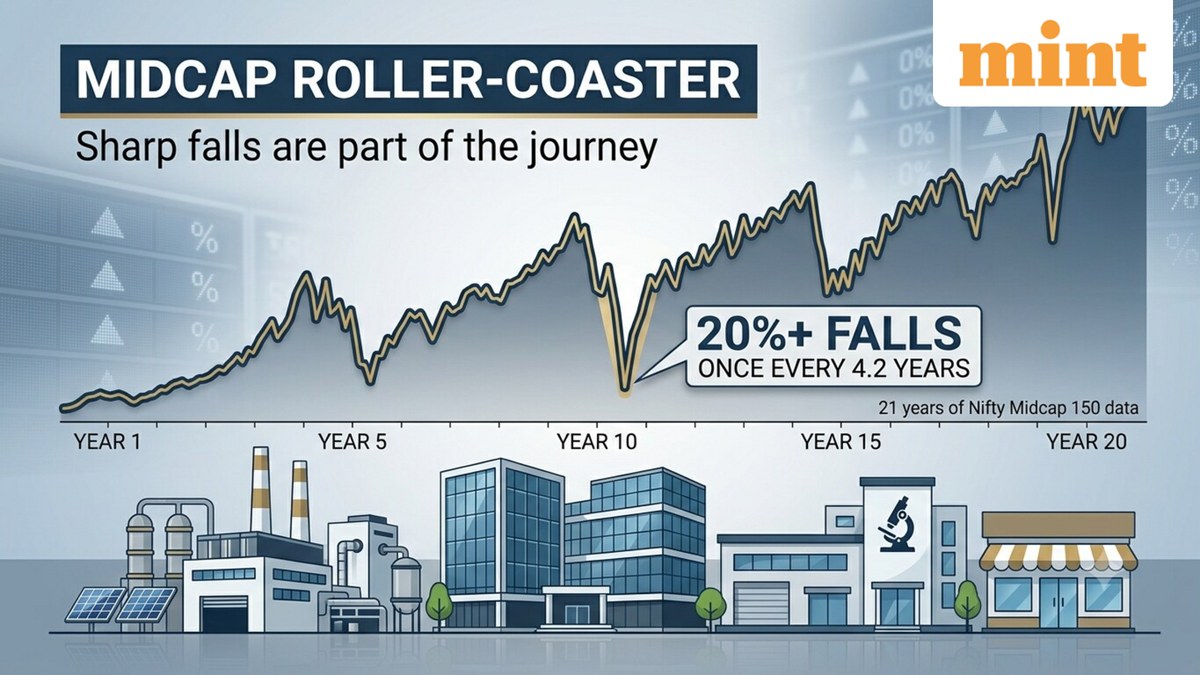
Midcap roller-coaster: Sharp falls of over 20% can happen once every 4.2 years — here's what you need to know
The 30-Second Skim
- What happened: Analysis by Abakkus Mutual Fund shows Nifty Midcap 150 has suffered 20%+ drops roughly once every 4.2 years over the past two decades, while missing the 50 best trading days can cut long-term returns from 17.23% to 5.77% CAGR.
- Key facts & numbers: Nifty Midcap 150 has fallen more than 20% on five occasions between April 2005 and August 2026, equating to roughly one such severe correction every 4.2 years on average, according to an Abakkus Mutual Fund study. Abakkus Mutual Fund analyzed the Nifty Midcap 150 from April 2005 to August 2026, finding that as of 31 August 2026 the index stood at 23,537, just 0.01% shy of completing a full recovery cycle. Nifty Midcap 150 TRI turned ₹10,000 invested in April 2005 into ₹3,00,810 by 31 August 2026, delivering a 17.23% CAGR over the 21-year period.
- What happens next: Miss 50 days out of thousands and your CAGR tanks from 17% to under 6%. The market's best days love to show up right after its worst ones.
- Nifty Midcap 150 has fallen more than 20% on five occasions between April 2005 and August 2026, equating to roughly one such severe correction every 4.2 years on average, according to an Abakkus Mutual Fund study.
- Abakkus Mutual Fund analyzed the Nifty Midcap 150 from April 2005 to August 2026, finding that as of 31 August 2026 the index stood at 23,537, just 0.01% shy of completing a full recovery cycle.
- Nifty Midcap 150 TRI turned ₹10,000 invested in April 2005 into ₹3,00,810 by 31 August 2026, delivering a 17.23% CAGR over the 21-year period.
- Missing the five best trading days during the study period reduced the terminal portfolio value by nearly ₹95,600 and dragged CAGR down to 15.15% from 17.23%.
Why It Matters
For midcap investors with 21-year horizons, the data quantifies a stark asymmetry: a 20% correction happens about every 4 years, but missing just 50 of roughly 5,000 trading days cuts CAGR nearly threefold. The material tradeoff is between accepting periodic steep drawdowns and accepting dramatically lower terminal wealth if one tries to time around them.
Sources Cited
Related Coverage
Ask SkimNews