Pakistan's Fa'az Test Targets China, US Arms Dependence
The 30-Second Skim
- What happened: Pakistan's military successfully flew the first indigenously developed beyond-visual-range air-to-air missile, adding a domestic source of advanced munitions for its fighter fleet as it seeks to reduce reliance on Washington and Beijing.
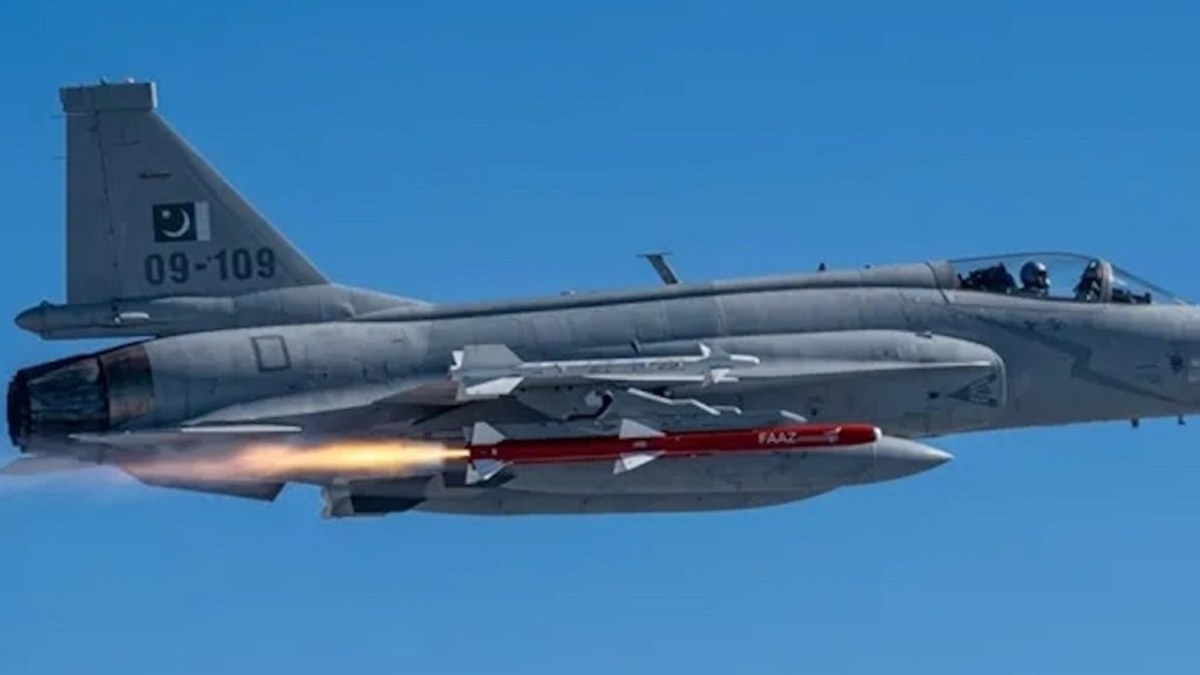
- Key facts & numbers: Fa'az passed its maiden flight test when Pakistan's military launched the orange-painted Fa'az-IIR variant from a JF-17 Thunder; the missile pairs an imaging infrared terminal seeker with midcourse inertial navigation and aircraft datalinks. NESCOM's Air Weapons Complex developed the missile, which is marketed by Global Industrial & Defense Solutions as a Mach 3.5 family with engagement ranges exceeding 100 kilometers, alongside the radar-guided Fa'az-RF, the extended-range Fa'az-2 targeting up to 180 kilometers, and a short-range surface-launched air-defense derivative. Pakistan is pursuing the domestic series to curb reliance on foreign suppliers in China and the US, insulate frontline fighter squadrons from embargoes and wartime supply disruption, and field a dual-guidance complement to its existing PL-15E and AIM-120 inventory; Gleb Makarevich (December 2023) describes domestic production as the anchor balancing Chinese alignment with Western ties, insulating combat units from foreign embargoes and serving as a diplomatic lever through external munitions transfers.
- What happens next: The "escape" framing misses it: Fa'az is meant to complement the Chinese PL-15E and U.S. AIM-120 already in that fleet.
- Fa'az passed its maiden flight test when Pakistan's military launched the orange-painted Fa'az-IIR variant from a JF-17 Thunder; the missile pairs an imaging infrared terminal seeker with midcourse inertial navigation and aircraft datalinks.
- NESCOM's Air Weapons Complex developed the missile, which is marketed by Global Industrial & Defense Solutions as a Mach 3.5 family with engagement ranges exceeding 100 kilometers, alongside the radar-guided Fa'az-RF, the extended-range Fa'az-2 targeting up to 180 kilometers, and a short-range surface-launched air-defense derivative.
- Pakistan is pursuing the domestic series to curb reliance on foreign suppliers in China and the US, insulate frontline fighter squadrons from embargoes and wartime supply disruption, and field a dual-guidance complement to its existing PL-15E and AIM-120 inventory; Gleb Makarevich (December 2023) describes domestic production as the anchor balancing Chinese alignment with Western ties, insulating combat units from foreign embargoes and serving as a diplomatic lever through external munitions transfers.
- PL-15E missiles achieved surprise intercepts at 160 to 190 kilometers against Indian aircraft in the May 2025 Kashmir aerial clashes; Farhat Hussain Khan (September 2026, Strategic Thought) credits their reach, first-shot capability and datalink integration, and argues Pakistan's edge lay in compressed kill chains, electronic warfare and sensor fusion, with airborne early warning, ground command and data-linked fighters outpacing the adversary's decision cycle.
Why It Matters
Pakistan flies 70 to 80 F-16s whose AIM-120C-5s reach only about 100 kilometers, and it took 61% of China's defense exports from 2021 to 2025; a domestic line spanning 100 to 180 kilometers adds a supply route outside both suppliers, while the $686 million U.S. upgrade package still tracks India's Russian purchases.
Sources Cited
- Asia Times — Pakistan’s Fa’az missile aims to escape China, US arms traps
- Aerospace Global News — Pakistan tests indigenous Fa’az air-to-air missile from JF-17 fighter
- TWZ — Pakistan Joins Air-to-Air Missile Club With Successful Test Of Fa’az
- Aviacionline — Pakistan tests the Fa’az, its first domestically developed BVR air-to-air missile
Related Coverage
Ask SkimNews