Watling's 'Statecraft' Book Faults U.S. Iran War Strategy
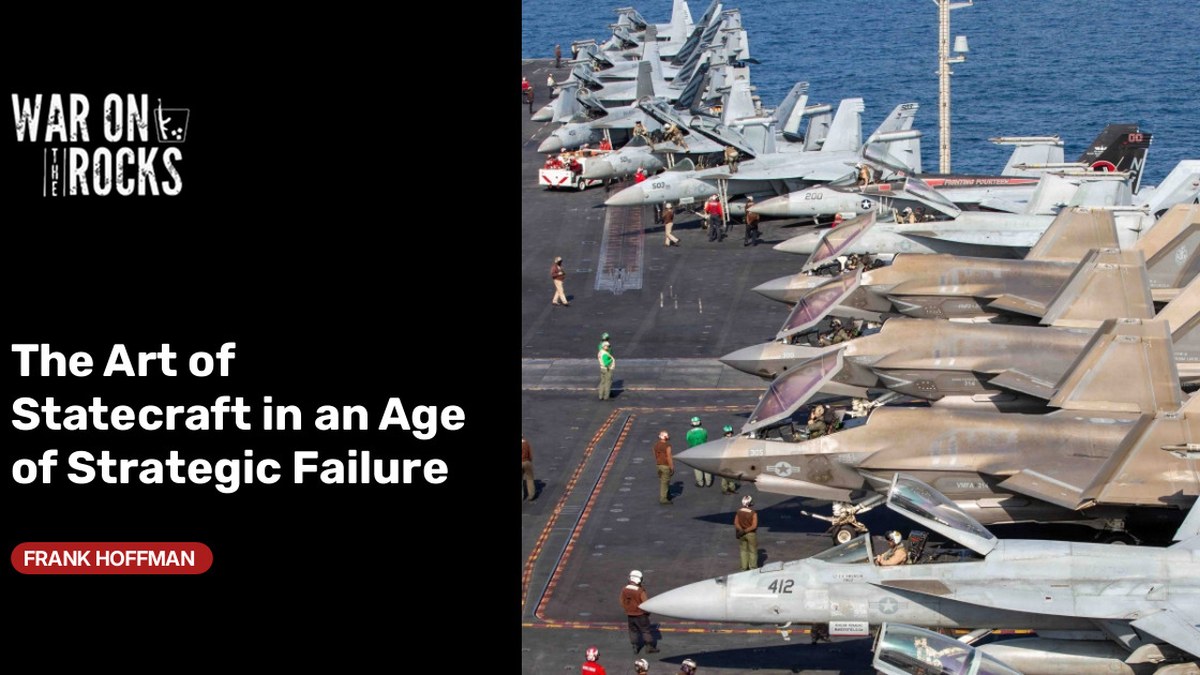
The 30-Second Skim
- What happened: Jack Watling's new book 'Statecraft: The New Rules of Power in a Divided World' (Macmillan, 2026) uses the U.S. war against Iran to diagnose what the review calls 'forced errors and own goals' in American statecraft, arguing Operation Epic Fury's 13,000 sorties failed to achieve stated policy aims despite military victory claims.
- Key facts & numbers: Jack Watling's book 'Statecraft' (Macmillan, 2026) uses the recent Iran war to diagnose failures in U.S. statecraft, arguing the conflict exposed 'forced errors and own goals' despite 13,000 sorties in Operation Epic Fury failing to induce Tehran's capitulation. Operation Epic Fury saw Adm. Brad Cooper claim the U.S. achieved 'all our military objectives,' while the president touted a 'military victory' and the combatant commander claimed a 'generational military defeat' — yet the review argues none identified which policy aims were actually obtained. Watling, a senior research fellow at the Royal United Services Institute in London, built his reputation over five years of battlefield research in Ukraine, documenting trench warfare and Ukraine's adaptations in drones, intelligence synthesis, and electronic warfare.
- What happens next: Sharpest line buried in para 8: 'Shock and awe was a flawed causal hypothesis.' 13,000 sorties, zero stated policy aims obtained. Three decades, same playbook.
- Jack Watling's book 'Statecraft' (Macmillan, 2026) uses the recent Iran war to diagnose failures in U.S. statecraft, arguing the conflict exposed 'forced errors and own goals' despite 13,000 sorties in Operation Epic Fury failing to induce Tehran's capitulation.
- Operation Epic Fury saw Adm. Brad Cooper claim the U.S. achieved 'all our military objectives,' while the president touted a 'military victory' and the combatant commander claimed a 'generational military defeat' — yet the review argues none identified which policy aims were actually obtained.
- Watling, a senior research fellow at the Royal United Services Institute in London, built his reputation over five years of battlefield research in Ukraine, documenting trench warfare and Ukraine's adaptations in drones, intelligence synthesis, and electronic warfare.
- The review identifies three areas where U.S. statecraft falls short — theory of success, multiple futures (scenario-based planning), and strategic risk — concluding that Iran's experience confirms 'shock and awe was a flawed causal hypothesis.'
Why It Matters
The review crystallizes a pattern the author says repeats across decades: U.S. officials extol military success without ever mapping it to policy outcomes. With Adm. Cooper claiming 'all military objectives' achieved while the review says no policy aims were identified, and no candid assessment likely forthcoming, the strategic gap that produced the Iran entanglement goes uncorrected — leaving the next contingency to inherit the same blind spots.
Sources Cited
- War on the Rocks — The Art of Statecraft in an Age of Strategic Failure
Related Coverage
Ask SkimNews