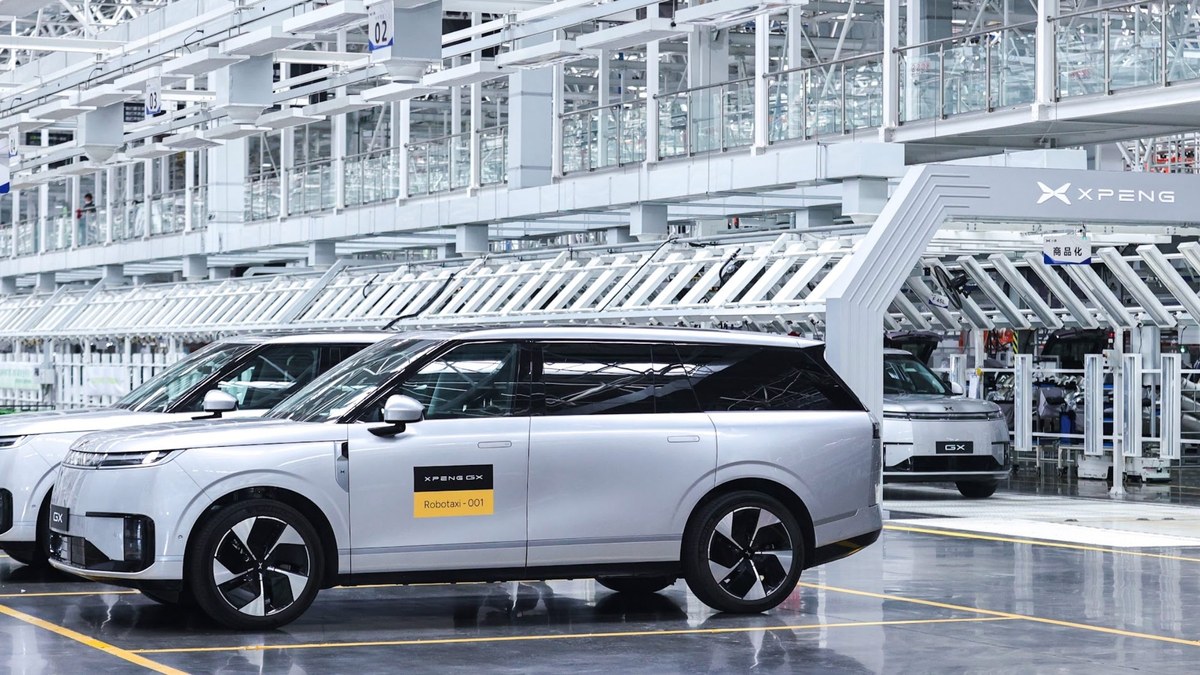
XPeng Rolls First Mass-Produced Robotaxi in China
The 30-Second Skim
- What happened: XPeng has rolled the first mass-produced robotaxi off its Guangzhou line, making it the first Chinese automaker to mass-produce a fully in-house L4 autonomous taxi powered by four of its own Turing AI chips — with no LiDAR.
- Key facts & numbers: XPeng rolled the first mass-produced robotaxi off its Guangzhou production line, becoming the first automaker in China to mass-produce a robotaxi built entirely through full-stack, in-house development. The GX platform robotaxi runs on four in-house Turing AI chips at 3,000 TOPS — roughly double the compute of Geely's Nvidia-based EVA Cab — and is engineered to L4 autonomous driving standards. VLA 2.0 is XPeng's pure-vision AI model (no LiDAR, no HD maps) that the robotaxi runs on, with claimed sub-80ms response latency and 12x faster inference than XPeng's previous generation.
- What happens next: XPeng's robotaxi shares chips and platform with its $58K SUV. Tesla and Geely build ground-up, but XPeng bets on shared scale to undercut them on cost.
- XPeng rolled the first mass-produced robotaxi off its Guangzhou production line, becoming the first automaker in China to mass-produce a robotaxi built entirely through full-stack, in-house development.
- The GX platform robotaxi runs on four in-house Turing AI chips at 3,000 TOPS — roughly double the compute of Geely's Nvidia-based EVA Cab — and is engineered to L4 autonomous driving standards.
- VLA 2.0 is XPeng's pure-vision AI model (no LiDAR, no HD maps) that the robotaxi runs on, with claimed sub-80ms response latency and 12x faster inference than XPeng's previous generation.
- XPeng plans pilot robotaxi operations in the second half of 2026 and targets fully autonomous service — no on-site safety officer — by early 2027.
Why It Matters
XPeng's bet is that sharing a platform between its $58,000 consumer SUV and its robotaxi cuts costs and speeds development, with 3,000 TOPS of in-house compute giving roughly 2x the headroom of Geely's Nvidia-based stack. But XPeng hasn't started pilot operations, trailing Baidu's Apollo Go (250,000 weekly rides) and Tesla's Austin service.
Sources Cited
Related Coverage
Ask SkimNews