Barandes Derives Tsirelson Bound From the Past
The 30-Second Skim7 points
- What happenedBarandes’ history-dependent reformulation of quantum mechanics treats the wave function as bookkeeping and derives the Tsirelson bound—about 41% stronger than non-quantum limits—from the universe’s light-speed horizon, though no distinct experimental prediction has emerged.
- Key facts & numbersBarandes published a paper last year showing that a quantum-like theory can be built from inherently probabilistic, non-Markovian processes, making the past indispensable and treating the wave function as bookkeeping rather than physical reality. Barandes likens a quantum marble’s wave function to unobservable “ghost marbles” encoding its state one, two or three seconds earlier or farther back; knowing those ghosts lets the real-plus-ghost system follow tractable Markovian laws. Barandes, working with Kagan and Hasan at the University of Massachusetts Dartmouth, calculated that the speed-of-light horizon keeps quantum correlations from exceeding the Tsirelson bound—about 41% above the maximum for non-quantum correlations.
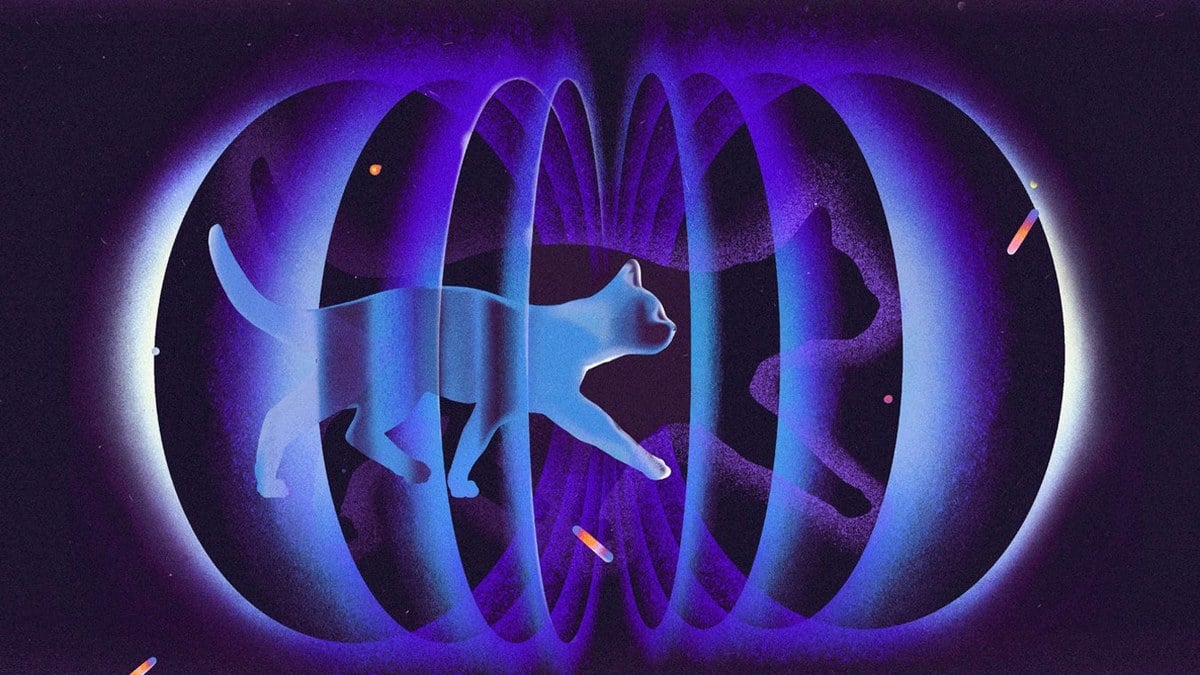
- What happens nextThe cat is the lure; the real story is Barandes tying the 41% Tsirelson cap to the universe’s light-speed limit.
- Barandes published a paper last year showing that a quantum-like theory can be built from inherently probabilistic, non-Markovian processes, making the past indispensable and treating the wave function as bookkeeping rather than physical reality.
- Barandes likens a quantum marble’s wave function to unobservable “ghost marbles” encoding its state one, two or three seconds earlier or farther back; knowing those ghosts lets the real-plus-ghost system follow tractable Markovian laws.
- Barandes, working with Kagan and Hasan at the University of Massachusetts Dartmouth, calculated that the speed-of-light horizon keeps quantum correlations from exceeding the Tsirelson bound—about 41% above the maximum for non-quantum correlations.
- Tsirelson derived the roughly 41% limit in 1980; Popescu and Rohrlich showed in 1994 that some hypothetical theories could, in principle, achieve correlations 100% greater than non-quantum theories without faster-than-light communication.
Why It Matters
For Simon Milz and other quantum-information researchers, the framework offers an underlying account of why correlations stop at the Tsirelson bound—41% above non-quantum limits—while restoring the universe’s history to prediction. The tradeoff is explicit: Barandes has produced no distinct experimental prediction, and David Wallace says denying the wave function physical reality remains an obstacle.
Sources Cited
Related Coverage
Ask SkimNews
The day’s news in one short email, every morning.
Free. One email a day. Unsubscribe in one click.