Bumble Bees Solve Classic Insight Puzzle Without Training
The 30-Second Skim
- What happened: Finnish researchers report that bumble bees spontaneously rolled a ball beneath an unreachable flower and climbed on top to claim a reward — solving an insect version of Köhler's classic chimpanzee box-and-banana puzzle with zero training.
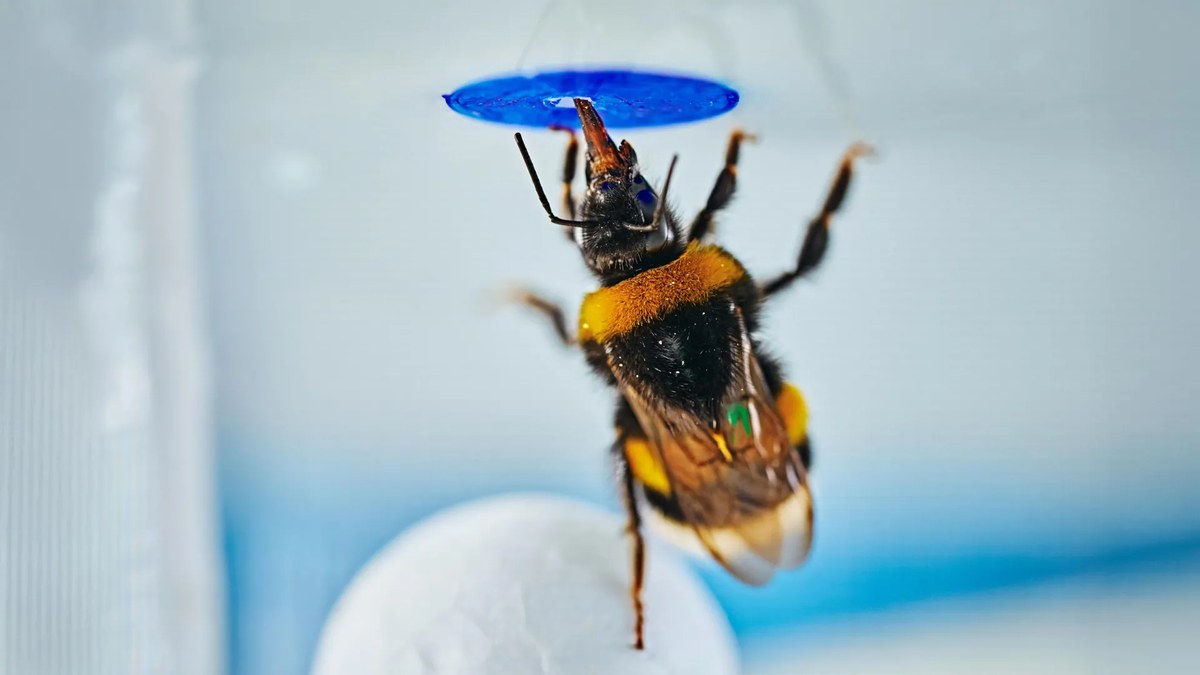
- Key facts & numbers: Researchers from the University of Oulu, University of Helsinki, and University of Turku published a study in Science on June 4, 2026 showing that bumble bees spontaneously solved an object-manipulation task they had never been trained on, rolling a small ball beneath a blue artificial flower placed on the ceiling of a transparent arena and climbing onto it to reach a reward. Lead author Akshaye Bhambore and senior author Olli Loukola emphasized the bees were 'fully naïve,' having previously learned only that the blue flower contained a reward and that the ball was movable, yet many combined those experiences into a goal-directed sequence no prior training had suggested. Control experiments ruled out simpler explanations such as accidental success, play behavior, trial-and-error learning, or visual guidance — in the most demanding tests the flower was hidden from view while bees moved the ball, yet many still rolled it to the correct location.
- What happens next: The mind-blowing detail buried mid-article: in the toughest tests the flower was hidden while bees moved the ball — and they still nailed it. Not trained, not guided.
- Researchers from the University of Oulu, University of Helsinki, and University of Turku published a study in Science on June 4, 2026 showing that bumble bees spontaneously solved an object-manipulation task they had never been trained on, rolling a small ball beneath a blue artificial flower placed on the ceiling of a transparent arena and climbing onto it to reach a reward.
- Lead author Akshaye Bhambore and senior author Olli Loukola emphasized the bees were 'fully naïve,' having previously learned only that the blue flower contained a reward and that the ball was movable, yet many combined those experiences into a goal-directed sequence no prior training had suggested.
- Control experiments ruled out simpler explanations such as accidental success, play behavior, trial-and-error learning, or visual guidance — in the most demanding tests the flower was hidden from view while bees moved the ball, yet many still rolled it to the correct location.
- The study echoes Wolfgang Köhler's century-old chimpanzee experiments, in which apes spontaneously stacked boxes to reach a suspended banana, and directly challenges the long-standing belief that spontaneous, insight-like problem solving is unique to humans and other large-brained vertebrates.
Why It Matters
Published in one of the most selective peer-reviewed journals, the study extends a century-old benchmark of animal insight — Köhler's chimpanzee box-and-banana problem — to an insect with a brain smaller than a sesame seed, forcing a rethink of which neural architectures can support spontaneous, goal-directed tool use. The rigorous controls (hidden goal, fully naïve subjects) give the finding unusual weight, meaning future comparative-cognition work can no longer treat 'spontaneous problem solving' as a vertebrate-only domain.
Sources Cited
- Science Daily — Scientists stunned as bumble bees solve a classic intelligence test
- NewsForKids.net — Bumblebees Surprise Scientists by Solving Puzzles
- Gadget Review — Bumble Bees Solved a Puzzle With No Training, and Scientists Are Stunned
Related Coverage
Ask SkimNews