Closing Eyes Impairs Hearing in Noise, Study Finds
The 30-Second Skim7 points
- What happenedA new study finds that closing your eyes in noisy environments actually makes it harder to hear faint sounds, contradicting the common belief that shutting out visual input sharpens hearing.
- Key facts & numbersShanghai Jiao Tong University researchers found that closing one's eyes impairs the ability to detect faint sounds in noisy settings, with author Yu Huang stating the result runs 'contrary to popular belief.' Yu Huang and colleagues published their findings in the Journal of the Acoustical Society of America (JASA), via AIP Publishing, showing that watching a dynamic video matching the sound significantly improved hearing sensitivity. EEG brain scans revealed that closing the eyes pushes the brain into a 'neural criticality' state that over-filters incoming information, suppressing not just background noise but the target sounds participants were trying to hear.
- What happens nextTurns out squinting at someone's mouth in a loud bar is actually the move — your brain needs visual anchors to stop over-filtering the signal you want.
- Shanghai Jiao Tong University researchers found that closing one's eyes impairs the ability to detect faint sounds in noisy settings, with author Yu Huang stating the result runs 'contrary to popular belief.'
- Yu Huang and colleagues published their findings in the Journal of the Acoustical Society of America (JASA), via AIP Publishing, showing that watching a dynamic video matching the sound significantly improved hearing sensitivity.
- EEG brain scans revealed that closing the eyes pushes the brain into a 'neural criticality' state that over-filters incoming information, suppressing not just background noise but the target sounds participants were trying to hear.
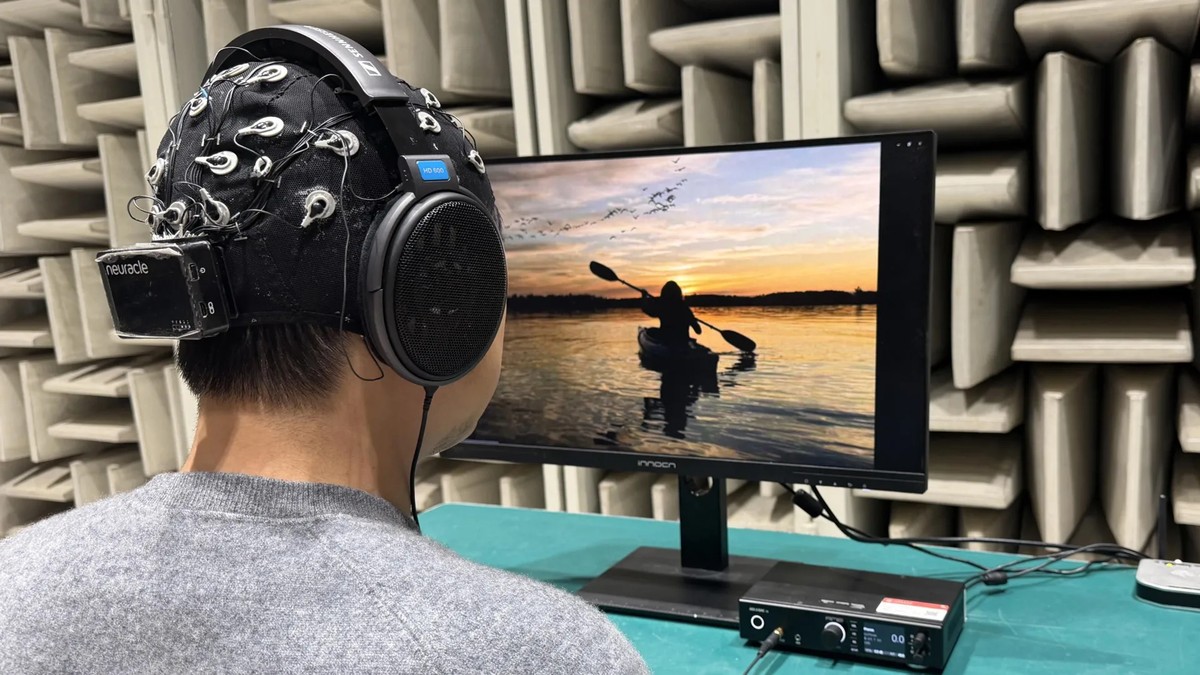
- In the headphone experiment, participants adjusted volume until test sounds were just barely audible over background noise, performing worst with eyes closed and best when visuals matched the audio.
Why It Matters
For the billions of people navigating daily noisy environments — cafés, offices, transit — the instinct to close their eyes to focus on a faint sound may actually be working against them, according to EEG-backed evidence from Huang's team. The practical takeaway is concrete and immediate: keeping eyes open, especially with matching visual context, better anchors the auditory system to external sound. Future research on mismatched pairings could reshape how we think about attention versus multisensory integration.
Sources Cited
Related Coverage
The day’s news in one short email, every morning.
Free. One email a day. Unsubscribe in one click.