JWST Data Suggests Black Holes Formed Before Galaxies
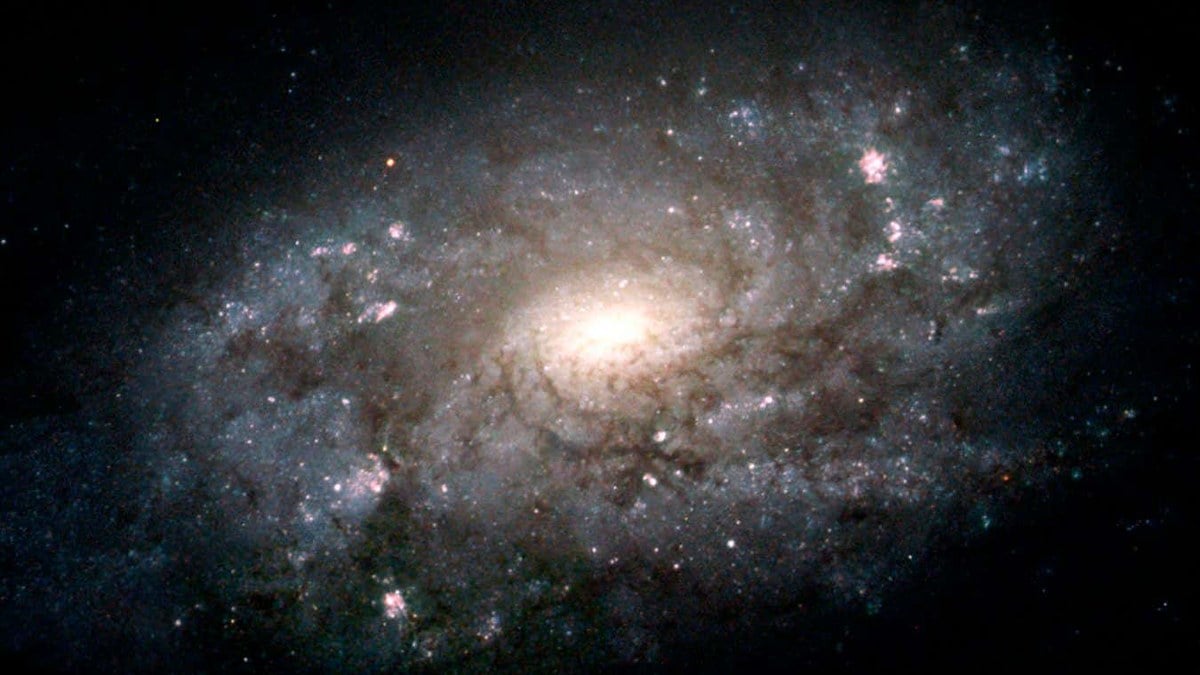
The 30-Second Skim
- What happened: James Webb Space Telescope observations of a galaxy just 700 million years after the Big Bang show its central black hole is so disproportionately massive that the black hole must have formed first, resolving cosmology's long-standing chicken-or-egg question.
- Key facts & numbers: Abell 2744-QSO1, a galaxy existing just 700 million years after the Big Bang, contains a central black hole of roughly 50 million solar masses inside a galaxy of at most 75 million solar masses — a ratio only direct gas collapse or primordial black holes can explain. James Webb Space Telescope (JWST) observations of 'little red dots' since 2024 revealed distant galaxies whose central black holes make up 20–70% of total galaxy mass, far exceeding the typical sub-half ratio and defying existing formation models. Supermassive black holes are too large to have formed via stellar-mass black hole mergers or massive stellar seeds within 500 million years of the Big Bang under known physics, leaving direct gas collapse and primordial black holes as the only viable formation routes.
- What happens next: Headline says 'finally solved' but it rests on ONE galaxy so far. Still wild: a black hole that's ~2/3 the mass of its entire galaxy, 700M years post-Big Bang.
- Abell 2744-QSO1, a galaxy existing just 700 million years after the Big Bang, contains a central black hole of roughly 50 million solar masses inside a galaxy of at most 75 million solar masses — a ratio only direct gas collapse or primordial black holes can explain.
- James Webb Space Telescope (JWST) observations of 'little red dots' since 2024 revealed distant galaxies whose central black holes make up 20–70% of total galaxy mass, far exceeding the typical sub-half ratio and defying existing formation models.
- Supermassive black holes are too large to have formed via stellar-mass black hole mergers or massive stellar seeds within 500 million years of the Big Bang under known physics, leaving direct gas collapse and primordial black holes as the only viable formation routes.
- Primordial black holes, which would have formed from extreme pressure in the first moments after the Big Bang rather than from stars, remain unevidenced but would definitively resolve the chicken-or-egg problem by seeding galaxies rather than emerging from them.
Why It Matters
The finding, if confirmed across more early galaxies, would overturn the conventional assumption that galaxies form first and instead point to primordial black holes or direct gas collapse as the seed of galaxy formation. The source itself notes the conclusion currently rests on one galaxy (QS01), so the broader theory depends on whether this proves representative of all little red dots.
Sources Cited
Related Coverage
Ask SkimNews