Light-Powered Nanorobots Hunt Bacteria in Liquid
The 30-Second Skim
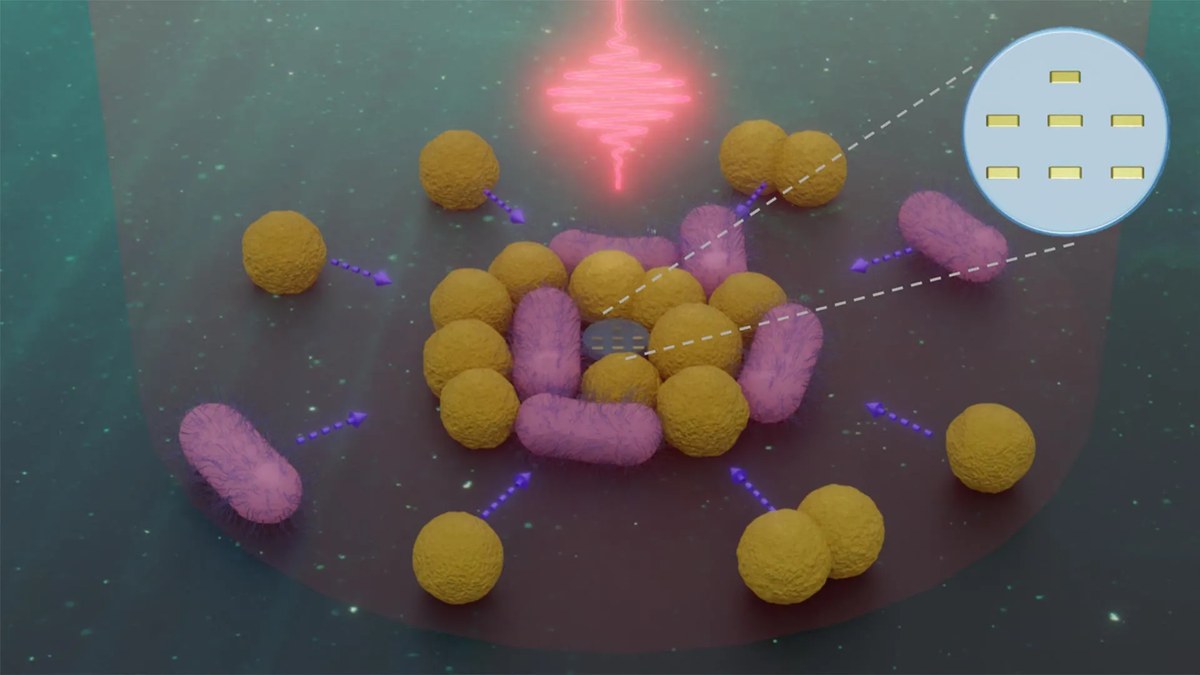
- What happened: Researchers at the University of Würzburg have built light-driven nanorobots smaller than one micrometer that can navigate liquid, capture bacteria, and deposit them at chosen locations using photon recoil and polarization-based steering.
- Key facts & numbers: University of Würzburg researchers led by Professor Bert Hecht have reduced their light-driven microdrones to below one micrometer — roughly 50 times smaller than a human hair — enabling them to operate directly in microbial environments. The nanorobots are propelled by photon recoil from up to four plasmonic nanoantennas that absorb light of a specific color and helicity, then emit it in a set direction, generating enough force to accelerate the tiny devices. Steering is achieved by changing the polarization of incoming light, which naturally aligns built-in nanoscale antenna wires and reorients the robot, functioning like a directional control system.
- What happens next: The cool detail: propulsion is literally photon recoil — each absorbed light particle nudges the bot like a tiny bullet fired backward. So the steering is just polarization.
- University of Würzburg researchers led by Professor Bert Hecht have reduced their light-driven microdrones to below one micrometer — roughly 50 times smaller than a human hair — enabling them to operate directly in microbial environments.
- The nanorobots are propelled by photon recoil from up to four plasmonic nanoantennas that absorb light of a specific color and helicity, then emit it in a set direction, generating enough force to accelerate the tiny devices.
- Steering is achieved by changing the polarization of incoming light, which naturally aligns built-in nanoscale antenna wires and reorients the robot, functioning like a directional control system.
- Lead experimental scientist Jin Qin said the team "built a light-driven nanorobot that can track down and collect bacteria," calling the devices "microscopic cleaning devices" that can selectively capture, carry, and release large numbers of bacteria.
Why It Matters
Hecht's lab has demonstrated a working physical mechanism for actively manipulating individual cells and bacteria in liquid — a capability that has been a persistent challenge at the microscale. For microbiologists and biomedical researchers, this opens a path to hands-on handling of objects too small to manipulate directly, with potential uses in sample preparation and targeted micro-scale interventions.
Sources Cited
- Science Daily — Tiny robots powered by light can hunt down and collect bacteria
Related Coverage
Ask SkimNews