NASA launched an emergency mission to stop the Swift Observatory from crashing to Earth
The 30-Second Skim
- What happened: NASA enlisted Katalyst Space Technologies on a nine-month, $30 million rush job to intercept and re-boost the $500 million Neil Gehrels Swift Observatory before solar storms drag it low enough to burn up in Earth's atmosphere.
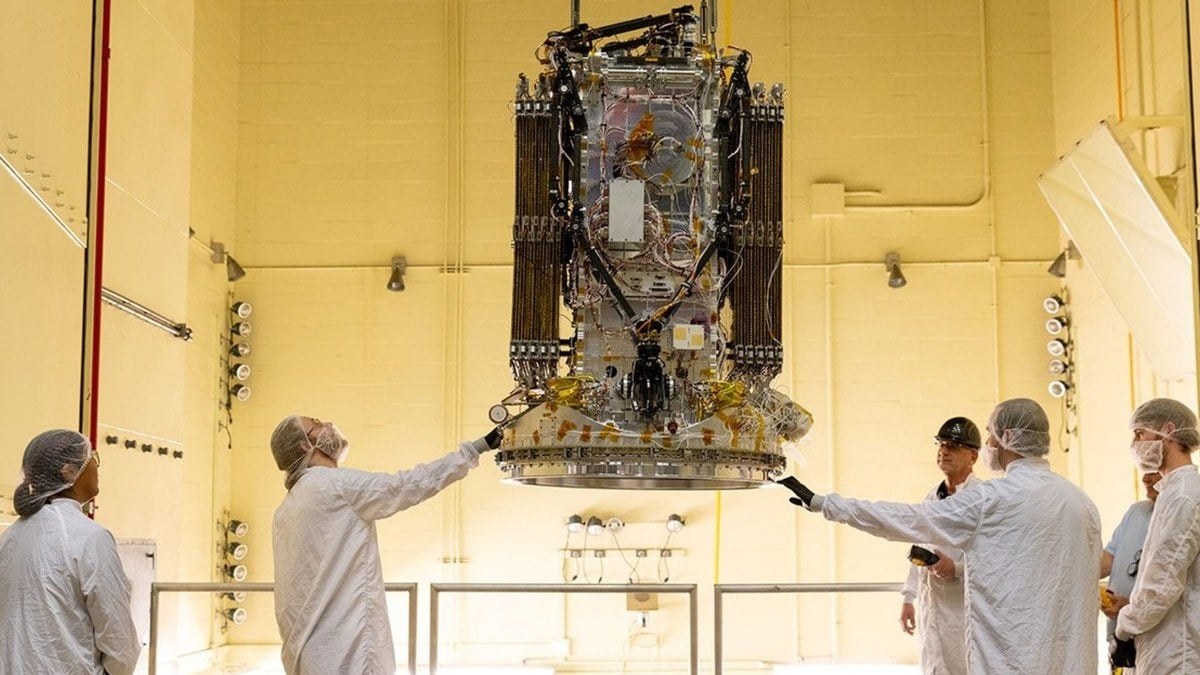
- Key facts & numbers: Katalyst Space Technologies launched its Link spacecraft Friday to intercept the Swift Observatory, whose orbit has dropped to 224 miles after recent solar storms pushed it lower. The rescue mission came together in just nine months under a $30 million NASA contract — a deadline dictated by the fact that Swift would be unsavable by October at its current decay rate. Link, a three-armed spacecraft with no easy precedent, must physically grab the propulsion-less Swift and raise its altitude by roughly 150 miles back toward its original orbit.
- What happens next: Real-life satellite rescue: a robotic arm has to grab a dead satellite with no engine and physically shove it 150 miles higher. Nine-month build for $30M. Buckle up.
- Katalyst Space Technologies launched its Link spacecraft Friday to intercept the Swift Observatory, whose orbit has dropped to 224 miles after recent solar storms pushed it lower.
- The rescue mission came together in just nine months under a $30 million NASA contract — a deadline dictated by the fact that Swift would be unsavable by October at its current decay rate.
- Link, a three-armed spacecraft with no easy precedent, must physically grab the propulsion-less Swift and raise its altitude by roughly 150 miles back toward its original orbit.
- The Neil Gehrels Swift Observatory, launched in 2004 and valued at $500 million, primarily studies gamma-ray bursts that have been key to understanding the early universe.
Why It Matters
NASA is betting $30 million and a novel grab-style spacecraft on rescuing a $500 million gamma-ray observatory before an October deadline — if the maneuver works, Swift keeps operating and the technique validates a new way to service propulsion-less satellites; if it fails, a uniquely productive science asset burns up on schedule.
Background & Timeline
- Editor context: Treating a $30 million tow as worthwhile insurance for a $500 million satellite quietly establishes orbital servicing as a standard cost of doing business, while exposing solar-driven atmospheric drag as an undermanaged threat to aging science assets.
Sources Cited
Related Coverage
Ask SkimNews