Primordial black hole could trigger star explosion
The 30-Second Skim
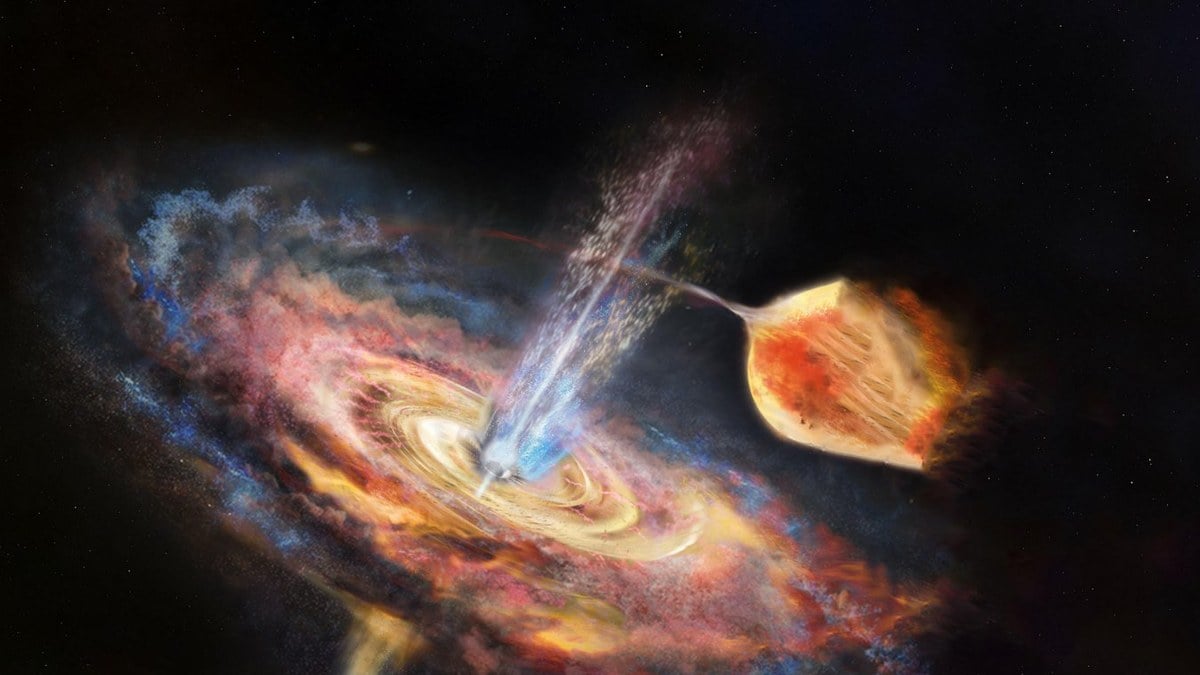
- What happened: A simulation shows that if a primordial black hole is captured by a rapidly spinning star, it can form an accretion disk and generate powerful jets that blast the star apart.
- Key facts & numbers: Primordial black holes could range from atom-sized to grain-of-sand volume, with masses between an asteroid and the moon. The study was published in The Astrophysical Journal (DOI: 10.3847/1538-4357/aeb7e1).
- What happens next: Ore Gottlieb and team are modeling the observational signatures of these stellar explosions to distinguish them from other supernova-like events.
Why It Matters
Detecting such stellar explosions could confirm the existence of primordial black holes, reshaping our understanding of dark matter composition and early universe physics. Astronomers would gain a new observational target beyond traditional dark matter particle searches.
This mechanism shifts focus from passive gravitational evidence to active astrophysical signals, potentially accelerating discovery. Observatories could prioritize transient events with unusual jet signatures, altering survey strategies and data analysis pipelines in time-domain astronomy.
How Outlets Are Framing It
- Science-focused outlets: Emphasize the explosive stellar destruction as a novel detection pathway for dark matter, highlighting the simulation’s predictive power for observables
- Cosmology and physics press: Frame the story around primordial black holes as long-theorized dark matter candidates, underscoring their potential role in early universe conditions
- Popular science headlines: Focus on the dramatic 'parasite black hole' metaphor and star-destroying visuals, sometimes at the expense of the dark matter detection implications
Background & Timeline
- Moments after big bang: Quantum fluctuations may have compressed matter enough to form primordial black holes, according to theoretical models
- Prior to this study: Primordial black holes were considered undetectable due to lack of emission; their influence was assumed to be only gravitational
Sources Cited
- New Scientist — An atom-sized black hole could force an entire star to explode
- Universe Today — What Would Happen if a Tiny Black Hole Passed Through Your Body?
- ZME Science — What would happen if a (small) black hole passed through your body?
- Universe Space Tech — Primordial black hole could destroy the Sun
Related Coverage
Ask SkimNews