Container Database Pushes Origins Back 500,000 Years
The 30-Second Skim7 points
- What happenedResearchers compiled a database of 739 prehistoric containers dating back 500,000 years, challenging the long-standing view that containers emerged only with farming and pottery roughly 10,000 years ago and reframing the 'first tool' as a carrying device rather than a weapon.
- Key facts & numbersMarc Kissel and colleagues at Appalachian State University compiled a database of 739 prehistoric mobile containers, published April 8 in the Journal of Anthropological Archaeology, with every example falling within the last 500,000 years of the 2.58-million-year Pleistocene epoch. The database's oldest entry is a bark tray or dish from Kalambo Falls, Zambia, dated 400,000–500,000 years old and originally excavated in the 1950s by archaeologist John Desmond Clark. 87.8% of containers in the database were found in Europe, but Kissel attributes this to the concentration of archaeological work on the continent rather than any European origin for containers — the oldest specimen is from Africa.
- What happens nextThe 'first tool' was probably a carrying device, not a club. Feminist anthropologists said so in 1976 — it just took 50 years of data to make it mainstream.
- Marc Kissel and colleagues at Appalachian State University compiled a database of 739 prehistoric mobile containers, published April 8 in the Journal of Anthropological Archaeology, with every example falling within the last 500,000 years of the 2.58-million-year Pleistocene epoch.
- The database's oldest entry is a bark tray or dish from Kalambo Falls, Zambia, dated 400,000–500,000 years old and originally excavated in the 1950s by archaeologist John Desmond Clark.
- 87.8% of containers in the database were found in Europe, but Kissel attributes this to the concentration of archaeological work on the continent rather than any European origin for containers — the oldest specimen is from Africa.
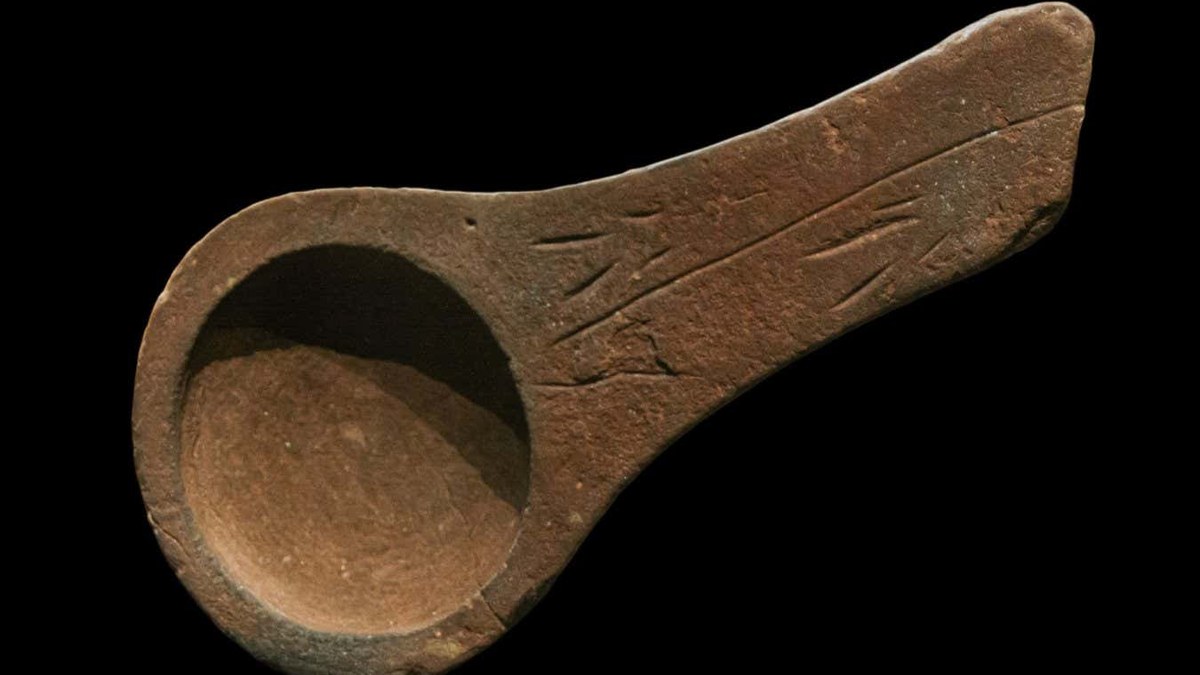
- The team used a deliberately broad definition that captures items beyond pots and baskets, including spoons, carved-stone lamps (such as the red sandstone lamp from Lascaux Cave, France), hollow swan wing-bone tubes for carrying needles, and ostrich eggs used to carry water across Africa.
Why It Matters
This pushes the documented origin of containers back roughly fifty-fold — from the Neolithic pottery revolution (~10,000 years ago) to at least 500,000 years ago — and Kissel argues even that is likely a floor, since preservation bias hides older examples. If baby slings are correct, the foundational narrative of human tool use shifts from clubs and blades to carrying devices, a reframing originating with feminist anthropologists in the 1970s whose ideas were dismissed for decades before a dedicated dataset validated them.
Sources Cited
Related Coverage
Ask SkimNews
The day’s news in one short email, every morning.
Free. One email a day. Unsubscribe in one click.