Anthropic is turning Claude Code’s auto mode on by default

SkimNews Take
The default flips the review burden from per-step to per-permission-class, meaning the taxonomy of what counts as "irreversible, destructive, or out-of-environment" silently becomes the most consequential product surface. Users will calibrate their trust to that boundary rather than to each tool call.
Get the Tech newsletter
Daily tech — startups, AI labs, chips, the launches that shape the next decade. Free.
- Anthropic is making Claude Code's auto mode the default for Pro, Max, and Team accounts starting August 14, reducing the need for human approval at each step.
- In auto mode, Claude Code proceeds without prompts unless actions are deemed "irreversible, destructive, or aimed outside your environment," Anthropic said.
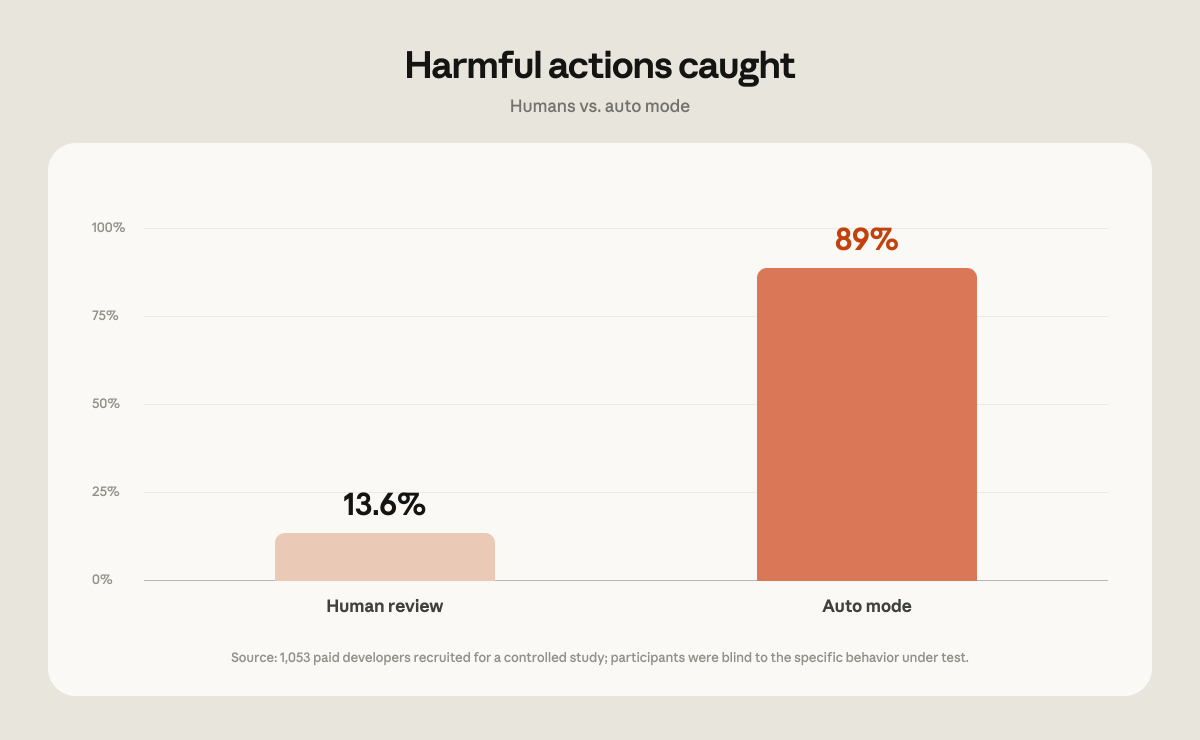
- A study with 1,053 paid testers found auto mode caught 89% of harmful actions, while human review caught only 13.6%, according to Anthropic.
- Anthropic attributes humans' poor manual-review performance to habituation, noting users approve 97% of permission prompts in Claude Code.
- Boris Cherny, Claude Code head, said on X that his team uses auto mode exclusively and "couldn't imagine going back to permission prompts."
- Anthropic first unveiled a test version of auto mode in March as a way to balance speed and control, and has since added prompt injection screening and customizable hard deny rules aimed at preventing data exfiltration.
Why it matters: For Pro, Max, and Team users, Claude Code programming becomes faster starting August 14 with less per-step human oversight. Anthropic's own testing shows auto mode catches 89% of harmful actions versus 13.6% for human review — but the real risk surface is data exfiltration, which is why Anthropic is layering on prompt injection screening and hard deny rules.
Ask SkimNews