Risk-off wave drags bitcoin below $63,000 as AI selloff spreads from stocks to crypto — SkimNews
Get the Finance newsletter
Daily finance — markets, central banks, M&A, the prints that move money. Free.
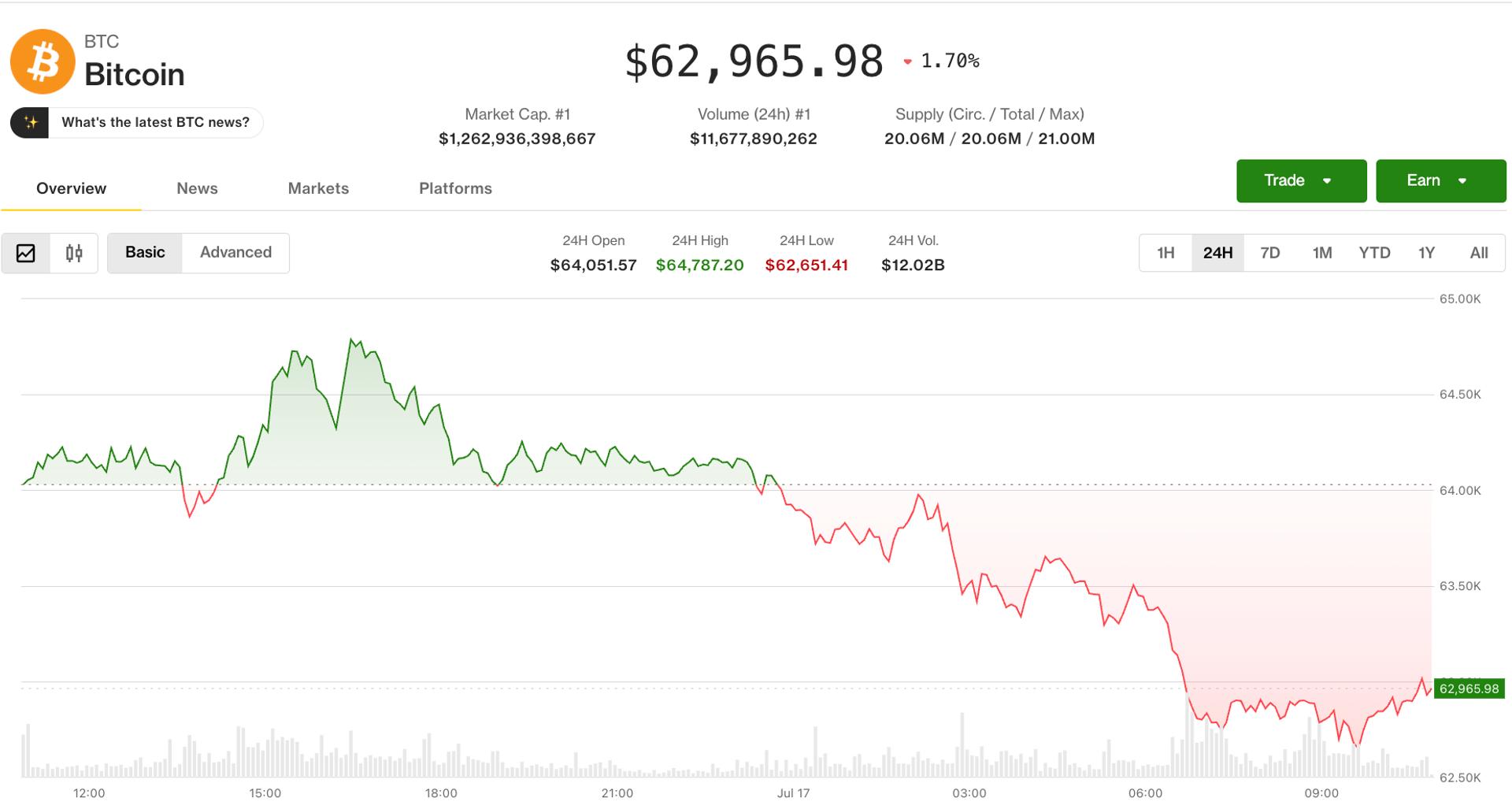
- Bitcoin fell 1.2% and ether dropped 1.74% as a selloff in semiconductor stocks from Asia to North America and renewed Middle East tensions drove a broad risk-off move, lifting gold back above $4,000.
- Nasdaq 100 futures dropped 1.91% and S&P 500 futures slipped 0.96%, while Japan's Nikkei 225 fell 4% and South Korea's Kospi was closed for Constitution Day, pointing to macro forces rather than crypto-specific drivers.
- Tickmill Group's Patrick Munnelly framed it as 'two bruises: AI fatigue and Hormuz heat,' saying the semiconductor selloff had 'gone from profit-taking to position-clearing, dragging Asia toward its worst levels in months.'
- The average relative strength index across crypto pairs dipped to 42.23, approaching the oversold territory that triggered July's relief bounce, offering bulls a potential foothold heading into the weekend.
- Crypto derivatives showed bearish skew: the long-short ratio fell to 0.94 (lowest since June 2), 24-hour volume cooled 4% to $163 billion, and open interest held steady at $111 billion — an orderly drop rather than a margin-call cascade.
- HYPE stood out with open interest up nearly 2% alongside an 8% spot drop, the most negative 24-hour OI-adjusted CVD among major tokens, confirming fresh short positions rather than passive selling.
- Privacy coins (ZEC +1.56%, DASH +0.78%) and AI tokens (FET, TAO each ~+0.20%) bucked the downtrend, though ether traders bought large straddles betting on significant price swings by July 24, signaling underlying uncertainty beneath the low implied volatility.
Why it matters: The decline was orderly rather than panicked — total crypto volume cooled 4% while open interest held near $111 billion, so no margin-call cascade materialized. But the ether straddle bets for July 24 and the fresh HYPE short positioning show conviction in any weekend bounce is thin, even as oversold RSI levels historically set up relief rallies.
Ask SkimNews