Bitcoin Slips to $79K With 10-Year Funding Record — SkimNews

Get the Finance newsletter
Daily finance — markets, central banks, M&A, the prints that move money. Free.
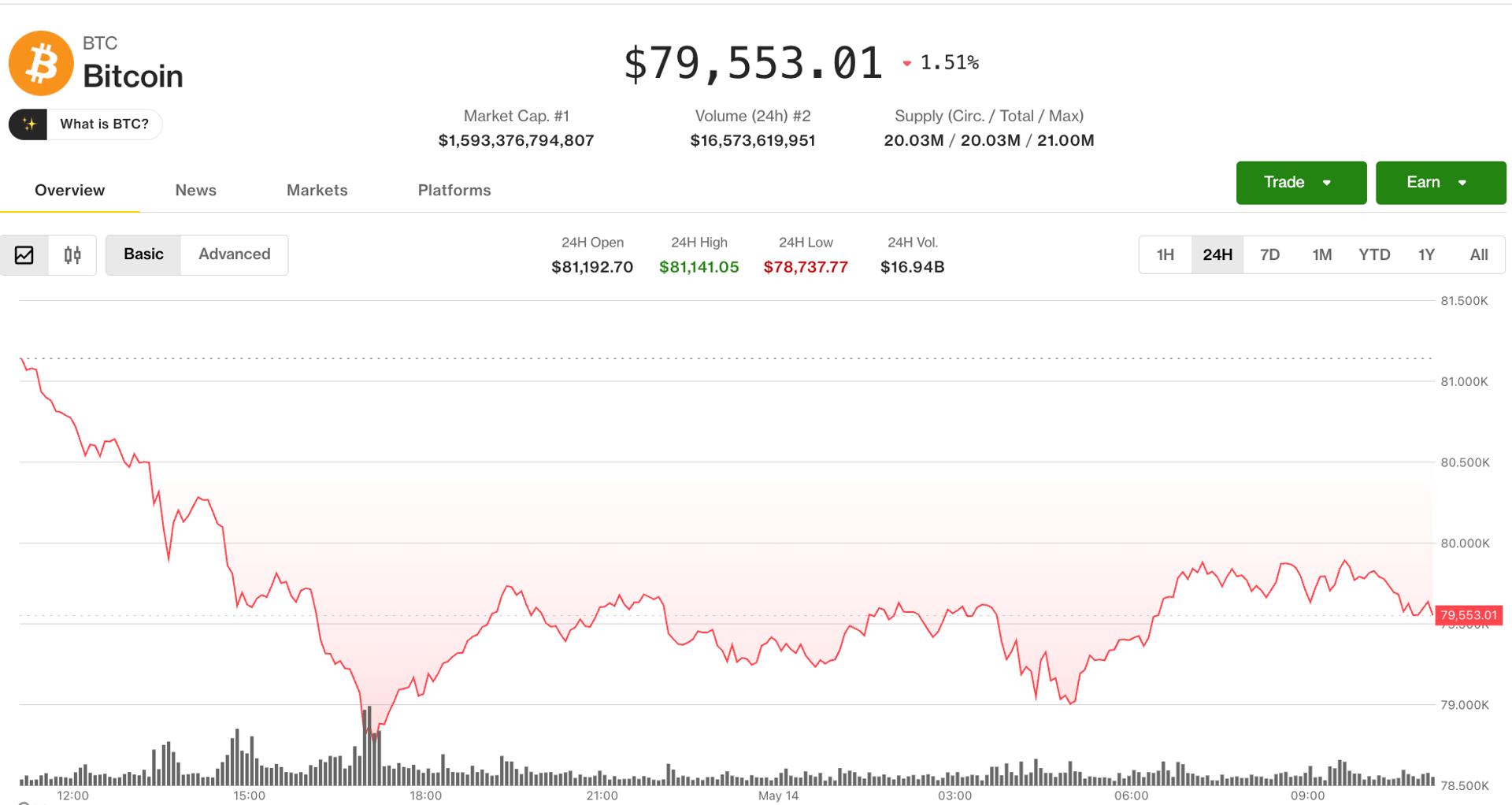
- Bitcoin pulled back from a midweek high of $81,500 to roughly $79,000 after U.S. forces struck Iranian targets in response to attacks on American naval destroyers transiting the Strait of Hormuz, though BTC remains higher on the week alongside mostly resilient global risk assets.
- Bitcoin futures funding rates have stayed negative for 67 consecutive days — the longest such stretch in 10 years per K33 Research — meaning shorts have been paying longs for over two months while price grinded higher, a setup the source describes as 'the cleanest' configuration for a short squeeze if BTC breaks the $83,200 200-day moving average.
- Dogecoin led major-coin losses at -3.8% to $0.1063 and is the only top token in the red on the seven-day chart, while ether fell 2% to $2,278, XRP dropped 1.7% to $1.38, and BNB slipped 0.7% to $638; Solana ($88.14) and TRON ($0.3474) held green.
- President Trump called the U.S. strike a "love tap" in an ABC News interview, said the ceasefire with Iran "remains in effect," and threatened harder hits if Tehran doesn't sign a deal soon, per the source.
- Brent crude climbed 1.2% to roughly $101 a barrel on the escalation but is still down more than 6% on the week as the broader U.S.-Iran de-escalation narrative holds, and the MSCI All Country World Index slipped just 0.3% with Wall Street futures up 0.2% in early trading.
- FxPro's Alex Kuptsikevich noted Bitcoin's daily RSI pushed above 70 into overbought territory, and that the previous three times this happened — August, October, and January — were followed by sharp selloffs, suggesting the current pause is profit-taking rather than buyer exhaustion.
- QCP Capital reported monthly implied volatility around 41% with persistent demand for put options, indicating traders are buying BTC but hedging downside, while XWIN Japan flagged $93,000 as a medium-term target tied to closing the CME futures gap, warning the path may not be linear.
Why it matters: The 67-day negative funding streak is a 10-year record that creates a coiled-spring dynamic: a decisive break above the $83,200 200-day moving average would force two-and-a-half months of accumulated short positions to cover, accelerating any rally. But with daily RSI above 70 (overbought — three prior instances led to sharp selloffs) and live U.S.-Iran escalation risk, the same record that could fuel a squeeze higher also means a break lower would compound rapidly as those same shorts add to positions.
Ask SkimNews