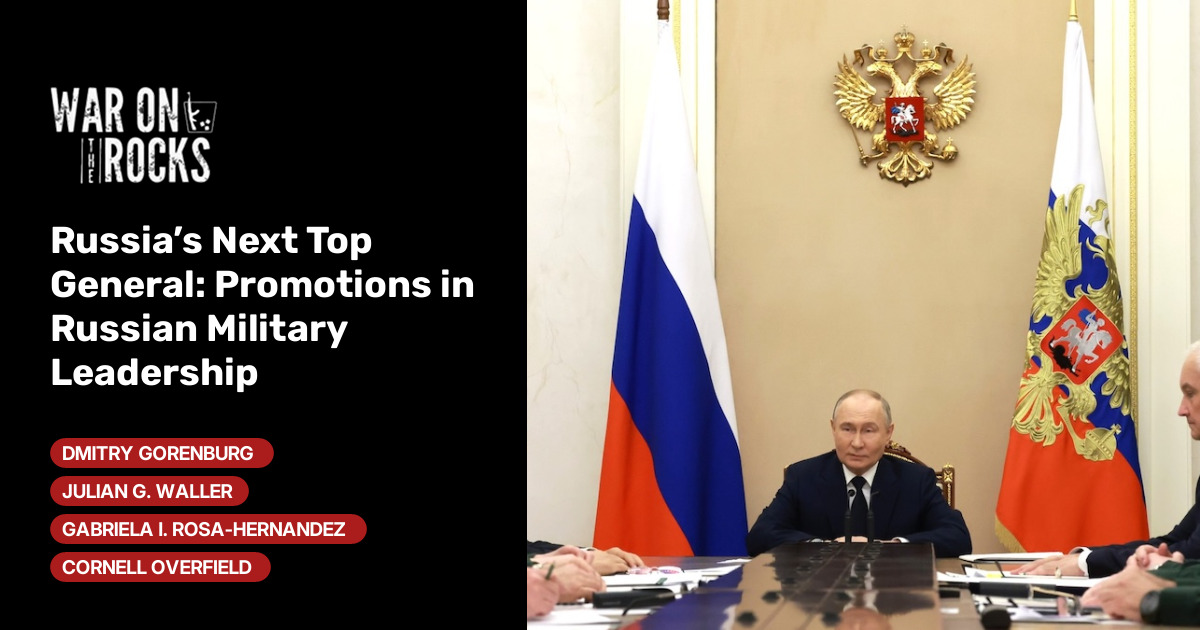
CNA Models Who Will Replace Russia's Top Generals
Get the Geopolitics newsletter
Daily geopolitics — wars, elections, sanctions, the diplomatic moves that move markets. Free.
- CNA published a report analyzing 125 senior Russian commanders using publicly available Russian-language sources, producing an empirically derived model of future promotion likelihoods across the Russian military elite.
- Russian general officers promoted to major general before age 46 are significantly more likely to reach three- and four-star ranks, with the pattern most pronounced in ground forces officers.
- The military career system splits into one primary operational track (ground and airborne forces) feeding top military district and General Staff positions, plus several insular satellite tracks — Strategic Rocket Forces, navy fleets, Aerospace Forces, and ground forces' air defense and artillery — that almost never exchange personnel.
- Command of remote military districts — historically the Siberian Military District — outweighed combat-zone postings as a career springboard, until the 2010 merger into the Central Military District diluted that geographic signal and wartime reshuffling further eroded district-specific patterns.
- The 58th, 20th, 41st, 36th, and 5th Armies appear repeatedly as feeder units for military district chief of staff and commander appointments, while in the navy the Northern and Pacific Fleets account for all early and mid-career development of commanders-in-chief.
- Since the 2022 invasion, the share of military district commanders arriving from General Staff billets dropped from 32% (2010–2021) to 0%, while wartime command and direct army-to-district appointments created entirely new feeder categories and froze the General Staff in place.
- Valery Gerasimov, 70, remains Chief of the General Staff despite a traditional mandatory retirement age of 65, kept in post partly because age limits were eliminated for senior Ministry of Defense military and civilian positions.
Why it matters: The dataset gives Western analysts a rare predictive window into who will command Russia's forces as Gerasimov and other wartime leaders age out, with concrete implications: the General Staff-to-district pipeline that produced 32% of district commanders from 2010–2021 has collapsed to 0% during the war, meaning the post-Gerasimov bench is being drawn from a fundamentally different and less predictable career pool.
Ask SkimNews