Cling Botnet Spoofs Google STUN to Hide Commands
The 30-Second Skim7 points
- What happenedThreat actors are exploiting a patched Realtek SDK flaw to deploy a new botnet called Cling, which stands out for abusing the legitimate STUN NAT-traversal protocol—and even spoofing Google's public STUN IP—to disguise its command-and-control traffic from network defenders.
- Key facts & numbersCVE-2021-35394, a critical CVSS 9.8 RCE flaw in the Realtek Jungle SDK, saw a spike in exploit attempts starting around September 5, 2026, with Nozomi Networks confirming a subset deliver the Cling botnet Cling embeds exploit logic for seven additional RCE vulnerabilities across routers and DVRs from Eir, MVPower, LB-LINK, FiberHome/China Mobile, TBK, and Linksys (CVE-2014-8361 through CVE-2025-34037) The malware achieves persistence by writing itself to /etc/inittab, /etc/init.d/rcS, and /etc/rc.d/rc.boot for SysV and BusyBox init systems, or by replacing the system's wget binary with itself
- What happens nextThe botnet's commands literally arrive from stun.l.google.com's IP address. Network defenders are going to have a very bad week.
- CVE-2021-35394, a critical CVSS 9.8 RCE flaw in the Realtek Jungle SDK, saw a spike in exploit attempts starting around September 5, 2026, with Nozomi Networks confirming a subset deliver the Cling botnet
- Cling embeds exploit logic for seven additional RCE vulnerabilities across routers and DVRs from Eir, MVPower, LB-LINK, FiberHome/China Mobile, TBK, and Linksys (CVE-2014-8361 through CVE-2025-34037)
- The malware achieves persistence by writing itself to /etc/inittab, /etc/init.d/rcS, and /etc/rc.d/rc.boot for SysV and BusyBox init systems, or by replacing the system's wget binary with itself
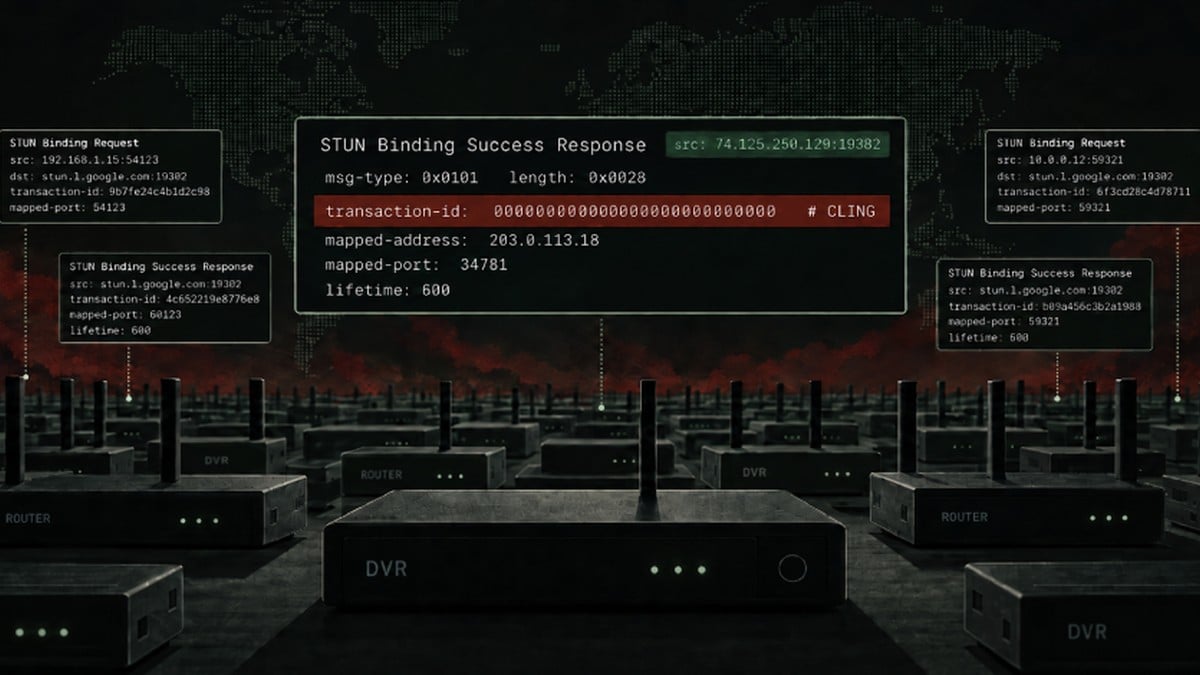
- Cling's C2 channel polls 13 hard-coded public STUN servers every ~5 seconds with all-zero transaction IDs, then encodes operator commands inside STUN transaction ID fields so traffic looks like routine NAT-traversal
Why It Matters
Cling turns STUN, a protocol nearly every NAT-traversal system allows by default, into a hidden C2 channel—and spoofs Google's own STUN IP so defenders can't block-list the source. With seven embedded router/DVR exploits plus worm-like spreading, IoT-heavy enterprises that haven't baseline'd their STUN traffic face a significantly harder detection problem.
Sources Cited
Related Coverage
Ask SkimNews
The day’s news in one short email, every morning.
Free. One email a day. Unsubscribe in one click.