Databricks, Stripe Share AI Coding Cost Playbook
The 30-Second Skim
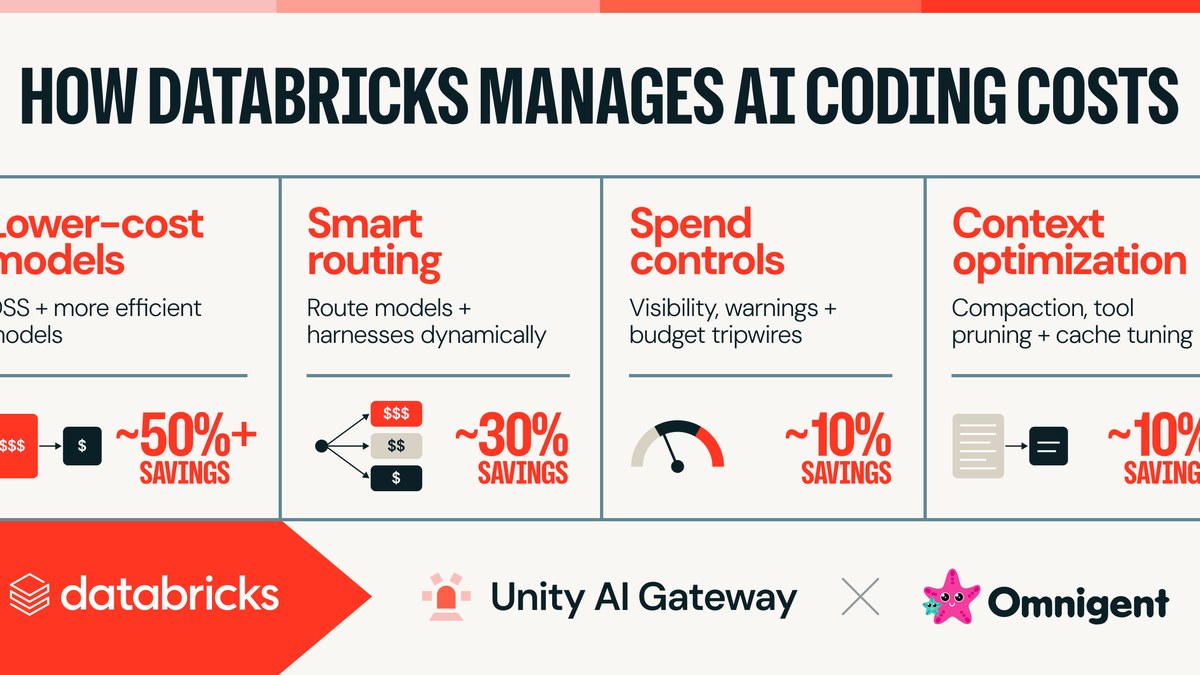
- What happened: Engineers at Databricks, drawing on conversations with Stripe, Coinbase, Uber, and Ramp, outline a shared playbook for containing exploding AI coding costs — chasing the efficiency frontier rather than peak intelligence, routing work to cheaper models, replacing hard budgets with visibility, and centralizing control through an AI gateway.
- Key facts & numbers: Databricks reports that agentic coding has improved every velocity metric it tracks, with some teams achieving order-of-magnitude output gains, but warns the accompanying cost curve is unsustainable and could eventually overtake revenue. Stripe, Coinbase, Uber, Ramp, and Databricks have converged on a 'dual mandate' — providing broad AI tool access to employees while keeping aggregate spend inside a roughly fixed per-user envelope. The efficiency frontier (best price for a given level of intelligence) is advancing far faster than the intelligence frontier, with new models released almost weekly; rapidly adopting these newer models delivers the largest cost wins of any technique surveyed.
- What happens next: The quiet bombshell: the cost war isn't about getting smarter models, it's about getting cheaper-per-token ones. Stripe just said no to Opus 4.7 because it wasn't worth the price. That's a new posture.
- Databricks reports that agentic coding has improved every velocity metric it tracks, with some teams achieving order-of-magnitude output gains, but warns the accompanying cost curve is unsustainable and could eventually overtake revenue.
- Stripe, Coinbase, Uber, Ramp, and Databricks have converged on a 'dual mandate' — providing broad AI tool access to employees while keeping aggregate spend inside a roughly fixed per-user envelope.
- The efficiency frontier (best price for a given level of intelligence) is advancing far faster than the intelligence frontier, with new models released almost weekly; rapidly adopting these newer models delivers the largest cost wins of any technique surveyed.
- Stripe evaluated Anthropic's Opus 4.7 and found it did not meaningfully improve quality over Opus 4.6 while increasing cost, and declined to roll it out internally — Databricks reports a similar cost regression when comparing Opus 5.0 to 4.8.
Why It Matters
The convergence of Databricks, Stripe, Coinbase, Uber, and Ramp on the same playbook signals that AI coding cost management is maturing from ad-hoc experimentation into a recognized discipline — with concrete, measured wins like Databricks's 50% token reduction and Stripe's refusal to upgrade to Opus 4.7. Enterprises that don't build (or buy) equivalent AI gateway infrastructure risk seeing the savings from AI coding tools erased by the very bills those tools generate.
Sources Cited
- Hacker News — Managing AI Coding Costs at Scale
Related Coverage
Ask SkimNews