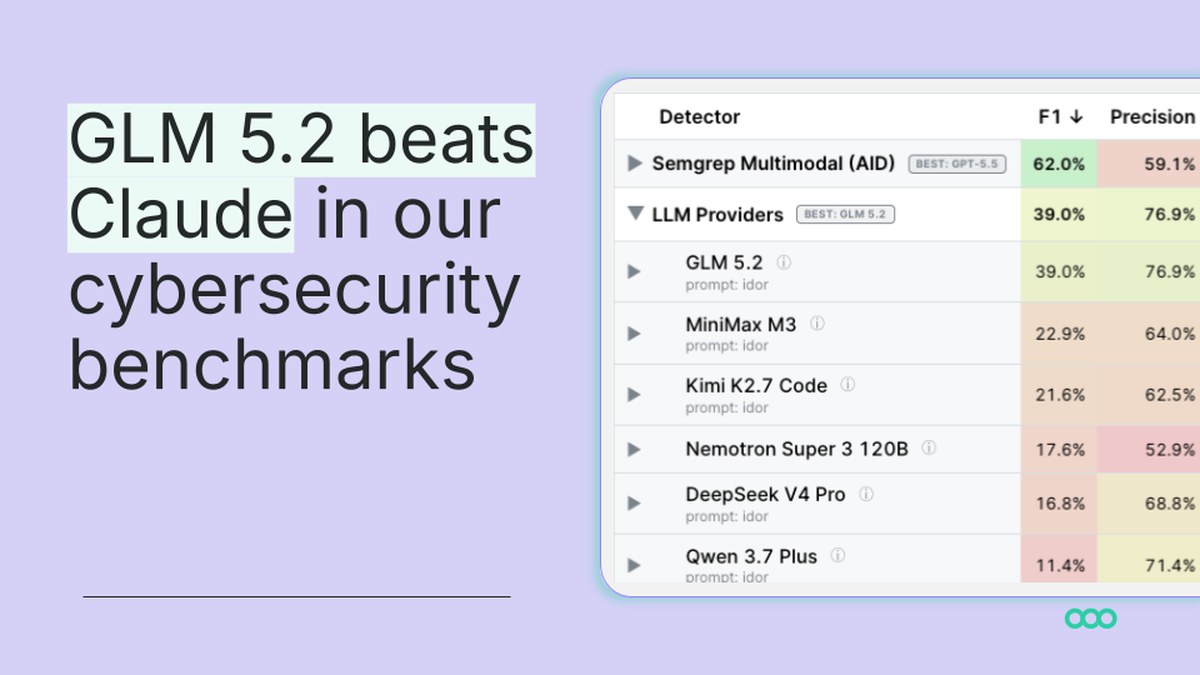
GLM 5.2 beats Claude in our benchmarks
The 30-Second Skim
- What happened: Semgrep's IDOR-detection benchmark found Zhipu AI's open-weight GLM 5.2 beat Claude Code 39% to 32% F1 with no scaffolding, at roughly $0.17 per vulnerability found, while the company's own purpose-built multimodal harness still led at 53–61%.
- Key facts & numbers: GLM 5.2 scored 39% F1 on Semgrep's IDOR benchmark, beating Claude Code's 32% despite running in a bare prompt with no endpoint-discovery scaffolding, at roughly $0.17 per vulnerability found. Semgrep's multimodal pipeline still led the benchmark at 53–61% F1 (GPT 5.5 at 61%, Claude Opus 4.8 at 53%), but only inside its purpose-built harness that enumerates endpoints and steers the model toward them. Z.ai rolled GLM 5.2 out to GLM Coding Plan members on June 13, 2026, with open weights and release notes on June 16; the MIT-licensed Mixture-of-Experts model has ~750B total parameters, ~40B active per token, and a 1M-token context window.
- What happens next: A bare-prompt open-weight model is within 7 points of Claude Code on a security reasoning task. The harness is doing more work than the model — and Z.ai literally had to build an anti-cheat for their own training.
- GLM 5.2 scored 39% F1 on Semgrep's IDOR benchmark, beating Claude Code's 32% despite running in a bare prompt with no endpoint-discovery scaffolding, at roughly $0.17 per vulnerability found.
- Semgrep's multimodal pipeline still led the benchmark at 53–61% F1 (GPT 5.5 at 61%, Claude Opus 4.8 at 53%), but only inside its purpose-built harness that enumerates endpoints and steers the model toward them.
- Z.ai rolled GLM 5.2 out to GLM Coding Plan members on June 13, 2026, with open weights and release notes on June 16; the MIT-licensed Mixture-of-Experts model has ~750B total parameters, ~40B active per token, and a 1M-token context window.
- GLM 5.2 posted 81.0 on Terminal-Bench 2.1 (up from 63.5 for GLM 5.1) and 62.1 on SWE-bench Pro, with pricing roughly one-sixth of comparable frontier models and a reception compared to DeepSeek's.
Why It Matters
For security teams scanning thousands of endpoints, per-bug economics often decide whether a detection approach is usable at scale — GLM 5.2's $0.17-per-vulnerability cost and MIT-licensed weights let teams run capable detection inside their own environment without frontier-model pricing or API dependencies. The open-weight run still trailed Semgrep's scaffolded pipeline by 14–22 F1 points, confirming the harness remains the dominant factor in vulnerability-detection performance.
Sources Cited
- Hacker News — GLM 5.2 beats Claude in our benchmarks
Related Coverage
Ask SkimNews