Open Models Cut AI Costs Up to 90%—and Shift the Work
The 30-Second Skim
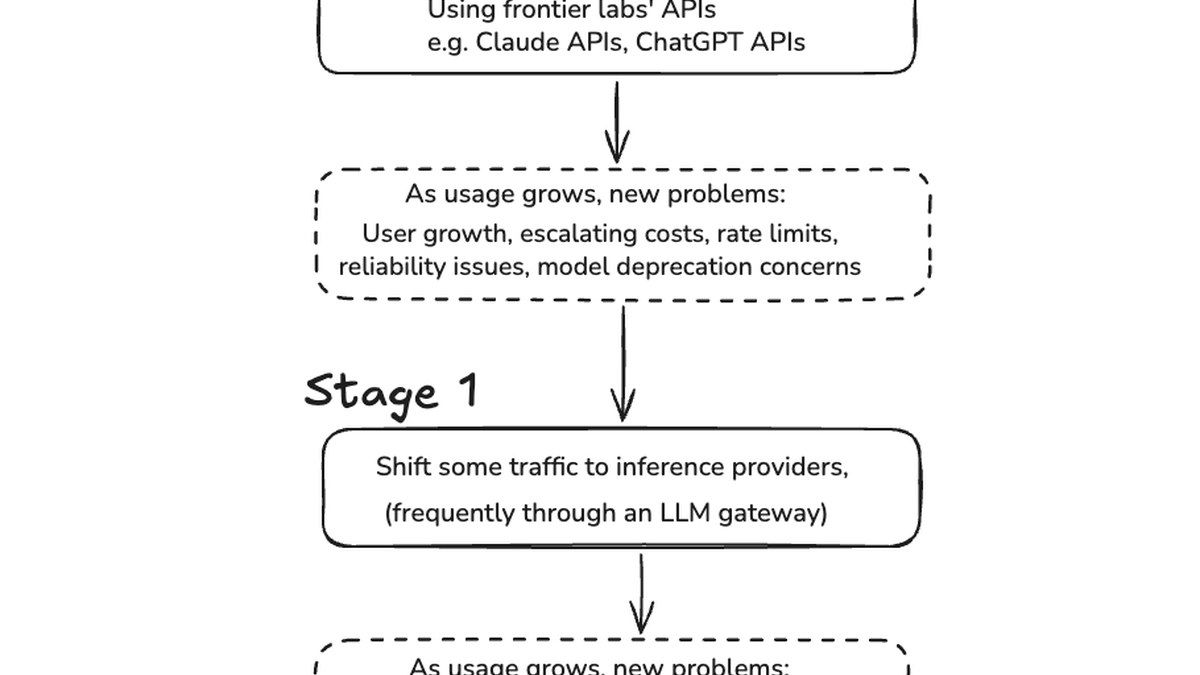
- What happened: Inference providers are emerging as a practical route from costly frontier-lab APIs to cheaper, customizable open models, but production adoption requires evaluation, workload-specific routing and a shift from shared API capacity to dedicated GPU infrastructure.
- Key facts & numbers: Pinterest cut per-token costs 90% as companies shifted toward open models to rein in AI spending; Uber reported a 50% reduction and AT&T 56%. Inference providers distinguish themselves from frontier labs by hosting and post-training open-weight models instead of pretraining them, while selling OpenAI/Anthropic-compatible APIs, dedicated hardware and customization; providers request prompt samples or evals because generic benchmarks do not fully represent real traffic. Modal presents itself as programmable cloud infrastructure, natively supporting inference through SDKs and merging stack performance tweaks upstream into the open-source ecosystem.
- What happens next: The catch: API swapping is stage one. Cache hit rates, tail latency and rate limits are the real engineering test.
- Pinterest cut per-token costs 90% as companies shifted toward open models to rein in AI spending; Uber reported a 50% reduction and AT&T 56%.
- Inference providers distinguish themselves from frontier labs by hosting and post-training open-weight models instead of pretraining them, while selling OpenAI/Anthropic-compatible APIs, dedicated hardware and customization; providers request prompt samples or evals because generic benchmarks do not fully represent real traffic.
- Modal presents itself as programmable cloud infrastructure, natively supporting inference through SDKs and merging stack performance tweaks upstream into the open-source ecosystem.
- Fireworks AI announced Ember-1 in September 2026, post-trained on Kimi K3 to deliver similar quality with 40% fewer reasoning tokens than vanilla Kimi K3; most of its business is dedicated deployments offering fine-tuning and latency guarantees.
Why It Matters
For software teams, open-model inference providers create a route to materially lower per-token costs—Pinterest cut 90%, versus 50% at Uber—while dedicated capacity improves latency control. The trade-off is operational: teams must run evals, size KV caches, manage failover and keep a fallback provider for uptime, making model hosting an engineering discipline rather than a one-click API swap.
Sources Cited
- The Pragmatic Engineer — Inference engineering for software engineers
Related Coverage
Ask SkimNews