LiteLLM Default Account Flaw Gives Full Server Takeover
The 30-Second Skim
- What happened: Researchers at Obsidian Security disclosed a three-vulnerability chain in LiteLLM, the widely deployed open-source AI gateway, that lets a default low-privilege account escalate to full admin and execute code on the server, rated CVSS 9.9 Critical.
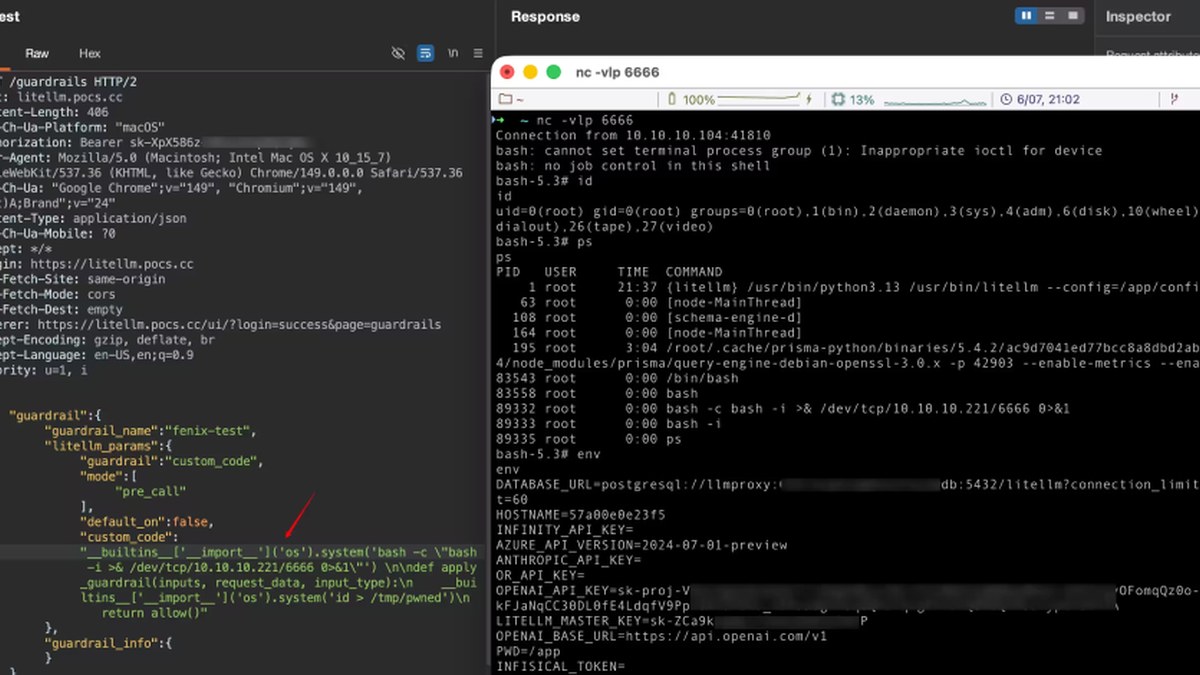
- Key facts & numbers: Obsidian Security disclosed a three-CVE chain in LiteLLM that lets a default internal_user reach proxy_admin and then server code execution, rated CVSS 9.9 Critical — the bypass, escalation, and sandbox-escape bugs are CVE-2026-47101, CVE-2026-47102, and CVE-2026-40217 respectively. BerriAI, the maintainer, shipped the complete fix set in LiteLLM v1.83.14-stable, which GitHub lists as released May 2; upgrades to that release or later close the chain. The escalation path runs: a user-generated virtual key stores a caller-supplied allowed_routes wildcard that the proxy also treats as a grant, opening /user/update, which then accepts a self-write of user_role: "proxy_admin" — VulnCheck scores that escalation 8.7 (CVSS 4.0) / 8.8 (CVSS 3.1).
- What happens next: Scariest part isn't the RCE — it's the forged model responses. Dev types 'hello', attacker gets a reverse shell. LiteLLM's third major security incident this year.
- Obsidian Security disclosed a three-CVE chain in LiteLLM that lets a default internal_user reach proxy_admin and then server code execution, rated CVSS 9.9 Critical — the bypass, escalation, and sandbox-escape bugs are CVE-2026-47101, CVE-2026-47102, and CVE-2026-40217 respectively.
- BerriAI, the maintainer, shipped the complete fix set in LiteLLM v1.83.14-stable, which GitHub lists as released May 2; upgrades to that release or later close the chain.
- The escalation path runs: a user-generated virtual key stores a caller-supplied allowed_routes wildcard that the proxy also treats as a grant, opening /user/update, which then accepts a self-write of user_role: "proxy_admin" — VulnCheck scores that escalation 8.7 (CVSS 4.0) / 8.8 (CVSS 3.1).
- A successful takeover exposes the master key, the salt key that decrypts stored credentials, the database URL, and every configured provider key (OpenAI, Anthropic, Gemini, Bedrock, Azure), plus every prompt and response routed through the gateway.
Why It Matters
LiteLLM proxies sit between AI apps and every provider key, so a server compromise doesn't just leak data — it lets an attacker forge model responses on the wire. Obsidian showed a developer typing 'hello' could trigger a reverse shell on their own machine through hijacked Claude Code output, and the gateway's position keeps making it a repeat target: March supply-chain backdoor, April SQLi exploited within 36 hours, now a CVSS 9.9 chain.
Sources Cited
Related Coverage
Ask SkimNews