North Korean Hackers Hide C2 IPs in Fake Ethereum Transfers
The 30-Second Skim
- What happened: Security researchers identified NullReceiver, a refined blockchain command-and-control technique linked to North Korea that conceals C2 server IPs inside fake Ethereum transfer destinations via two trojanized npm packages.
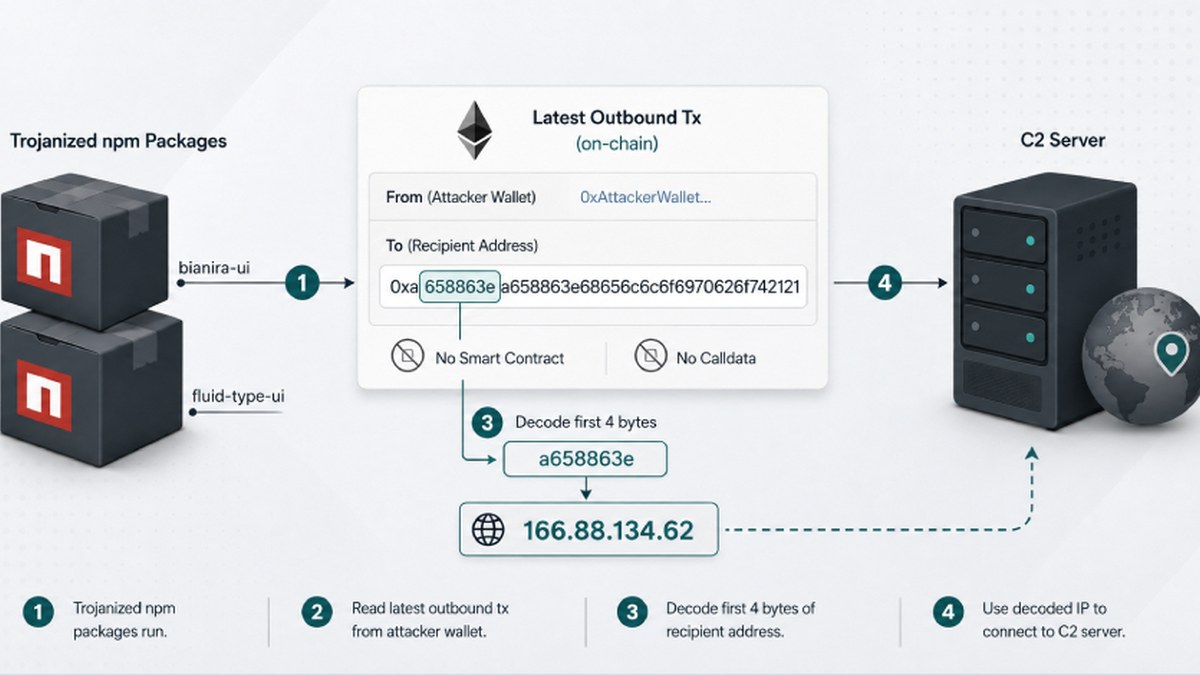
- Key facts & numbers: NullReceiver encodes C2 server IPs directly in the destination address bytes of zero-value, zero-data Ethereum transfers, eliminating the fixed, watchable address that EtherHiding required. OpenSourceMalware documented the technique after spotting it in trojanized npm packages "bianira-ui" (109 downloads) and "fluid-type-ui" (587 downloads), both published starting July 28, 2026 and now removed from npm. The campaign is linked to North Korean hackers, the same actors behind the Contagious Interview LinkedIn scheme previously detailed by Google Threat Intelligence Group.
- What happens next: Hide the C2 IP in ETH transfer bytes — no field to fingerprint, no fixed address to watch. North Korea's playbook just got sneakier and cheaper.
- NullReceiver encodes C2 server IPs directly in the destination address bytes of zero-value, zero-data Ethereum transfers, eliminating the fixed, watchable address that EtherHiding required.
- OpenSourceMalware documented the technique after spotting it in trojanized npm packages "bianira-ui" (109 downloads) and "fluid-type-ui" (587 downloads), both published starting July 28, 2026 and now removed from npm.
- The campaign is linked to North Korean hackers, the same actors behind the Contagious Interview LinkedIn scheme previously detailed by Google Threat Intelligence Group.
- Paul McCarty explained the malware reads the first four bytes of the destination address from the attacker's most recent outbound transaction and converts them from hexadecimal — in one example, wallet "0xa322e5f3d311d3080e6f0121063e9adc2490ef1a" decodes to C2 IP "166.88.134[.]62."
Why It Matters
NullReceiver strips away the fixed watchable destination address that made EtherHiding detectable, leaving defenders without a fingerprintable field to track while zero-value Ethereum transfers cost less gas than the prior technique. Two packages totaling under 700 downloads already reached developer machines, showing the npm supply-chain delivery channel is operational.
Sources Cited
- The Hacker News — Trojanized npm Packages Decode C2 IP From Ethereum Recipient Addresses
Related Coverage
Ask SkimNews