Titanium Battery Hits 97% Efficiency, Ditches Vanadium
The 30-Second Skim
- What happened: Researchers from Japan and China have built a grid-scale redox flow battery that uses titanium ions in molten salt electrolytes, aiming to replace scarce, expensive vanadium with a far more abundant metal.
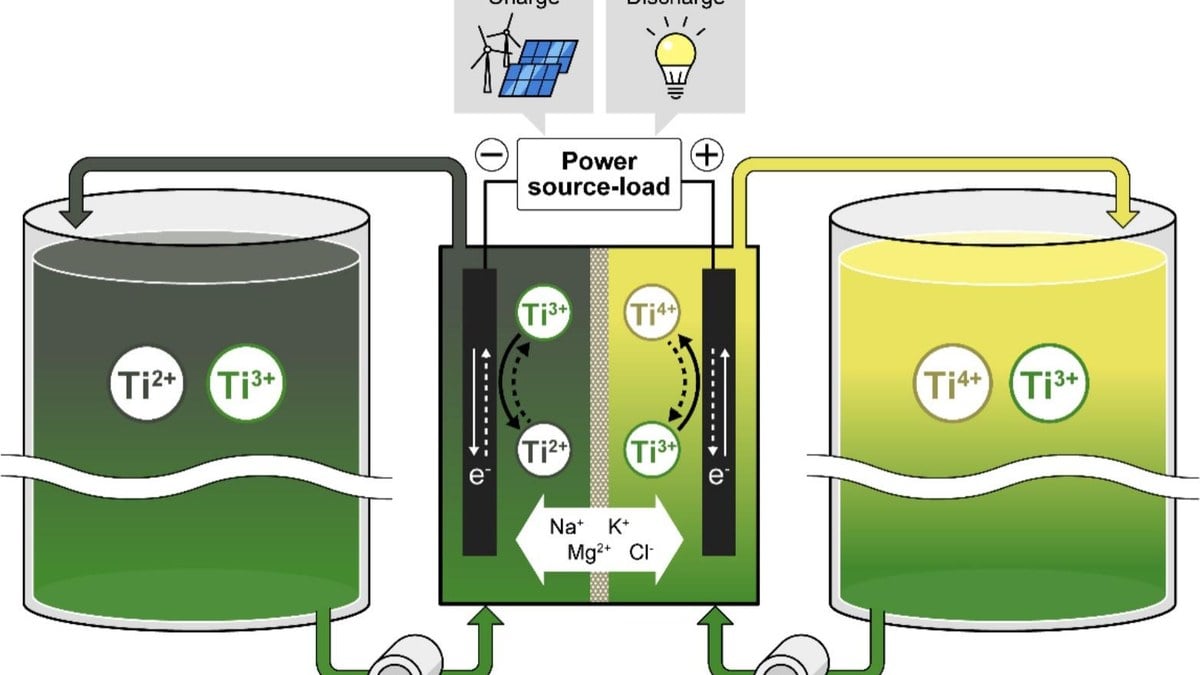
- Key facts & numbers: A Japan-China research team developed a titanium molten salt redox battery (TMSRB) using titanium ions as the redox-active material and molten salt as the electrolyte, targeting grid-scale energy storage with higher charge-discharge current density than vanadium redox flow batteries (VRFBs). Titanium is the seventh-most abundant metal in the earth's crust at 0.56% crustal abundance — 35 times that of vanadium — eliminating supply-chain and cost concerns that constrain conventional VRFB designs, the researchers said. The TMSRB operates at 300–450°C using LiCl–KCl or NaCl–MgCl₂–KCl molten salts, with Ti⁴⁺/Ti³⁺ at the cathode and Ti³⁺/Ti²⁺ at the anode, yielding a theoretical cell voltage of about 1.55V (extendable to 1.80V including Ti/Ti²⁺).
- What happens next: The underrated flex: titanium is 35x more abundant than vanadium, and the team hit 97% efficiency operating at 400°C. Vanadium RFBs have been the grid-storage frontrunner — this could dethrone them.
- A Japan-China research team developed a titanium molten salt redox battery (TMSRB) using titanium ions as the redox-active material and molten salt as the electrolyte, targeting grid-scale energy storage with higher charge-discharge current density than vanadium redox flow batteries (VRFBs).
- Titanium is the seventh-most abundant metal in the earth's crust at 0.56% crustal abundance — 35 times that of vanadium — eliminating supply-chain and cost concerns that constrain conventional VRFB designs, the researchers said.
- The TMSRB operates at 300–450°C using LiCl–KCl or NaCl–MgCl₂–KCl molten salts, with Ti⁴⁺/Ti³⁺ at the cathode and Ti³⁺/Ti²⁺ at the anode, yielding a theoretical cell voltage of about 1.55V (extendable to 1.80V including Ti/Ti²⁺).
- Cyclic and square-wave voltammetry in molten LiCl–KCl at 400°C, combined with ab initio molecular dynamics (AIMD) simulations, confirmed clear, reversible redox reactions and stable cycling at high charge-discharge rates with coulombic efficiency exceeding 97%.
Why It Matters
Vanadium price volatility and supply concentration have been a real bottleneck for grid-scale redox flow batteries; swapping in titanium — 35 times more abundant — directly targets that constraint. With 97%+ coulombic efficiency and a 1.55V theoretical cell voltage demonstrated in molten salt, the TMSRB is a credible path to cheaper long-duration storage, though engineering and system-level energy density work remains unfinished.
Sources Cited
Related Coverage
Ask SkimNews