Hall and Woodford Win Nobel Economics Prize
The 30-Second Skim7 points
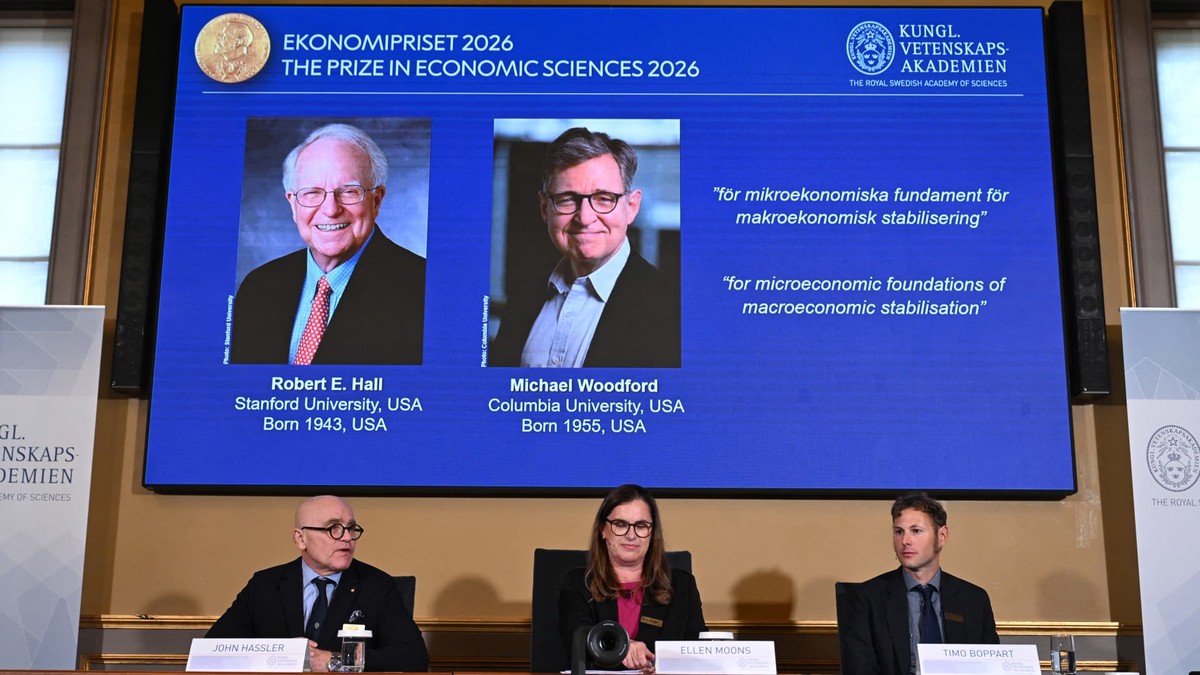
- What happenedRobert E. Hall and Michael Woodford won the Nobel memorial prize in economics for work that gave central banks the theoretical tools to smooth economic cycles by understanding how individual decision-making and government communication shape macroeconomic outcomes.
- Key facts & numbersRobert E. Hall and Michael Woodford were jointly awarded the Nobel memorial prize in economics for work underpinning models central banks and governments use to "smooth out" periods of boom and bust. The pair showed how forward-looking decisions by individual households and businesses collectively shape the economy, and how central bank and government communications steer those expectations, per the Royal Swedish Academy of Sciences. The Royal Swedish Academy of Sciences said the models enable "well-timed fiscal and monetary policy measures" to reduce economic peaks and troughs, helping policymakers respond to shocks like energy crises.
- What happens nextThe Fed-speech-moves-bond-yields playbook traces back to these two. Most headlines just say 'won Nobel' — the real story is they wrote the rules for expectation management.
- Robert E. Hall and Michael Woodford were jointly awarded the Nobel memorial prize in economics for work underpinning models central banks and governments use to "smooth out" periods of boom and bust.
- The pair showed how forward-looking decisions by individual households and businesses collectively shape the economy, and how central bank and government communications steer those expectations, per the Royal Swedish Academy of Sciences.
- The Royal Swedish Academy of Sciences said the models enable "well-timed fiscal and monetary policy measures" to reduce economic peaks and troughs, helping policymakers respond to shocks like energy crises.
- The laureates will split a 12 million Swedish kronor ($1.2 million) prize; California-born Hall is a Stanford professor and Massachusetts-born Woodford teaches at Columbia.
Why It Matters
Their models gave central banks and governments the theoretical foundation to manage expectations through communication, not just rate moves — the academy said the work enables 'well-timed fiscal and monetary policy measures' to reduce economic peaks and troughs. The prize committee specifically cited shock-response as a direct application, putting Hall and Woodford's framework at the operating core of how modern policymakers handle crises.
Sources Cited
- AxiosAxios
Related Coverage
Ask SkimNews
The day’s news in one short email, every morning.
Free. One email a day. Unsubscribe in one click.