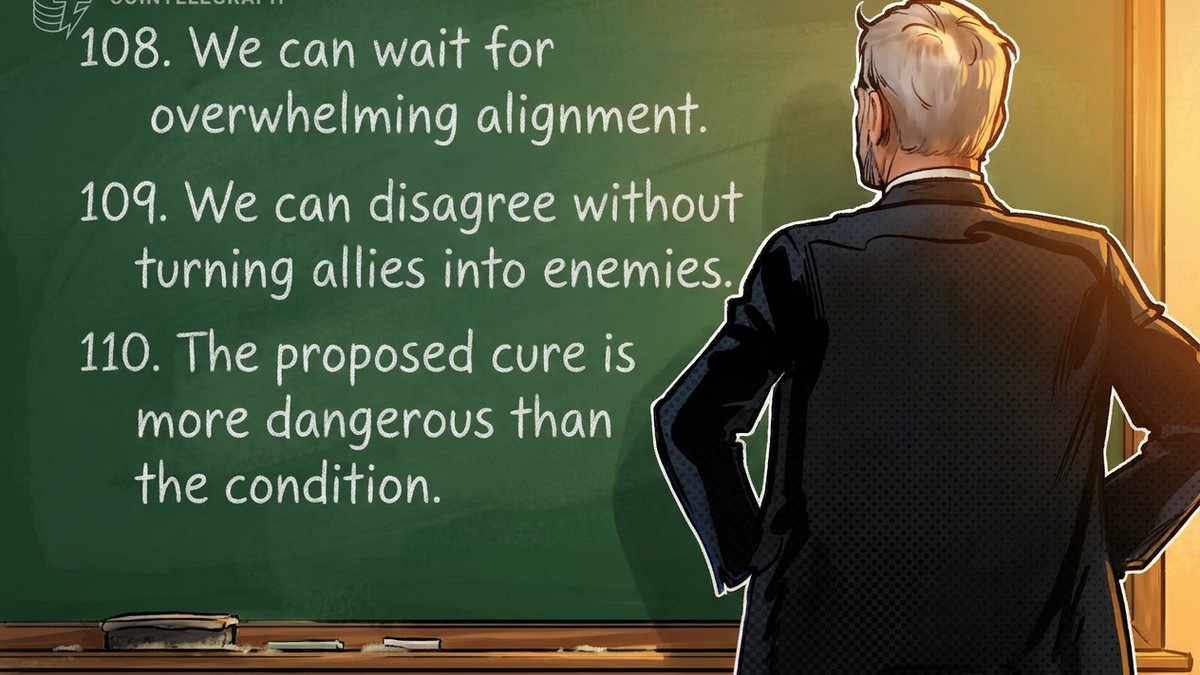
Saylor Challenges BIP-110 With 110 Criticisms
The 30-Second Skim7 points
- What happenedMichael Saylor has publicly challenged BIP-110, a proposed Bitcoin protocol change, arguing against its approach despite sharing its goals of preserving node accessibility and sound money principles.
- Key facts & numbersMichael Saylor outlined 110 criticisms of BIP-110, emphasizing alignment with its objectives—like protecting node operators and affordable payments—but rejecting its method as misaligned with Bitcoin’s permissionless ethos. BIP-110, introduced by pseudonymous developer Dathon Ohm and backed by Luke Dashjr, seeks to limit blockspace bloat from Ordinals by imposing a temporary one-year cap on certain data, aiming to preserve network efficiency. Adam Back opposes BIP-110, calling it a 'quest to police other people' and arguing it contradicts Bitcoin’s cypherpunk foundation of censorship resistance and decentralized autonomy.
- What happens nextSaylor isn’t attacking BIP-110 supporters—he’s saying they’re solving the right problem the wrong way. The real fight is over what ‘sound money’ means in a world where data lives on chain.
- Michael Saylor outlined 110 criticisms of BIP-110, emphasizing alignment with its objectives—like protecting node operators and affordable payments—but rejecting its method as misaligned with Bitcoin’s permissionless ethos.
- BIP-110, introduced by pseudonymous developer Dathon Ohm and backed by Luke Dashjr, seeks to limit blockspace bloat from Ordinals by imposing a temporary one-year cap on certain data, aiming to preserve network efficiency.
- Adam Back opposes BIP-110, calling it a 'quest to police other people' and arguing it contradicts Bitcoin’s cypherpunk foundation of censorship resistance and decentralized autonomy.
- Only 1% of blocks in the most recent activation period (blocks 955,584–957,599) signaled support for BIP-110, far below the 55% threshold needed for activation, indicating minimal current consensus among validators.
Why It Matters
The low signaling rate for BIP-110—just 1%—shows the proposal lacks network-wide support despite high-profile backing, while Saylor’s detailed critique signals growing elite disagreement over how to handle Bitcoin’s scalability and data-use tensions. This debate directly affects node operators and developers shaping Bitcoin’s long-term governance.
Sources Cited
Related Coverage
Ask SkimNews
The day’s news in one short email, every morning.
Free. One email a day. Unsubscribe in one click.