China's Sea-Skimming Hypersonic Bid Hits Engineering
The 30-Second Skim
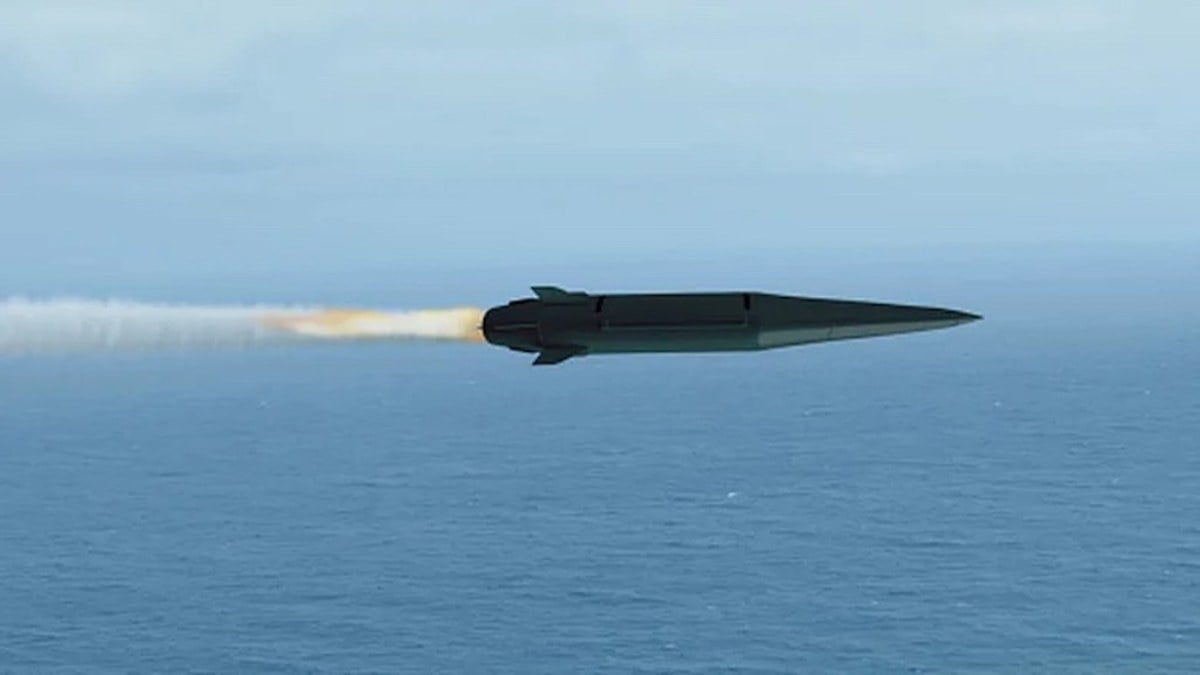
- What happened: China's Academy of Sciences has launched a research program to develop a sea-skimming hypersonic missile aimed at slashing radar detection against US carriers, though punishing physics, limited inventories, and a fragile kill chain may blunt the threat.
- Key facts & numbers: Chinese Academy of Sciences launched a low-altitude hypersonic flight research program this month, led by its Institute of Mechanics with the University of Science and Technology of China and the Ningbo Institute of Materials Technology and Engineering, to develop foundational technologies for a Mach 5+ sea-skimming missile using detonation combustion. China's existing hypersonic arsenal totals roughly 600 weapons per a leaked 2025 US military assessment, a small share of the People's Liberation Army Rocket Force's approximately 3,450-missile stockpile — which Lt. Gen. James Adams detailed in April 2026 testimony as 1,300 MRBMs, 900 SRBMs, 550 IRBMs, 400 ICBMs, and 300 GLCMs. David Wright and Cameron Tracy warned in the March 2024 Bulletin of the Atomic Scientists that low-altitude hypersonic flight generates drag that could make such weapons no faster — potentially slower — than traditional ballistic missiles, with Mach 5 producing 100 times the heating of Mach 1 sustained for up to 30 minutes.
- What happens next: The whole pitch is Mach 5 at wavetop height — but Wright and Tracy note the drag could make it slower than a ballistic missile. The real target isn't the warhead, it's the sensors.
- Chinese Academy of Sciences launched a low-altitude hypersonic flight research program this month, led by its Institute of Mechanics with the University of Science and Technology of China and the Ningbo Institute of Materials Technology and Engineering, to develop foundational technologies for a Mach 5+ sea-skimming missile using detonation combustion.
- China's existing hypersonic arsenal totals roughly 600 weapons per a leaked 2025 US military assessment, a small share of the People's Liberation Army Rocket Force's approximately 3,450-missile stockpile — which Lt. Gen. James Adams detailed in April 2026 testimony as 1,300 MRBMs, 900 SRBMs, 550 IRBMs, 400 ICBMs, and 300 GLCMs.
- David Wright and Cameron Tracy warned in the March 2024 Bulletin of the Atomic Scientists that low-altitude hypersonic flight generates drag that could make such weapons no faster — potentially slower — than traditional ballistic missiles, with Mach 5 producing 100 times the heating of Mach 1 sustained for up to 30 minutes.
- The proposed weapon would exploit the radar horizon to drastically shorten detection range and warning time, and fits into a broader Chinese multi-layered swarm strategy in which submarines fire hypersonic anti-ship missiles at Aegis destroyers, decoy drones exhaust interceptor stocks, and low-flying follow-on weapons finish off carrier strike groups.
Why It Matters
The article's central message is skepticism: the missile concept collides with Mach 5 heating sustained for 30 minutes, drag that could slow it below ballistic-missile speeds, and a Chinese hypersonic inventory of roughly 600 weapons against a PLARF total near 3,450. For US Navy planners, the actionable threat may be the kill web (sensors, radar, underwater cables) rather than the warhead itself, shifting defensive priorities from missile defense to targeting-network resilience.
Sources Cited
Related Coverage
Ask SkimNews