China details 3,000km carrier-swarm strategy
The 30-Second Skim
- What happened: Chinese researchers at the National University of Defense Technology published a peer-reviewed plan to destroy dispersed US carrier groups from 3,000 kilometers away using coordinated missile swarms, though analysts warn the real test is whether the targeting network can survive disruption.
- Key facts & numbers: Gao Tianyun of China's National University of Defense Technology published a peer-reviewed paper in Tactical Missile Technology outlining a step-by-step plan to destroy dispersed US carrier groups from 3,000 kilometers away, with reach extending to assets as far as Guam. The strategy opens with submarine-launched hypersonic anti-ship missiles aimed at US Aegis destroyers to crack the outer mid-course shield, followed by a multi-directional "firepower package" of decoy drones, cheap cruise missiles, and wave-skimming subsonic stealth missiles operating in a "leader-follower" mode so trailing missiles adapt if a scout is intercepted. Seth Jones of CSIS noted in a May 2026 brief that US carriers and destroyers are highly exposed to PLARF precision strikes because of their massive physical profiles, while Jonathan Caverley (2025 Texas National Security Review) warned the plan's kill chain rests on vulnerable space-based surveillance that US forces can disrupt.
- What happens next: The 'carrier-killer missile' framing misses the real fight — it's about whose sensor/comm network degrades slower once the shooting starts. Both sides already know this.
- Gao Tianyun of China's National University of Defense Technology published a peer-reviewed paper in Tactical Missile Technology outlining a step-by-step plan to destroy dispersed US carrier groups from 3,000 kilometers away, with reach extending to assets as far as Guam.
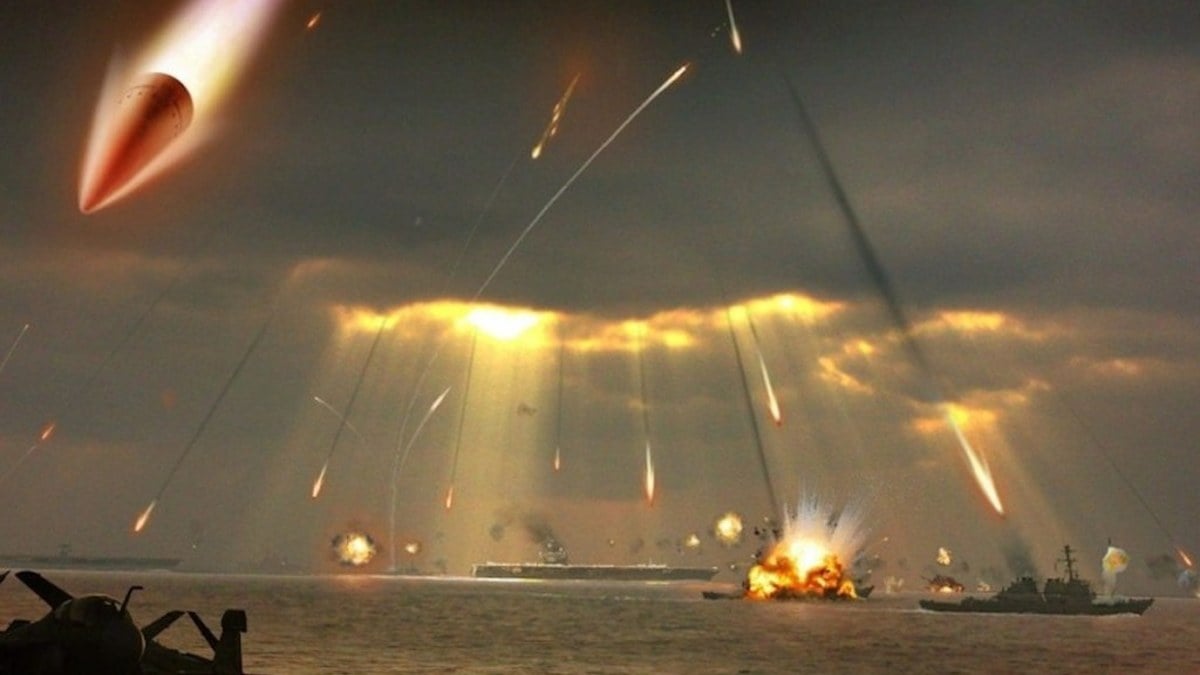
- The strategy opens with submarine-launched hypersonic anti-ship missiles aimed at US Aegis destroyers to crack the outer mid-course shield, followed by a multi-directional "firepower package" of decoy drones, cheap cruise missiles, and wave-skimming subsonic stealth missiles operating in a "leader-follower" mode so trailing missiles adapt if a scout is intercepted.
- Seth Jones of CSIS noted in a May 2026 brief that US carriers and destroyers are highly exposed to PLARF precision strikes because of their massive physical profiles, while Jonathan Caverley (2025 Texas National Security Review) warned the plan's kill chain rests on vulnerable space-based surveillance that US forces can disrupt.
- Jordan Spector, writing in the March 2026 US Naval Institute Proceedings, outlined a US Navy counter-architecture of medium unmanned surface vessels for early-warning detection and electronic jamming, large unmanned surface vessels acting as remote missile magazines, and cruisers/destroyers handling terminal defense — a framework that offloads risk to affordable autonomous systems.
Why It Matters
China's plan reframes a Pacific conflict from a missile-range race to a contest over which side's battle network keeps functioning under attack. The US is betting on layered unmanned defenses to absorb saturation strikes; China is pursuing kill webs and edge autonomy — meaning carrier survival now hinges on which distributed network degrades slower once the shooting starts.
Sources Cited
- Asia Times — China’s plan to swarm US carriers from 3,000km away
Related Coverage
Ask SkimNews