Mecca Defence Pact Not Targeting Iran, Turkiye Says
The 30-Second Skim7 points
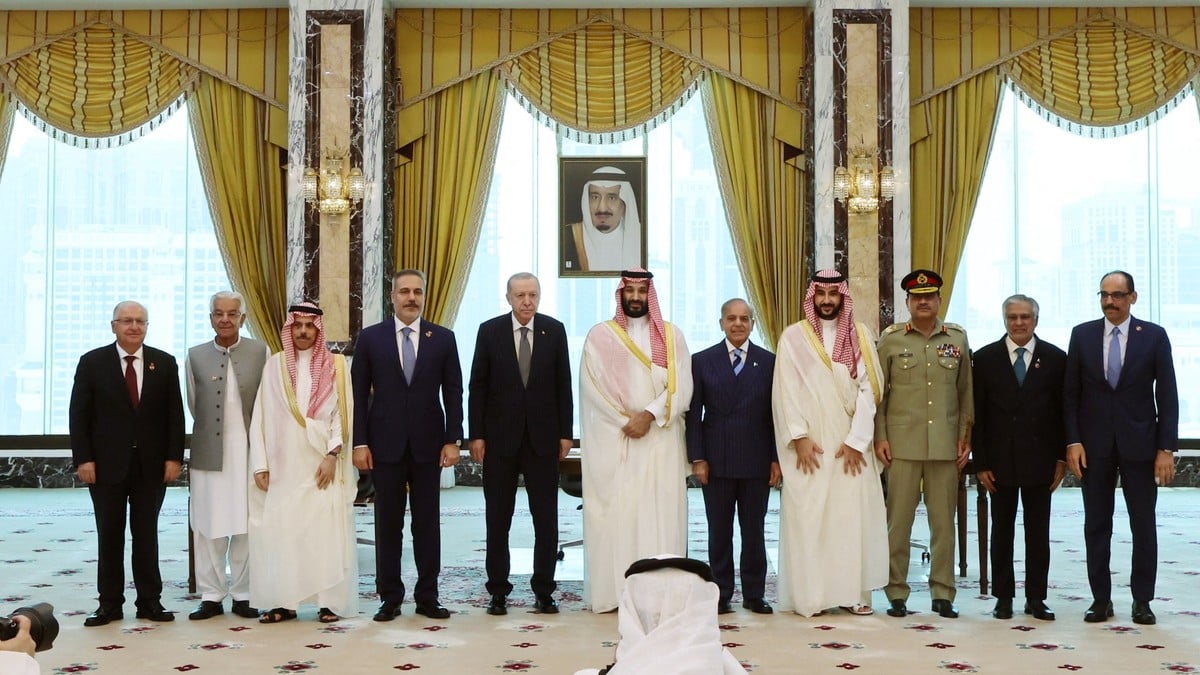
- What happenedTurkiye, Saudi Arabia, and Pakistan signed the Mecca Joint Defence Agreement on Friday, creating an Article 5-style mutual-defence pact that Ankara insists names no common threat — including Iran, which has publicly pushed back.
- Key facts & numbersTurkiye, Saudi Arabia, and Pakistan signed the Mecca Joint Defence Agreement on Friday, with Erdogan, Crown Prince Mohammed bin Salman, and Prime Minister Shehbaz Sharif declaring that an armed attack on one would be treated as an attack on all three. Turkish Foreign Minister Hakan Fidan told Anadolu on Saturday that the pact does not identify Iran or any other country as a common threat: "There is no common threat that we have put in writing," adding that non-signatory states are not targets. The agreement includes a NATO Article 5-style clause, but Fidan said responses would be case-by-case — the attacked country would request specific support, ranging from intelligence and logistics to ammunition or troop deployment.
- What happens next32 months of prep, a permanent secretariat in Riyadh, and Egypt queued to join — this is a real military bloc, not a diplomatic gesture.
- Turkiye, Saudi Arabia, and Pakistan signed the Mecca Joint Defence Agreement on Friday, with Erdogan, Crown Prince Mohammed bin Salman, and Prime Minister Shehbaz Sharif declaring that an armed attack on one would be treated as an attack on all three.
- Turkish Foreign Minister Hakan Fidan told Anadolu on Saturday that the pact does not identify Iran or any other country as a common threat: "There is no common threat that we have put in writing," adding that non-signatory states are not targets.
- The agreement includes a NATO Article 5-style clause, but Fidan said responses would be case-by-case — the attacked country would request specific support, ranging from intelligence and logistics to ammunition or troop deployment.
- Iranian officials publicly pushed back: parliamentary National Security Commission member Mahmoud Nabavian warned Saudi Arabia that cooperation with Turkiye and Pakistan would not guarantee its security, while fellow member Ebrahim Rezaei called the pact a "paper agreement."
Why It Matters
After nearly 32 months of preparation, the three countries built more than a declaration — a permanent secretariat in Riyadh, joint training, and defence-industry cooperation — with Egypt likely to join next, formalizing a Muslim-majority mutual-defence bloc that operates outside US and NATO structures and directly answers Fidan's critique that "external hegemons" worsen regional problems.
Sources Cited
- Breaking News, Latest News and VideosTurkey says defense pact with Saudi Arabia and Pakistan is not aimed at Iran or any other country - ABC News
Related Coverage
Ask SkimNews
The day’s news in one short email, every morning.
Free. One email a day. Unsubscribe in one click.