Brain Evolved From Two Merged Ancient Nervous Systems
The 30-Second Skim
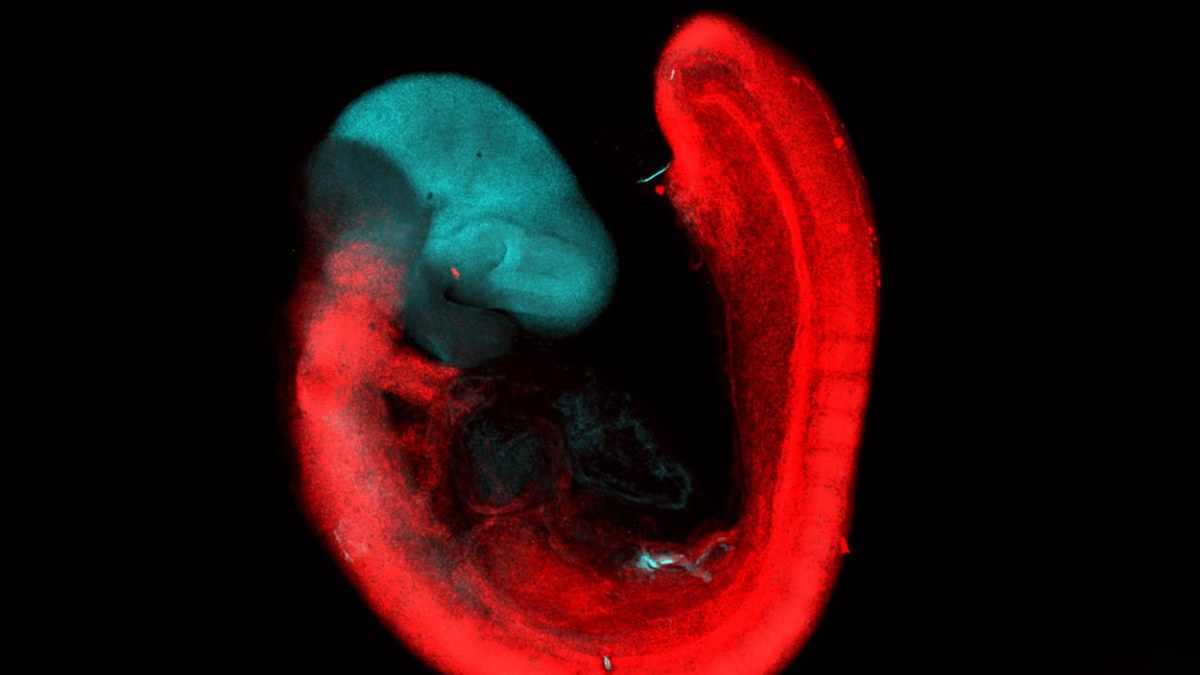
- What happened: Stanford researchers have shown that the human brain develops from two distinct types of embryonic progenitor cells—one forming the forebrain and midbrain, the other the hindbrain—suggesting our brain evolved by merging two ancient nervous systems at least 550 million years ago.
- Key facts & numbers: Kyle Loh at Stanford University found that the forebrain and midbrain develop from progenitor cells expressing the gene OTX2, while the hindbrain develops from a separate population expressing GBX2—a pattern confirmed in mouse, human, chicken, zebrafish, and acorn worm embryos. The two-origin architecture dates back at least 550 million years, according to the study in Nature Neuroscience; jellyfish, which humans diverged from 600-700 million years ago, still carry two entirely separate nervous systems. Using the correct hindbrain progenitor cell type, the team grew functional human hindbrain motor neurons in a dish for the first time—a breakthrough triggered by a summer student's failed experiment that exposed why prior labs had been working from the wrong starting cells.
- What happens next: Brain = two ancient nervous systems duct-taped together 550M years ago. Also: a summer student's failed experiment unlocked how to grow hindbrain neurons.
- Kyle Loh at Stanford University found that the forebrain and midbrain develop from progenitor cells expressing the gene OTX2, while the hindbrain develops from a separate population expressing GBX2—a pattern confirmed in mouse, human, chicken, zebrafish, and acorn worm embryos.
- The two-origin architecture dates back at least 550 million years, according to the study in Nature Neuroscience; jellyfish, which humans diverged from 600-700 million years ago, still carry two entirely separate nervous systems.
- Using the correct hindbrain progenitor cell type, the team grew functional human hindbrain motor neurons in a dish for the first time—a breakthrough triggered by a summer student's failed experiment that exposed why prior labs had been working from the wrong starting cells.
- The new ability to culture hindbrain neurons should accelerate research into ALS and spinal muscular atrophy, diseases that kill hindbrain motor neurons controlling speech and swallowing.
Why It Matters
Researchers can now grow human hindbrain motor neurons in a dish for the first time, creating human-cell models for ALS, spinal muscular atrophy, and the appetite-suppression pathways of GLP-1 drugs like Ozempic and Wegovy—diseases and mechanisms that previously had no workable laboratory system.
Sources Cited
- New Scientist — Our brain evolved from two primitive nervous systems that merged
- Stanford Medicine — Human brain is two separate organs, Stanford Medicine-led research finds
- Neuroscience News — The Brain Is Two Separate Organs Joined by Evolution
- The Times of India — Not one, but two? Stanford University scientists find the brain is two separate organs
- democrata.es — A study reveals that the brain comes from two ancestral neural systems that evolution fused.
Related Coverage
Ask SkimNews