MIT Team Observes Paraparticles in Quantum Simulator
The 30-Second Skim3 points
- What happenedA team at MIT has detected emergent paraparticles in a quantum simulator, demonstrating particle behavior not seen before and confirming predictions made possible by a 2025 theoretical advance.
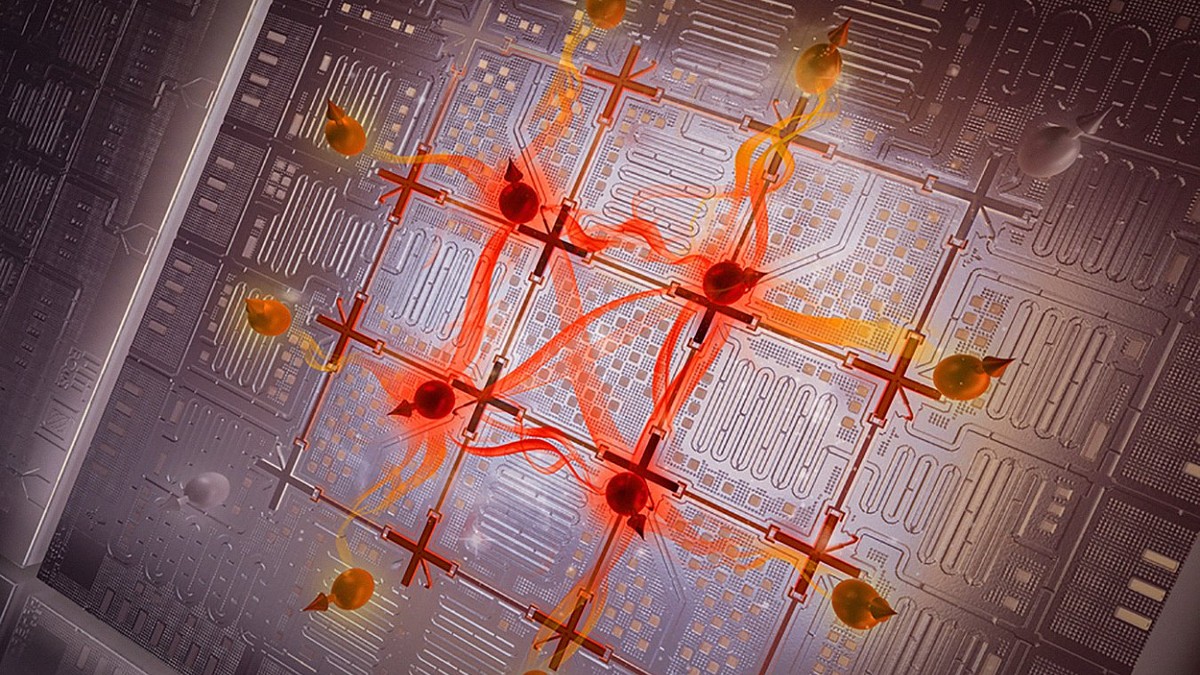
- Key facts & numbersThe experiment used 16 superconducting qubits arranged in a grid; paraparticle behavior emerged from paired qubits. The detection followed a 2025 paper by Kaden Hazzard and Zhiyuan Wang.
- What happens nextThe team plans to expand the system to include interacting paraparticles and more complex geometries, aiming to explore unresolved questions in quantum statistics.
Why It Matters
This demonstration shifts paraparticles from mathematical curiosities to experimentally accessible phenomena, opening new pathways in quantum simulation and condensed matter physics. Researchers can now probe exotic quantum statistics that may inform future quantum computing architectures.
The use of physical qubits to embody paraparticle behavior suggests certain quantum phenomena may be infeasible to replicate on classical computers, reinforcing the value of quantum simulators as discovery tools. This could influence how quantum hardware is designed for fundamental physics exploration.
How Outlets Are Framing It
Observations from the coverage. No single outlet is named.
- Focuses on the breakthrough detection of paraparticles as a fundamental physics milestone, highlighting the MIT experiment and its validation of long-standing theory
- Emphasizes the enabling role of the 2025 mathematical work by Hazzard and Wang, framing the observation as a triumph of theory-guided experimentation
- Surfaces the distinction between simulation and physical embodiment in quantum hardware, underscoring the impossibility of classical replication
Background & Timeline
- 1950s: Theoretical physicists first propose paraparticles as alternative quantum statistics, but consider them experimentally indistinguishable from bosons and fermions
- 2025: Kaden Hazzard and Zhiyuan Wang publish a mathematical breakthrough proving paraparticles could be detectable under specific experimental conditions
Sources Cited
Related Coverage
Ask SkimNews
The day’s news in one short email, every morning.
Free. One email a day. Unsubscribe in one click.