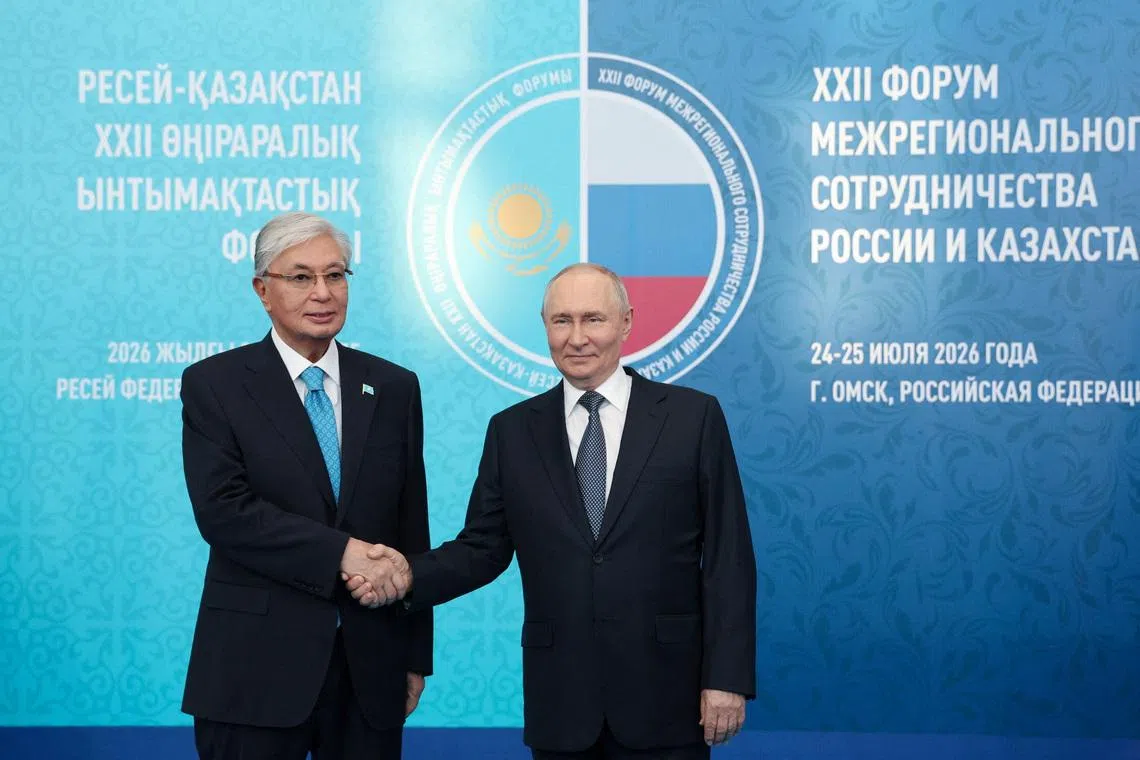
Tokayev Urges Putin to Freeze Ukraine, Reaffirms Alliance

Get the Geopolitics newsletter
Daily geopolitics — wars, elections, sanctions, the diplomatic moves that move markets. Free.
- Tokayev urged Putin to 'freeze' the Ukraine conflict and return to the Istanbul 2.0 negotiation formula at the Russia-Kazakhstan Forum in Omsk on July 24-25, saying 'all of this must be stopped' because the war 'plays into the hands... of the adversaries of both Russia and Ukraine.'
- Tokayev explicitly rejected serving as a mediator, saying 'Russia is a great country... they can manage on their own without intermediaries,' while framing his comments as relaying requests from others.
- Tokayev walked a diplomatic tightrope, reaffirming Kazakhstan's 'allied relationship' with Russia while adding 'we have always treated the Ukrainian people with respect' and conceding 'the nature of this conflict is not entirely clear to many, including us.'
- Kremlin spokesperson Dmitry Peskov rejected the overture, saying 'a freeze as such is impossible' and that 'we must achieve our goals,' signaling Moscow's hard-line posture.
- Putin signed two executive orders shortly after, authorizing negotiations with Kazakhstan and Uzbekistan to update existing military-technical cooperation agreements (signed December 2013 with Kazakhstan, November 2016 with Uzbekistan).
- The existing military-technical treaties govern mutual deliveries of weapons, military vehicles, technology and intellectual property, repair and modernization, joint R&D, joint manufacturing facilities, and human capacity building.
- Kazakhstan and Uzbekistan's militaries primarily run on Russian and Soviet equipment, making them reliant on Moscow for spare parts and ammunition at a time when Western sanctions have banned weapons and dual-use goods exports to Russia.
Why it matters: The Kremlin's flat rejection — 'a freeze as such is impossible' — shows Tokayev's peace nudge won't move Putin, leaving Kazakhstan exposed on the same dependency it tried to manage diplomatically. With Kazakhstan's military dependent on Russian/Soviet platforms and Western sanctions complicating that supply chain, updating the 2013 and 2016 military-technical agreements gives Moscow fresh leverage precisely when Central Asian states are publicly asking for restraint.