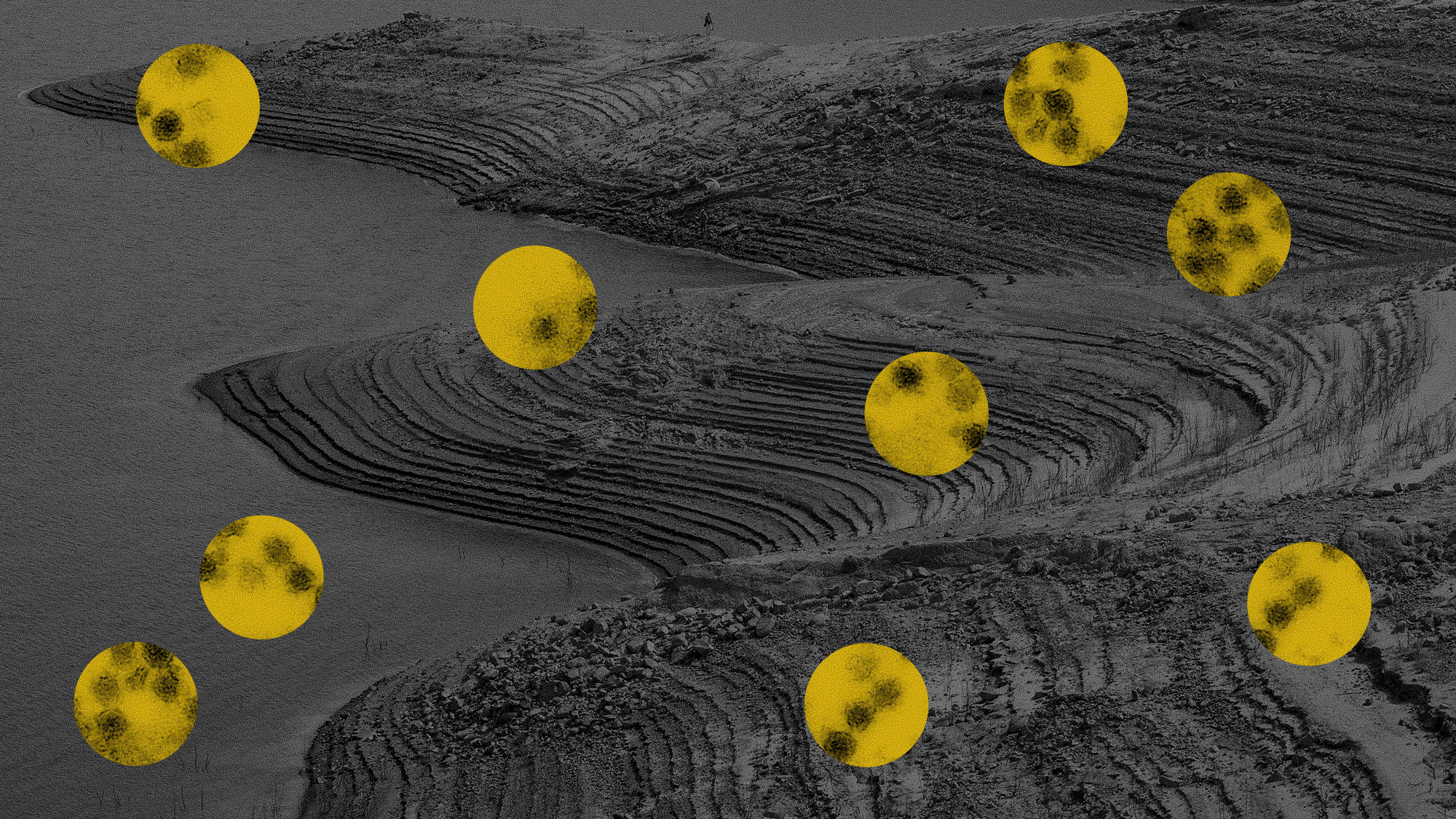
Drought Fuels Disease Spread in 'Paradox': Study
Get the Energy newsletter
Daily energy & climate — solar, EVs, oil, the policy fights and tech bets shaping the transition. Free.
- New paper in Trends in Ecology and Evolution synthesizes nearly 100 studies showing drought can help deadly infections and parasites spread across humans, large mammals, fish, amphibians, and insects.
- Tara Stewart Merrill of the Cary Institute of Ecosystem Studies and Pieter Johnson of the University of Colorado Boulder coauthored the paper, coining the "drought-disease paradox" after their own California pond study sites dried up mid-research.
- While water-borne diseases like schistosomiasis and malaria decline as ponds dry, cholera, West Nile virus, and dengue cases boom — with the world now 77% drier than three decades ago, according to a UN report.
- Real-world cases cited: California droughts in the 2000s drove thousands of excess valley fever infections; a 2014 superdrought contributed to California's second-highest West Nile virus tally; a 2017 Somalia drought caused nearly 80,000 cholera cases that killed more than 1,000 people.
- Georgia Titcomb of Colorado State University found that after low-rainfall periods, animals crowding around remaining African savannah watering holes left behind dung containing more than 100,000 parasite eggs per kilogram.
- Severity matters: Vibrio vulnificus bacteria initially spreads during drought but is wiped out entirely if drought persists long enough, while "weather whiplash" — heavy rains followed by drought — amplifies valley fever, which grows in wet winters then spreads as wind-borne summer dust.
Why it matters: This peer-reviewed synthesis reframes drought from a water-supply crisis into a disease-emergence crisis, giving epidemiologists a framework linking specific drought patterns — including human responses like dam-building and irrigation — to outbreaks of cholera, West Nile, and dengue. With the planet already 77% drier than 30 years ago, the paper's authors argue satellite water tracking and drought-aware public health planning are now foundational, not optional.
Ask SkimNews