Vietnam-Australia: defense deepens, private capital lags — SkimNews

Get the Geopolitics newsletter
Daily geopolitics — wars, elections, sanctions, the diplomatic moves that move markets. Free.
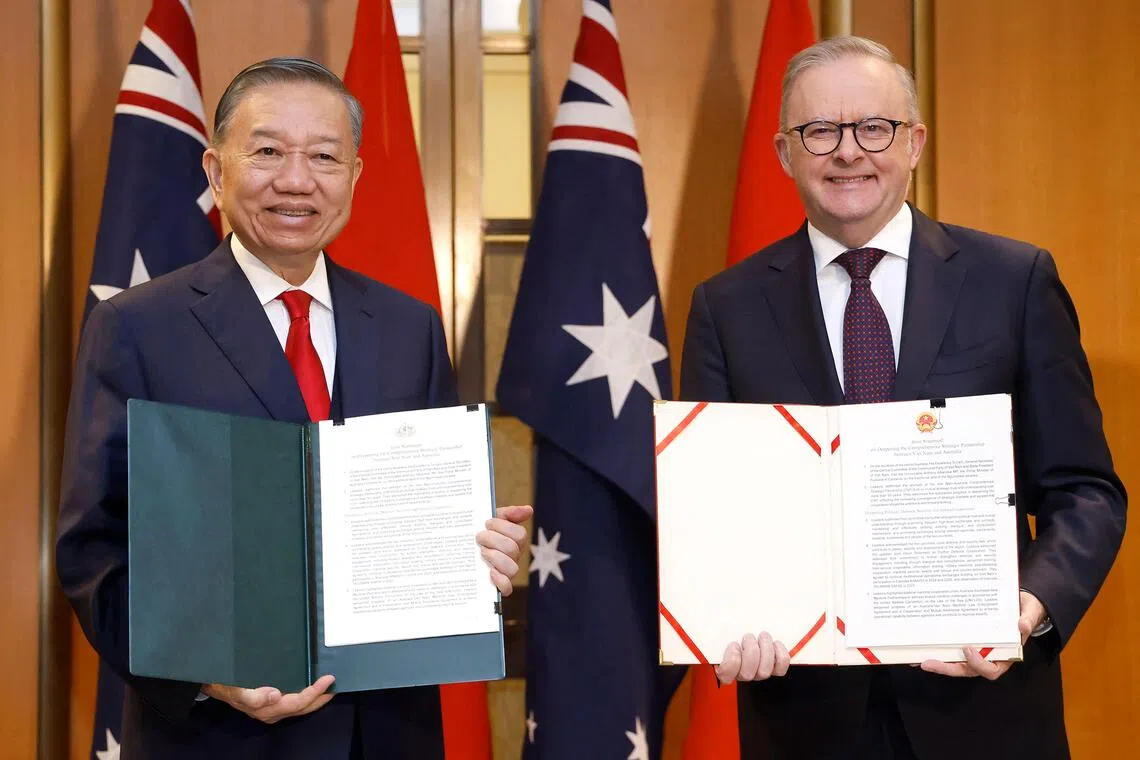
- To Lam made the first state visit to Australia by a Vietnamese head of state since the 1975 reunification on August 11, following visits to China, India, Sri Lanka, Thailand, Singapore and the Philippines and preceding a stop in New Zealand to meet Christopher Luxon.
- The Vietnam-Australia comprehensive strategic partnership, elevated in March 2024, is delivering on its 2024 headline commitments: the ministerial security dialogue was inaugurated in 2024, a peacekeeping partnership agreement was signed in July 2025, a defense cooperation plan for 2025–2027 is in place, and the ministerial energy and minerals dialogue—committed in 2024—was finally held alongside this visit.
- Defense cooperation expanded with an updated Joint Vision Statement, Vietnam's participation in Exercise Kakadu in 2024 and 2026, and observation of Exercise Talisman Sabre in 2025—steps the source calls meaningful for a country whose defense policy rules out military alliances.
- The economic track produced no new quantified commitment beyond cumulative Export Finance Australia finance of A$1.3 billion since 2017; two-way trade sat at A$30.0 billion in 2025 while total two-way investment stock was just A$2.0 billion.
- Structural constraints keep the partnership's economic section dominated by public finance: Vietnam caps aggregate foreign ownership in commercial banks at 30% of charter capital, foreign individuals and organizations are limited to 50-year land leases under the 2024 Land Law, and Australian institutional investors have limited exposure to frontier markets.
- A new Joint Statement on Economic Resilience Cooperation covers critical minerals, semiconductors, clean energy, grid infrastructure and agricultural essentials, but the source notes its operational substance will depend on whether specific projects follow.
- The Vietnamese diaspora of around 350,000 people in Australia—with Vietnam as Australia's fourth-largest international student market at roughly 35,000 students and over 160,000 alumni—carries unresolved political tension, as descendants of post-1975 refugees have routinely protested Vietnamese leaders' visits to Canberra through Black April commemorations and use of the heritage flag.
Why it matters: Two-way trade of A$30 billion sits alongside total investment of just A$2 billion, a gap the article attributes to Vietnam's 30% foreign bank ownership cap and 50-year land lease limits—not a shortfall in political will, which has delivered on every 2024 commitment. Until Hanoi adjusts ownership rules or Canberra expands blended finance, the CSP's economic pillar will keep running on public money while private capital stays on the sidelines.
Ask SkimNews