Titanium Battery Hits 97% Efficiency, Ditches Vanadium — SkimNews
Get the Energy newsletter
Daily energy & climate — solar, EVs, oil, the policy fights and tech bets shaping the transition. Free.
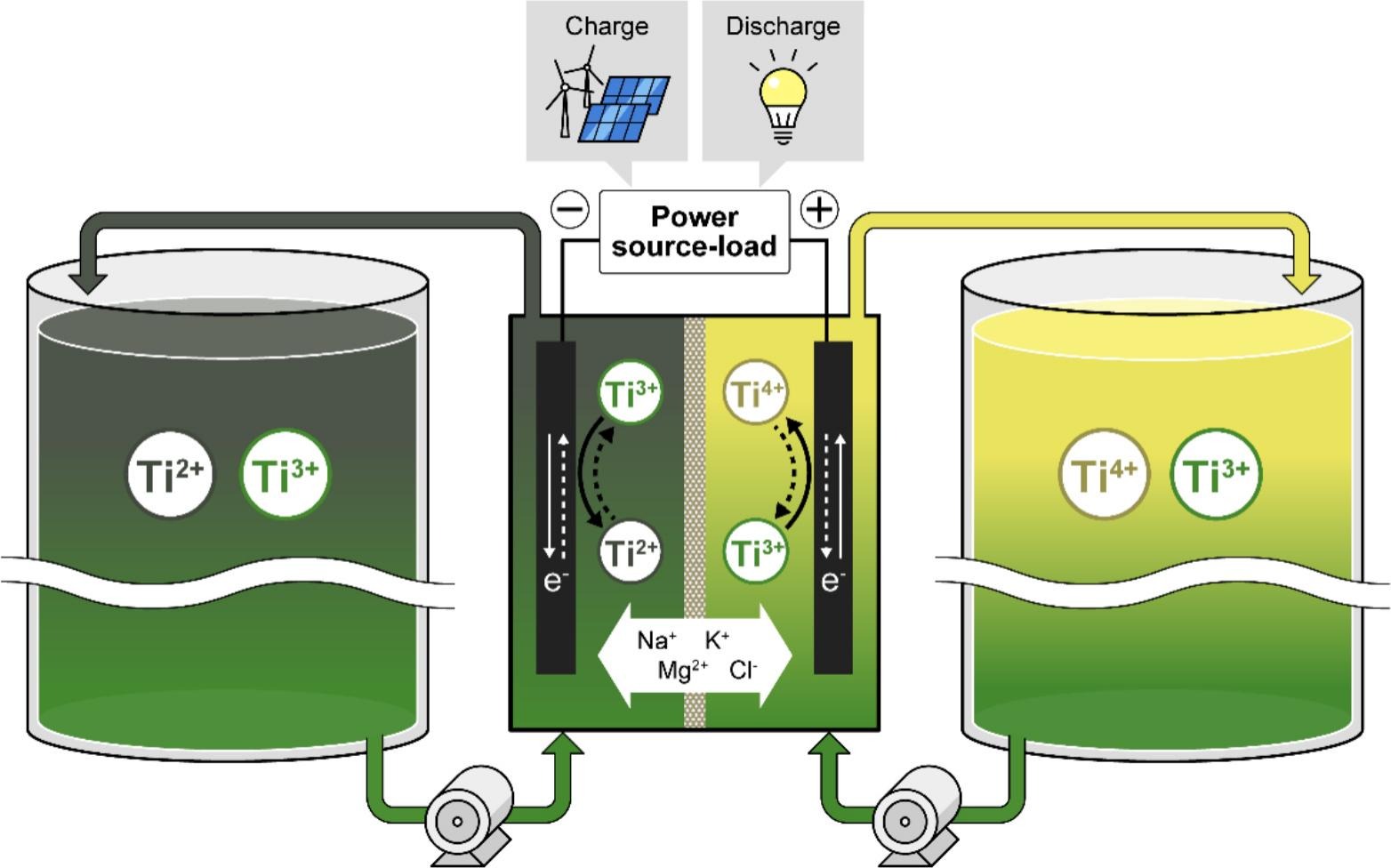
- A Japan-China research team developed a titanium molten salt redox battery (TMSRB) using titanium ions as the redox-active material and molten salt as the electrolyte, targeting grid-scale energy storage with higher charge-discharge current density than vanadium redox flow batteries (VRFBs).
- Titanium is the seventh-most abundant metal in the earth's crust at 0.56% crustal abundance — 35 times that of vanadium — eliminating supply-chain and cost concerns that constrain conventional VRFB designs, the researchers said.
- The TMSRB operates at 300–450°C using LiCl–KCl or NaCl–MgCl₂–KCl molten salts, with Ti⁴⁺/Ti³⁺ at the cathode and Ti³⁺/Ti²⁺ at the anode, yielding a theoretical cell voltage of about 1.55V (extendable to 1.80V including Ti/Ti²⁺).
- Cyclic and square-wave voltammetry in molten LiCl–KCl at 400°C, combined with ab initio molecular dynamics (AIMD) simulations, confirmed clear, reversible redox reactions and stable cycling at high charge-discharge rates with coulombic efficiency exceeding 97%.
- The cell architecture uses a porous aluminum oxide (Al₂O₃) crucible as separator, carbon and graphite electrodes with nickel leads, and lithium fluoride (LiF) additives to suppress TiCl₄ evaporation during operation under argon.
- The research team included academics from the University of Science and Technology Beijing and Tohoku University, and noted that engineering work on cell-stack design, thermal management, and system-level energy density metrics is ongoing.
- The molten salt composition can be tuned to optimize cost, temperature range, and electrochemical performance, with experiments confirming consistent high-voltage redox activity across multiple electrolyte systems.
Why it matters: Vanadium price volatility and supply concentration have been a real bottleneck for grid-scale redox flow batteries; swapping in titanium — 35 times more abundant — directly targets that constraint. With 97%+ coulombic efficiency and a 1.55V theoretical cell voltage demonstrated in molten salt, the TMSRB is a credible path to cheaper long-duration storage, though engineering and system-level energy density work remains unfinished.
Ask SkimNews