China Urged to Lead Myanmar Reform as Junta Loses Ground — SkimNews
SkimNews Take
China's proposed "hero" role implicitly requires reversing its own arms pipeline — the same supplies that fueled the junta's entrenchment are now what any reform push would need to constrain.
Get the Geopolitics newsletter
Daily geopolitics — wars, elections, sanctions, the diplomatic moves that move markets. Free.
- Myanmar's civil war is heading into its sixth year with approximately 3.6 million people displaced as of December 2025, about 90% of them uprooted since the February 2021 coup that ended a brief democratic experiment.
- Min Aung Hlaing, the general who staged the 2021 coup and recently anointed himself Myanmar's president, visited both Beijing and New Delhi in June for enhanced economic and security cooperation with the junta.
- China serves as the regime's principal weapons supplier, has blocked UN arms embargo proposals, and has specifically empowered Burma's air force — which now conducts airstrikes on populated areas including markets, schools, hospitals, and displacement camps.
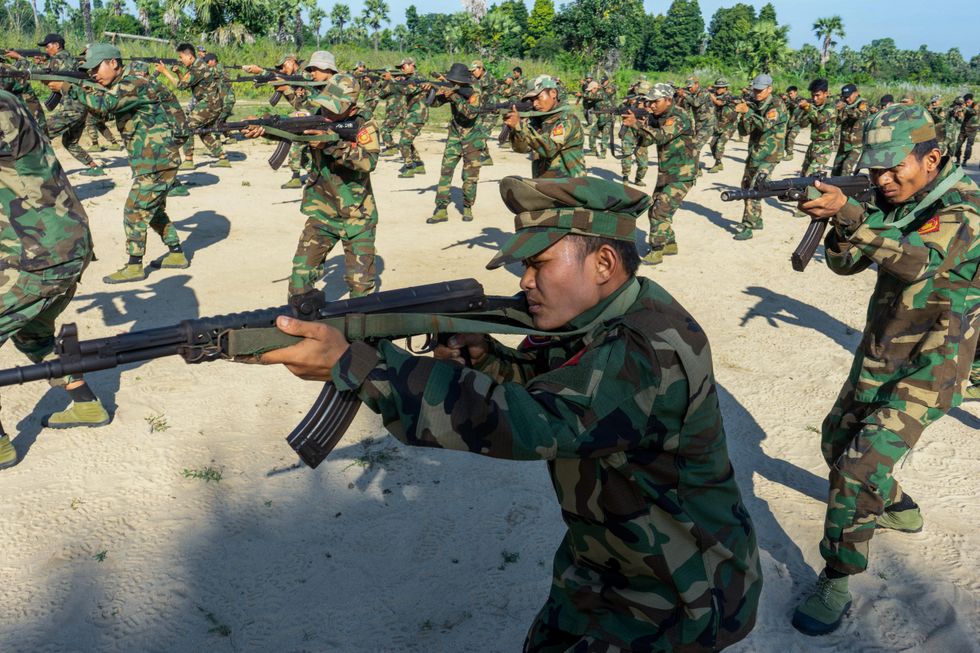
- The Tatmadaw controls only about one-fifth of Myanmar, half the territory held by opposition forces, with the People's Defense Force and ethnic armed organizations pushing the junta on the defensive toward Mandalay.
- China arrested Min Zin, an American citizen heading the Institute for Strategy and Policy–Myanmar in Thailand, on spying charges — bringing the conflict's reach to American soil and underscoring Beijing's tight ties to Naypyidaw.
- The Rohingya crisis persists alongside the civil war, with roughly one million refugees still in Bangladesh after fleeing what the UN refugee agency calls armed attacks and mass human rights violations in Rakhine State.
- Ethnic minorities including the Christian Kachin, Chin, and Karen face a regime that Georgetown's Berkley Center says has fused Burmese nationalism with Buddhism, demonizing non-Buddhists as threats to the state.
Why it matters: China's backing has kept the Tatmadaw in power but prevented outright victory — the junta now holds roughly 20% of Myanmar versus twice that for opposition forces. Cornell analyst Aung Thura Ko Ko warns anti-China sentiment is the greatest long-term risk to Beijing in Myanmar, meaning continued arms supply may now cost China more in regional standing than a push for reform would.
Ask SkimNews


