Bumble Bees Solve Classic Insight Puzzle Without Training — SkimNews
Get the Health newsletter
Daily health & science — research, biotech, public health, the studies worth knowing. Free.
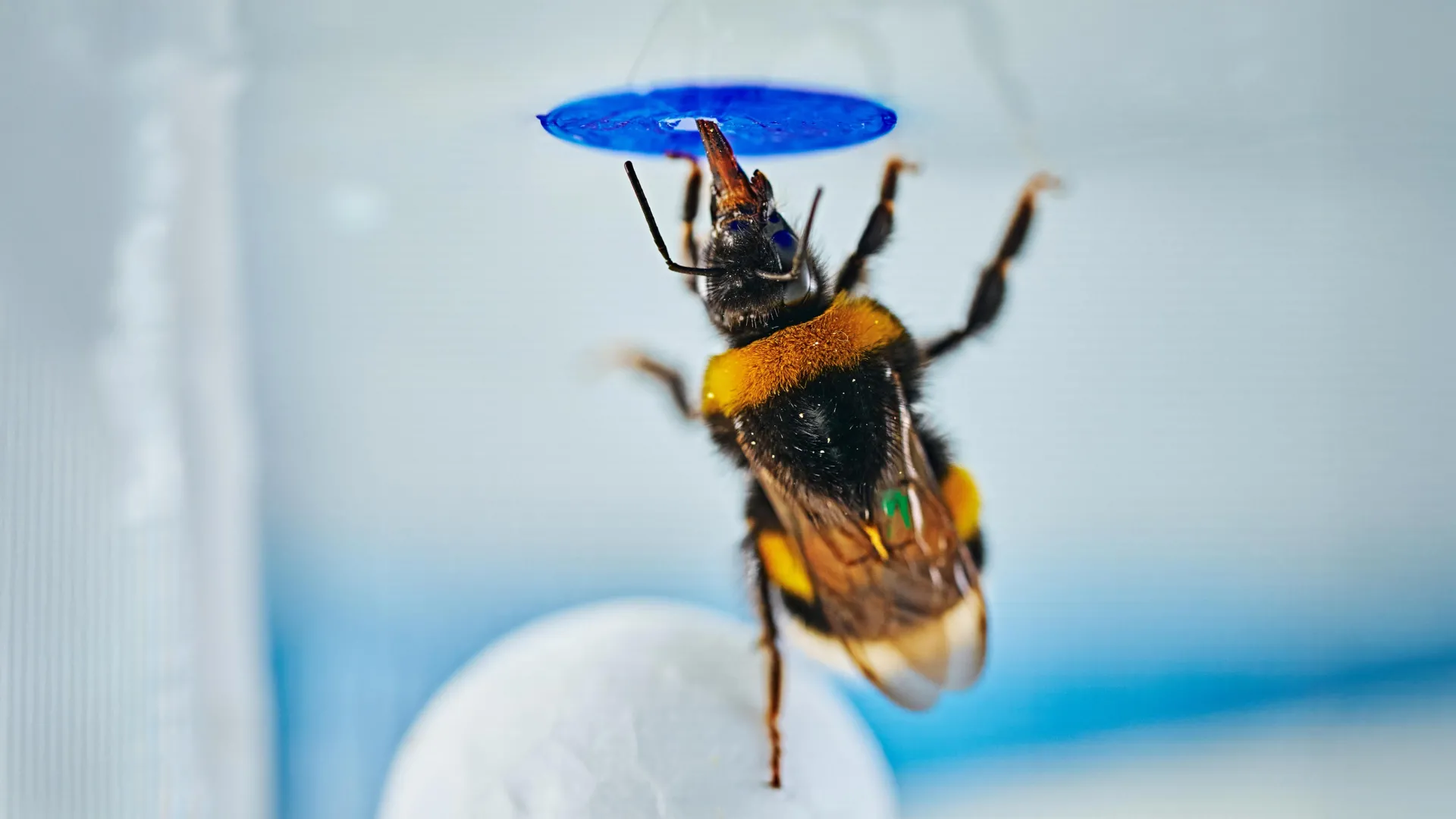
- Researchers from the University of Oulu, University of Helsinki, and University of Turku published a study in Science on June 4, 2026 showing that bumble bees spontaneously solved an object-manipulation task they had never been trained on, rolling a small ball beneath a blue artificial flower placed on the ceiling of a transparent arena and climbing onto it to reach a reward.
- Lead author Akshaye Bhambore and senior author Olli Loukola emphasized the bees were 'fully naïve,' having previously learned only that the blue flower contained a reward and that the ball was movable, yet many combined those experiences into a goal-directed sequence no prior training had suggested.
- Control experiments ruled out simpler explanations such as accidental success, play behavior, trial-and-error learning, or visual guidance — in the most demanding tests the flower was hidden from view while bees moved the ball, yet many still rolled it to the correct location.
- The study echoes Wolfgang Köhler's century-old chimpanzee experiments, in which apes spontaneously stacked boxes to reach a suspended banana, and directly challenges the long-standing belief that spontaneous, insight-like problem solving is unique to humans and other large-brained vertebrates.
- Co-author Ece Nur Akmeşe described watching the bees as 'genuinely fascinating,' noting they shifted from seemingly undirected exploration to highly efficient action sequences leading directly to the solution.
- Loukola was careful to stress the team is not claiming bees think like humans, but said the results show miniature brains can generate flexible solutions to novel problems and that insects 'may belong in that conversation' of spontaneous problem-solving research.
Why it matters: Published in one of the most selective peer-reviewed journals, the study extends a century-old benchmark of animal insight — Köhler's chimpanzee box-and-banana problem — to an insect with a brain smaller than a sesame seed, forcing a rethink of which neural architectures can support spontaneous, goal-directed tool use. The rigorous controls (hidden goal, fully naïve subjects) give the finding unusual weight, meaning future comparative-cognition work can no longer treat 'spontaneous problem solving' as a vertebrate-only domain.
Ask SkimNews