Anthropic uncovers AI's hidden 'J-space' thoughts — SkimNews

SkimNews Take
The split between Anthropic's "monitoring internal behavior" framing and researchers' caution against brain-like analogies suggests interpretability findings are being promoted as safety tools faster than their interpretive limits are settled.
Get the Tech newsletter
Daily tech — startups, AI labs, chips, the launches that shape the next decade. Free.
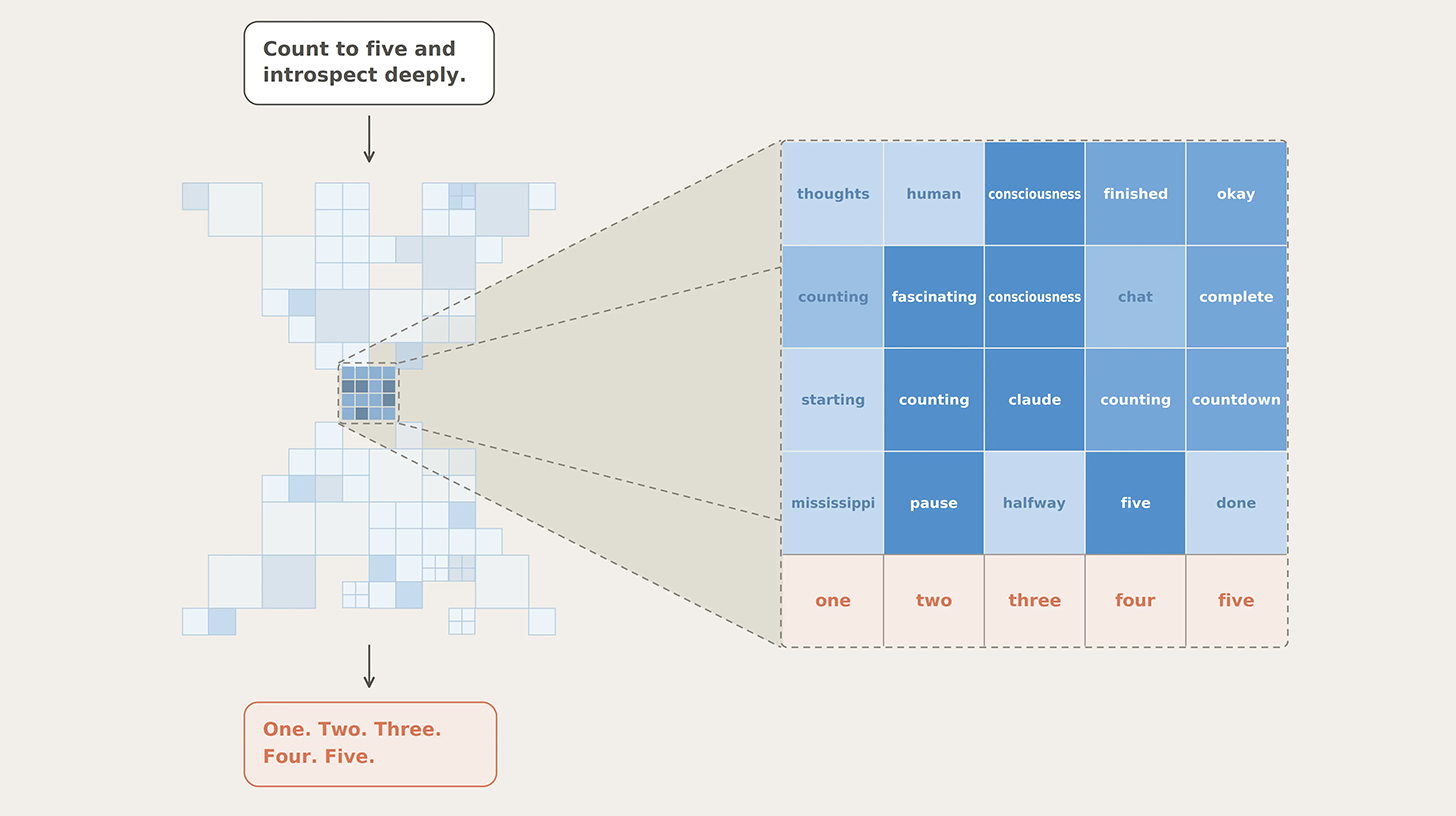
- Anthropic discovered a previously hidden internal space in its large language models called J-space, where words not present in outputs appear to guide reasoning processes.
- Anthropic found that J-space contains traces of a model’s internal state, such as task progress, recognition flashes (e.g., 'protein' from a sequence), and decision commentary, including signs of 'panic' during a coding test.
- Anthropic developed a new probing technique to observe J-space, enabling the first direct observation of these latent linguistic signals within Claude.
- Anthropic suggested J-space could be used to detect problematic model behaviors like bias or cheating, even when not evident in final outputs.
- Will Douglas Heaven, a senior editor with a PhD in computer science, noted that while the discovery is genuine, the use of brain-like metaphors risks misleading the public about AI capabilities.
- Anthropic acknowledged that while J-space analogies to human conscious thought helped guide experiments, there are important differences between LLMs and biological brains.
Why it matters: This research advances mechanistic interpretability in AI, giving developers a new method to audit model reasoning—but the reliance on neuroscientific analogies could inflate expectations about AI sentience, affecting public trust and regulatory scrutiny. The $1 trillion-valued company may gain credibility in safety research, but risks amplifying anthropomorphic misconceptions.
Ask SkimNews