Bayer's PRINCE: Agentic AI for Drug Safety Data — SkimNews
Get the Tech newsletter
Daily tech — startups, AI labs, chips, the launches that shape the next decade. Free.
- Bayer AG developed the Preclinical Information Center (PRINCE) with Thoughtworks, using Agentic Retrieval-Augmented Generation and Text-to-SQL to integrate decades of safety study reports and answer complex preclinical research questions in natural language.
- PRINCE evolved through three distinct phases: a 'Search' tool for structured metadata, an AI-powered 'Ask' system using RAG on unstructured PDFs (including scanned historical reports), and a current 'Do' phase with multi-agent orchestration capable of drafting regulatory documents.
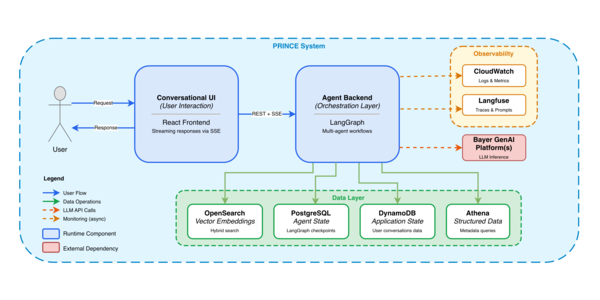
- The platform is orchestrated with LangGraph and served via FastAPI, routing requests through a workflow that clarifies intent, plans, conducts research, validates completeness, and writes responses — with deliberate pause points and feedback loops before generation.
- PRINCE runs models from OpenAI, Anthropic, Google, and open-source providers through a unified OpenAI-compatible endpoint, allowing the team to swap models per task and enforce rate limits and safeguards via an internal GenAI control plane.
- Langfuse provides detailed production traces for observability, with the RAGAS framework running daily live-traffic evaluations and on-demand dataset evaluations whenever core workflows, prompts, or underlying models change.
- Resilience is layered with automatic retries at both the LLM-call and logical-node levels, fallback to alternative models or platforms when a specific LLM fails, and error context fed back to agents so they can chart alternative trajectories rather than repeat the same path.
- The system stores vector representations of all study reports in OpenSearch and accesses curated structured data via Athena, with agent execution state persisted in PostgreSQL via a LangGraph checkpointer and broader application state in DynamoDB.
Why it matters: PRINCE shows that production agentic AI in regulated pharma depends as much on context engineering and harness engineering — specialized model routing, multi-step orchestration, human-in-the-loop checkpoints, and continuous evaluation — as on the underlying LLMs themselves. For drug developers, the platform demonstrates that decades of legacy PDF safety reports can be made queryable while preserving governance, with multi-provider model swapping giving Bayer flexibility to pick the best tool for each task. The architecture offers a concrete template for other life-sciences enterprises sitting on similar document troves.
Ask SkimNews


