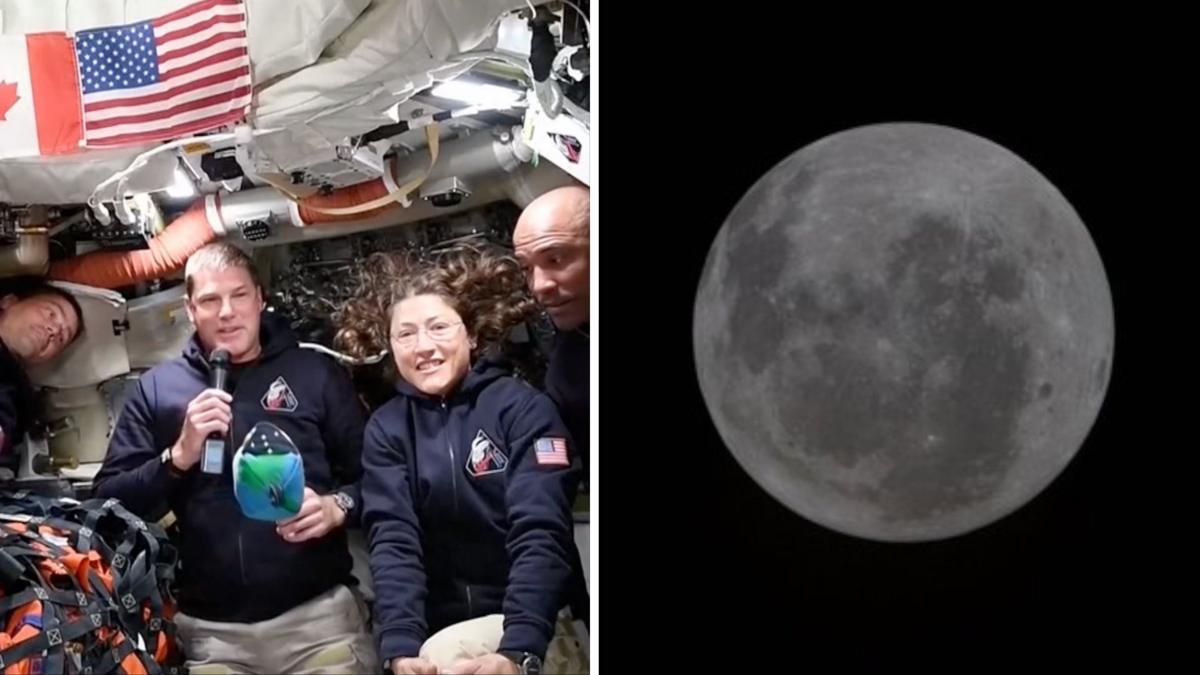
Artemis 2 crew sees Orientale basin for first time — SkimNews

Get the Health newsletter
Daily health & science — research, biotech, public health, the studies worth knowing. Free.
- Artemis 2 crew began day five of the 10-day mission on Sunday, with Orion positioned roughly 215,000 miles from Earth and 65,000 miles from the moon, according to NASA's online dashboard.
- NASA published a crew-captured image of the Orientale basin — which astronaut Christina Koch called the moon's "Grand Canyon" — marking the first time the entire basin has been seen with human eyes.
- Charlie Duke, the 90-year-old Apollo 16 moonwalker, delivered a ceremonial wake-up call telling the crew that a photo of his family had been placed on the lunar surface to symbolize the Apollo-to-Artemis handoff.
- NASA chief Jared Isaacman said the crew completed a manual piloting demonstration and would spend day five testing orange survival suits, including pressurization, leak checks, seat-entry simulation, and mobility and eating assessments.
- The next major milestone comes overnight Sunday into Monday, when Orion crosses into the lunar sphere of influence, where the moon's gravity overtakes Earth's pull on the spacecraft.
- During the lunar flyby, Americans Koch, Reid Wiseman, and Victor Glover, and Canadian Jeremy Hansen are expected to break the all-time record for farthest distance from Earth, generating data Isaacman called "pretty paramount" for Artemis 3 in 2027 and the Artemis 4 lunar landing in 2028.
Why it matters: Artemis 2 is a test flight, not a landing — Isaacman framed it as a shakedown of Orion's life-support and piloting systems whose data feeds directly into the 2027 Artemis 3 mission and the 2028 crewed lunar landing on Artemis 4, meaning any systems surprises surface now rather than during a surface mission.
Ask SkimNews