India's 137 deeptech startups pitch at IIT Bombay summit — SkimNews
Get the Tech newsletter
Daily tech — startups, AI labs, chips, the launches that shape the next decade. Free.
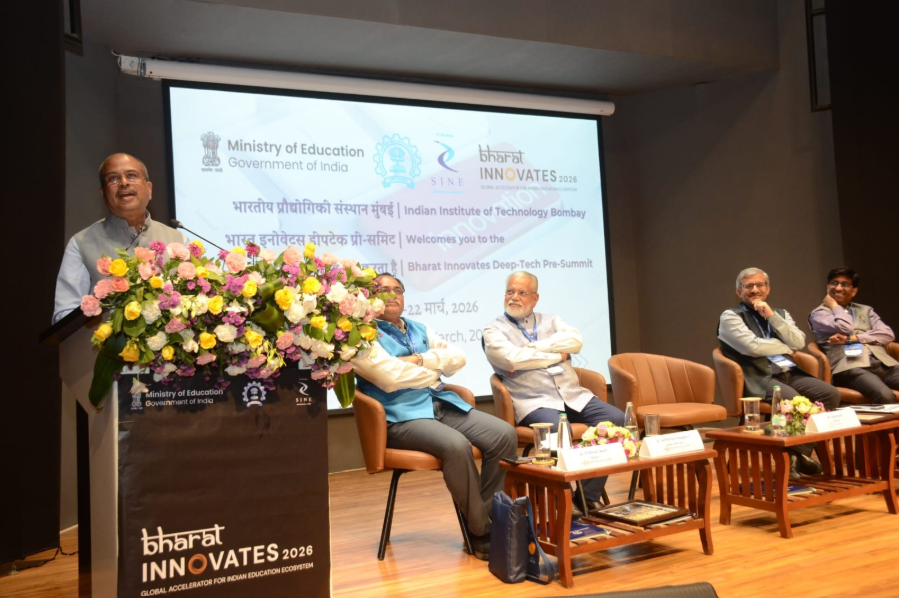
- Dharmendra Pradhan presided over the Bharat Innovates Deep-Tech Pre Summit at IIT Bombay, where 137 startups pitched after being selected from more than 1,100 applicants spanning semiconductors, biotechnology, AI, clean energy, and advanced manufacturing.
- Indian deeptech startups raised $1.65 billion in 2025, a sharp rebound from $1.1 billion in each of the two prior years, but the figure trails the $147 billion raised by US startups and $81 billion by Chinese startups, according to Tracxn data.
- India imports 90-95% of its semiconductor and electronics components, leaving hardware startups exposed to supply-chain disruptions from China and Taiwan, and underscoring the structural hurdle the Nice showcase is meant to address.
- Tata Electronics' semiconductor fabrication facility in Dholera began equipment installation in late 2025, with first commercial chips expected by late 2026 — a milestone that would mark India's first domestic chip production at scale.
- India ranked sixth globally in patent filings in 2025, yet the commercial exploitation of those patents remains far below that of leading innovation economies, a gap the ministry's lab-to-market pitch is designed to close.
- K. Radhakrishnan, former ISRO chairman and current IIT Bombay board chair, attended the closing ceremony alongside senior officials from the Department of Higher Education and the Department of Science and Technology.
- Pradhan framed India as capable of developing scalable, cost-effective solutions not only for domestic needs but for developing nations across the Global South — explicitly extending the summit's pitch beyond home markets.
Why it matters: India's deeptech sector rebounded to $1.65 billion in 2025 funding, yet that is roughly 1% of the $147 billion US startups attracted and a fraction of China's $81 billion. The 137 startups heading to Nice are betting on a diplomatic showcase to help close that gap, but India's 90-95% semiconductor import dependency means the deeper test is whether Tata Electronics' Dholera fab delivers first commercial chips by late 2026.
Ask SkimNews