Watling's 'Statecraft' Book Faults U.S. Iran War Strategy — SkimNews
Get the Geopolitics newsletter
Daily geopolitics — wars, elections, sanctions, the diplomatic moves that move markets. Free.
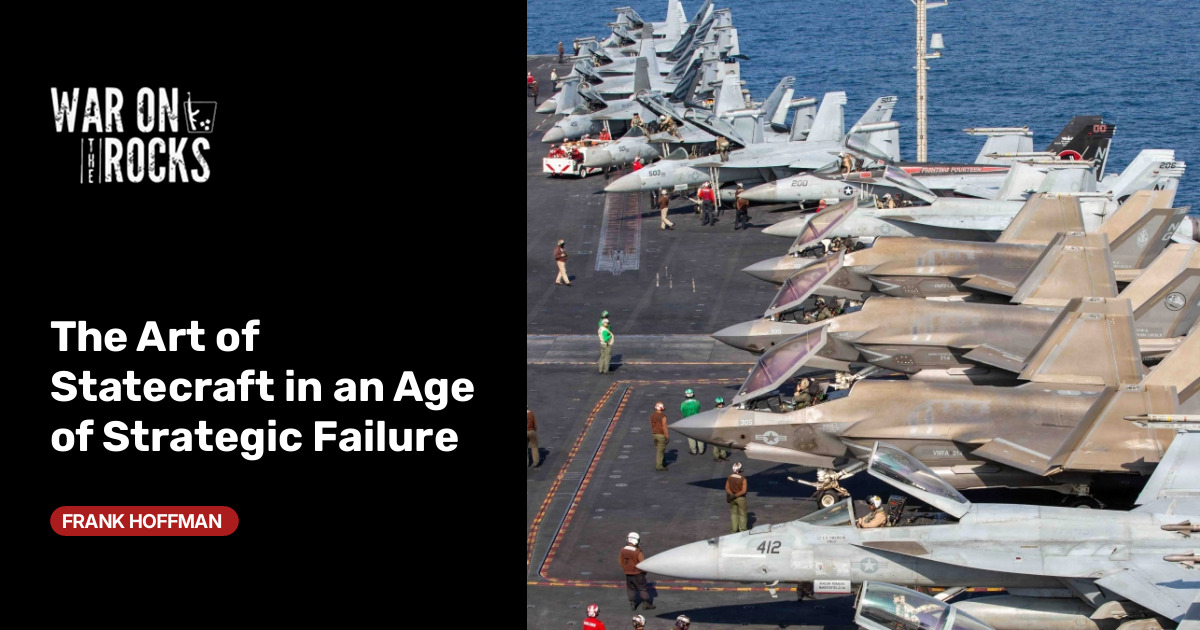
- Jack Watling's book 'Statecraft' (Macmillan, 2026) uses the recent Iran war to diagnose failures in U.S. statecraft, arguing the conflict exposed 'forced errors and own goals' despite 13,000 sorties in Operation Epic Fury failing to induce Tehran's capitulation.
- Operation Epic Fury saw Adm. Brad Cooper claim the U.S. achieved 'all our military objectives,' while the president touted a 'military victory' and the combatant commander claimed a 'generational military defeat' — yet the review argues none identified which policy aims were actually obtained.
- Watling, a senior research fellow at the Royal United Services Institute in London, built his reputation over five years of battlefield research in Ukraine, documenting trench warfare and Ukraine's adaptations in drones, intelligence synthesis, and electronic warfare.
- The review identifies three areas where U.S. statecraft falls short — theory of success, multiple futures (scenario-based planning), and strategic risk — concluding that Iran's experience confirms 'shock and awe was a flawed causal hypothesis.'
- U.S. strategists are warned they will likely 'encounter' rather than learn from the Iran experience, drawing explicit parallels to the post-conflict failures to absorb lessons from Afghanistan and Iraq.
- Unassessed risks included Iran's potential missile attacks on partners, mining of the Strait of Hormuz, economic impacts, Chinese naval intervention in the Gulf, and Russian opportunism in the Baltics.
Why it matters: The review crystallizes a pattern the author says repeats across decades: U.S. officials extol military success without ever mapping it to policy outcomes. With Adm. Cooper claiming 'all military objectives' achieved while the review says no policy aims were identified, and no candid assessment likely forthcoming, the strategic gap that produced the Iran entanglement goes uncorrected — leaving the next contingency to inherit the same blind spots.
Ask SkimNews