Cambridge's $10 Sensor Tracks Glucose Without Needles — SkimNews
Get the Health newsletter
Daily health & science — research, biotech, public health, the studies worth knowing. Free.
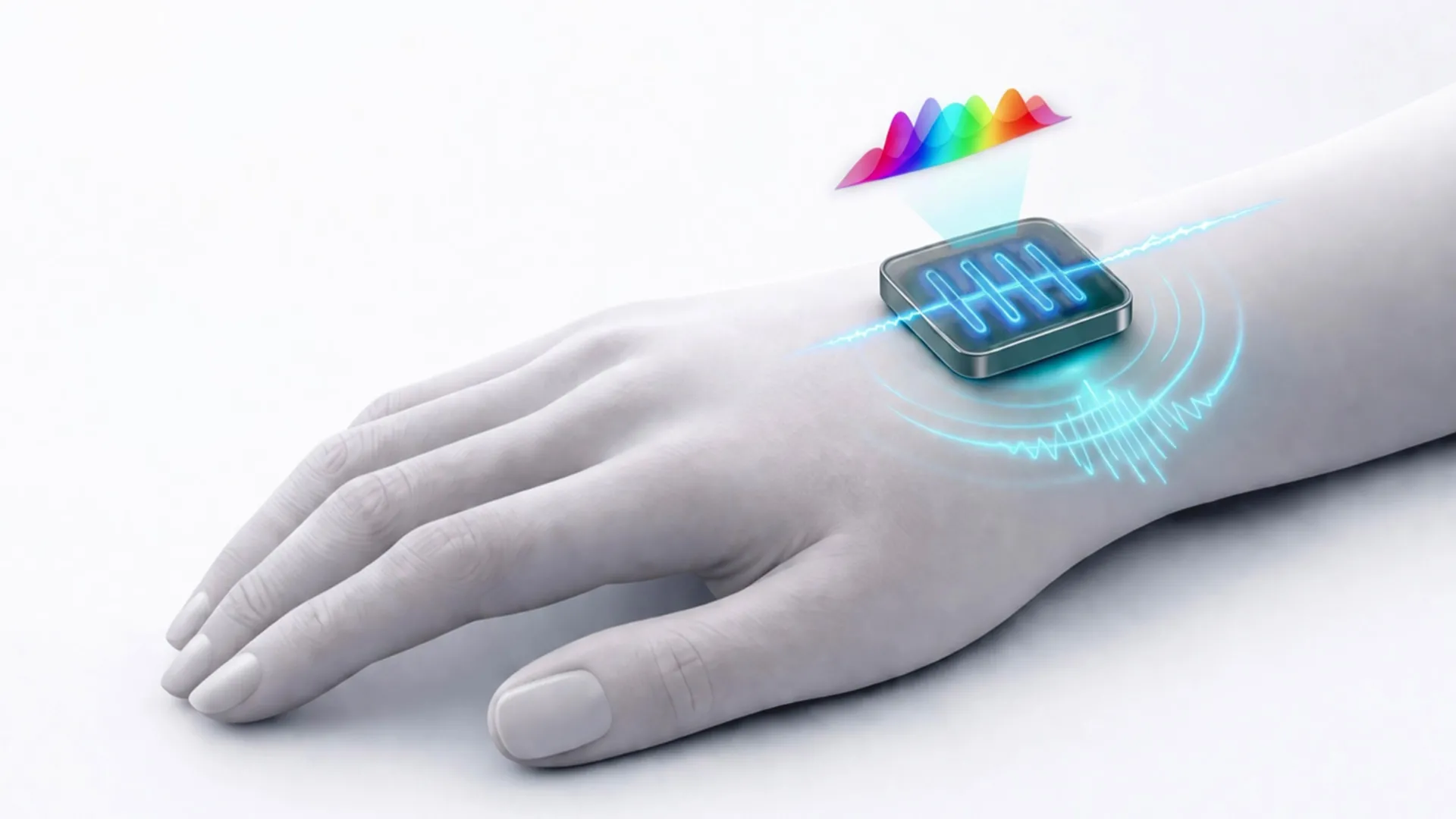
- University of Cambridge researchers and startup GlitterinTech built a convolutional optical spectrometer costing around $10 and measuring only centimeters across, using a silicon nitride photonic platform with onboard electronics to process 1200–1700 nm near-infrared readings in under a second.
- Optical convolutional spectrometer classified plastics, pharmaceuticals, coffee, flour and tea with a 100% success rate in the reported tests and measured concentrations in water-based and organic solutions to roughly 0.01% accuracy, exceeding the performance of commercial benchtop spectrometers in those experiments.
- Chunhui Yao said the team's use of the convolution theorem directly in the optical domain — repeating spectral responses built from unbalanced Mach-Zehnder interferometers or micro-ring resonators, with fast Fourier transforms to recover the spectrum — sidesteps limits that have held miniaturized spectrometers back, adding high precision, noise tolerance and low computational overhead.
- Qixiang Cheng, who led the project, said the device measured skin moisture, blood alcohol, blood lactate and blood glucose under conditions designed to reflect physiological environments, and tracked glucose non-invasively over an extended period in one participant; further testing would be needed before it becomes a practical medical product.
- Richard Penty described the architecture as simple, scalable and manufacturable; the packaged sensor operated reliably from −20°C to 80°C, and its repeating optical patterns allow bandwidth to be extended almost without limit, with resolution rising exponentially as more optical components are added.
- Nature Photonics published the work as “Optical convolutional spectrometer” (2026; 20(6): 664, DOI 10.1038/s41566-026-01891-6), with Chunhui Yao listed first among 15 authors.
Why it matters: Roughly $10 buys 100% material classification and ~0.01% concentration accuracy, exceeding commercial benchtop spectrometers in the reported tests — a direct cost-and-size contrast with instruments the team says are too bulky or expensive for embedded use. Healthcare gains the same economics, but non-invasive glucose tracking was shown in one participant and still needs further testing.
Ask SkimNews