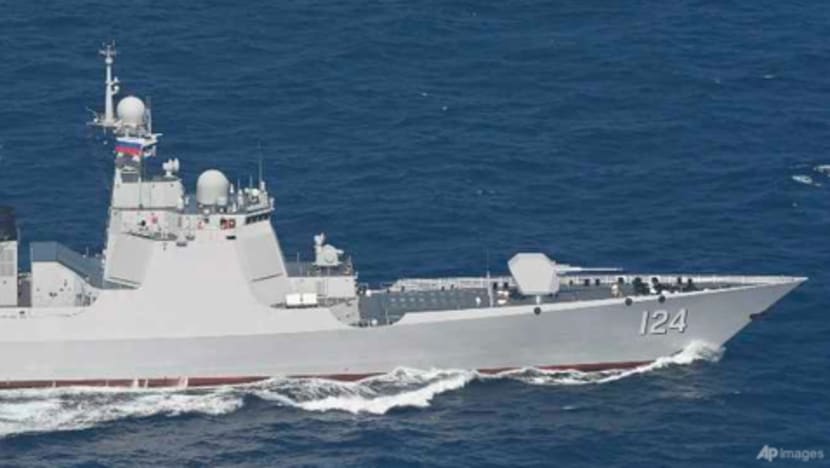
Chinese Destroyer Fires Inside Japan's EEZ Near Okinotorishima

Get the Geopolitics newsletter
Daily geopolitics — wars, elections, sanctions, the diplomatic moves that move markets. Free.
- Japan's Ministry of Defense announced on July 21 that the Type 052D (Luyang III-class) destroyer Kaifeng conducted a machine-gun firing exercise two days earlier roughly 180 km southwest of Okinotorishima, inside Japan's claimed EEZ — the first time Tokyo has publicly disclosed such an incident involving a foreign warship.
- Japan's Joint Staff had detected four ships sailing northeast about 330 km southwest of Okinotorishima — the Type 055 destroyer Anshan, Kaifeng, replenishment ship Kekexilihu, and Russian Navy Steregushchiy-class frigate Rezkiy — the same group that transited southward between Okinawa and Miyako on July 16.
- Japan deliberately did not allege a violation of international law, since UNCLOS preserves foreign military freedom of navigation in EEZs beyond the 12-nautical-mile territorial sea, a principle the US and its allies rely on elsewhere.
- Chinese Foreign Ministry spokesperson Lin Jian rejected Japan's protest as groundless and revived Beijing's long-standing argument that Okinotorishima is a rock, not an island entitled to an EEZ under UNCLOS Article 121 — the same legal posture China resists when applied to its own South China Sea claims.
- Defense Minister Koizumi Shinjiro and Chief Cabinet Secretary Kihara Minoru framed the Kaifeng's drill as evidence of deepening China-Russia military cooperation, noting it followed the two navies' "Joint Sea 2026" exercise near Qingdao and marked a transition into coordinated Western Pacific patrols.
- China-Russia naval coordination has moved from largely symbolic exercises to operational interoperability, with joint bomber flights, a July 6 Chinese submarine-launched ballistic missile test, and repeated transits through the Miyako and Tsushima straits all cited by Tokyo as part of the same pattern.
Why it matters: The Kaifeng's live fire near Okinotorishima exposes Beijing's legal contradiction — invoking permissive freedom-of-navigation principles against Japan while resisting similar US operations in the South China Sea. It also marks a milestone in China-Russia naval evolution: 'Joint Sea 2026' drills are now extending into coordinated Western Pacific patrols around Japan, narrowing warning time for commercial shipping.