Russia Sends Medieval Prince's Bones to Ukraine Front — SkimNews
Get the Geopolitics newsletter
Daily geopolitics — wars, elections, sanctions, the diplomatic moves that move markets. Free.
- The Russian Orthodox Church dispatched a fragment of Grand Prince Dmitry Donskoy's right hand—the 'sword hand' he wielded at the 1380 Battle of Kulikovo against the Mongol Golden Horde—to Russian combat units in Donetsk, with the Moscow Patriarchate saying the relic will 'stand invisibly shoulder-to-shoulder' with troops.
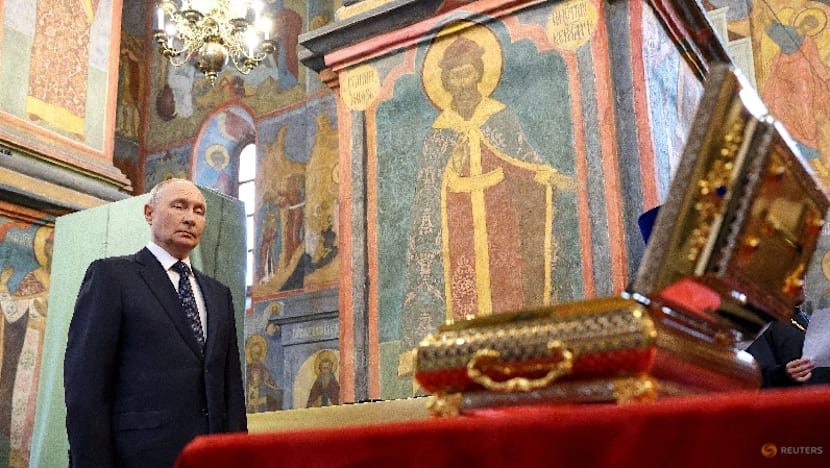
- Donskoy's sarcophagus was uncovered this summer during restoration work at Moscow's Cathedral of the Archangel inside the Kremlin, and Putin personally inspected the remains in August, calling them 'an absolutely unique and marvellous discovery' that reinforced 'the foundations of Russian history.'
- The relic, held in an ornate casket beneath toughened glass, will be shown to Russian units along the more than 1,000km front line; Sergei Kiriyenko, Putin's first deputy Kremlin chief of staff, joined military commanders and the Russian-installed regional head at a Donetsk WWII memorial ceremony kissing the casket and making the sign of the cross.
- The patriotic push comes ahead of a parliamentary election later this month, as Russian forces seek full control of Donetsk and diplomatic efforts to end the war have yet to yield a breakthrough in the conflict's fifth year.
- Donskoy, who died in 1389 and was declared a saint by the Russian Orthodox Church in 1988, had his name given to a Soviet tank column funded by the church during World War II; his relics were carried through Moscow streets at the weekend in a huge Orthodox procession.
- Critics, including Orthodox priest and historian Alexander Zanemonets of the Carnegie Russia Eurasia Center, accuse the Church of breaking religious protocol to please the Kremlin and question why the remains—whose location was 'broadly known for decades'—were recovered and venerated only now, 38 years after his sainthood.
Why it matters: The relic tour fuses nationalism, Orthodox Christianity, and wartime morale into a state-aligned campaign timed for parliamentary elections while peace efforts remain stalled in the fifth year of war. By deploying a 14th-century saint's bones to an active front, the Kremlin weaponizes religious authority to frame the invasion as a continuation of Russia's historical struggle—a framing critics say shows the Church subordinating religious protocol to the state.
Ask SkimNews