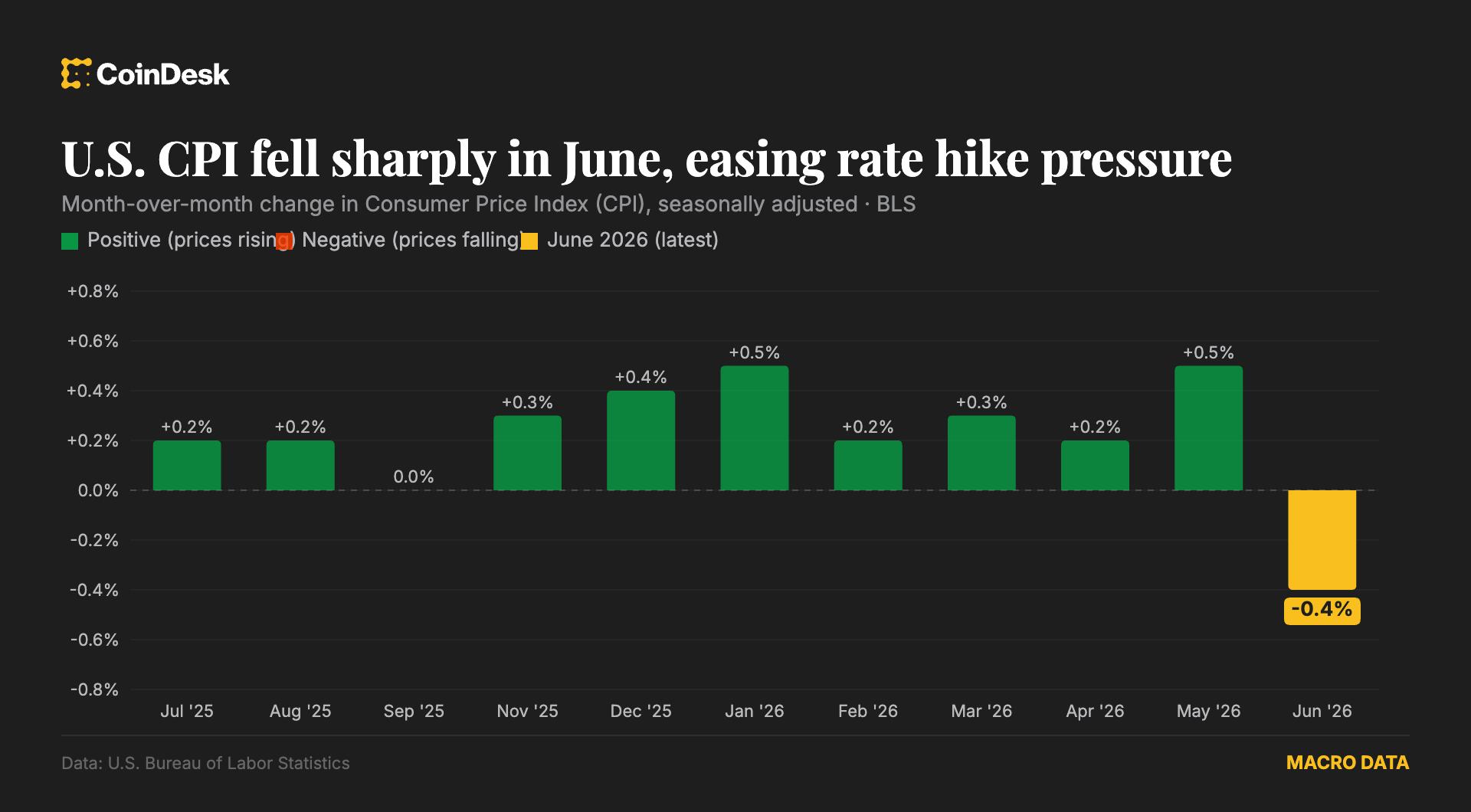
Here’s the inflation breakdown for June 2026 — in one chart

Get the Finance newsletter
Daily finance — markets, central banks, M&A, the prints that move money. Free.
- The Bureau of Labor Statistics reported the CPI fell 0.4% month-over-month in June — the steepest single-month decline since April 2020 — with annual inflation at 3.5%, down from 4.2% in May
- Energy prices drove the drop, with gasoline falling about 10%, fuel oil dropping 9%, and the broader energy index down 6% in June, though each remains up double-digits over the past year (27%, 43%, and 16% respectively)
- Global oil prices declined from over $90 per barrel to roughly $73 by end-June after a mid-June U.S.-Iran ceasefire deal ended a conflict that began Feb. 28 with U.S. and Israeli strikes on Iran
- The U.S.-Iran ceasefire appeared increasingly fractured on Tuesday, with adversaries exchanging hostilities for a third consecutive day and oil rising to about $86 per barrel as of 9:45 a.m. ET
- Goldman Sachs Research warned in a Sunday note that 'a serious re-escalation of the conflict would threaten to revive the key upside risk to inflation and raise the odds of rate hikes'
- Economists Mark Zandi (Moody's) and Tom Porcelli (Wells Fargo) said inflation should moderate over the coming year barring full-blown war that closes the Strait of Hormuz, with Porcelli seeing 'no compelling reason' for the Fed to raise rates
- Beef roast prices rose about 14% over the past year amid decades-low cattle supply, while tariffs and adverse weather pushed tomato prices up 20% year-over-year
Why it matters: The Fed had been leaning toward rate hikes to contain inflation; this report gives policymakers cover to pause, yet the ceasefire driving oil's drop is already fracturing with crude back at $86 per barrel. Zandi told the outlet renewed war shutting the Strait of Hormuz 'would push interest rates higher,' putting the reprieve at risk.