Quad's New Agenda: Ports, Cables, Critical Minerals — SkimNews

Get the Geopolitics newsletter
Daily geopolitics — wars, elections, sanctions, the diplomatic moves that move markets. Free.
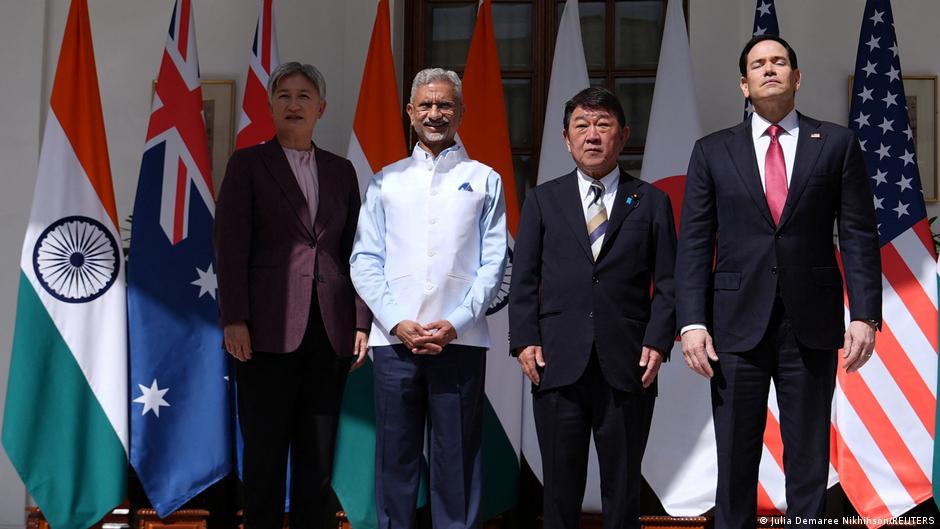
- The Quad foreign ministers announced new initiatives at their New Delhi meeting covering a port project in Fiji, maritime surveillance, maritime domain awareness, and critical mineral partnerships.
- The South China Sea carries more than 30% of global maritime crude oil trade and almost 40% of global LNG shipments, with roughly one-third of global maritime trade — over $3 trillion annually — transiting its sea lanes.
- Around 80% of global trade by volume moves by sea, and more than 95% of international data traffic travels through submarine cables, several of which pass through or near Pacific Island territories.
- China's diplomatic and infrastructure footprint has expanded across Kiribati, the Solomon Islands, Papua New Guinea, and Vanuatu, reinforced by a 2022 China–Solomon Islands security agreement that has heightened regional concerns.
- India's Great Nicobar project sits near the western approaches to the Malacca Strait and the Six Degree Channel, through which 75–80% of China's oil imports transit, positioning New Delhi to monitor and project influence across the eastern Indian Ocean.
- The Quad's agenda is extending beyond military deterrence into critical minerals, undersea cables, supply-chain resilience, and digital infrastructure — the intersection of economic security and strategic competition.
Why it matters: With roughly 80% of global trade moving by sea and over 95% of international data traffic on submarine cables, infrastructure resilience has become a national-security variable. The Quad's pivot means Fiji-style port investments and India's Great Nicobar project are now explicit bids by India, Japan, and Australia to shape the maritime and digital corridors that China, Japan, and South Korea also depend on — turning economic geography into a frontline of regional power competition.
Ask SkimNews