Autonomous Umbrella Drone Follows Users With 3D Tracking
The 30-Second Skim7 points
- What happenedMaker John Tse upgraded his remote-controlled flying umbrella into a hands-free autonomous version that hovers over and follows users, keeping them shaded via 3D depth-camera person tracking.
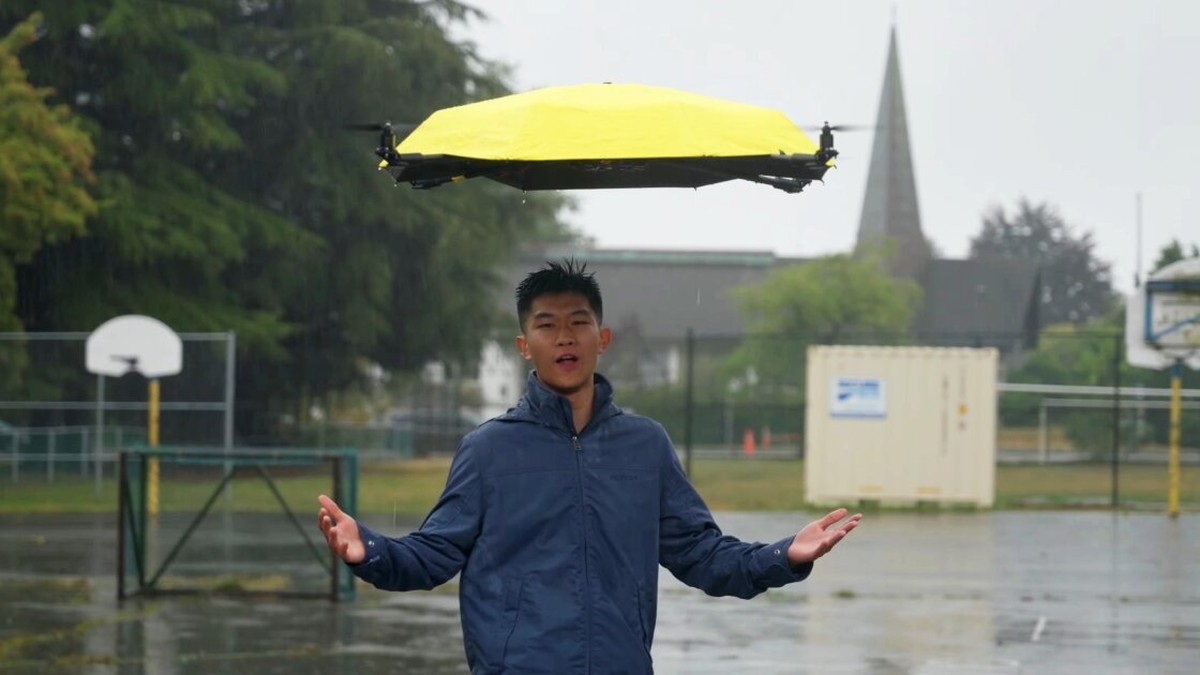
- Key facts & numbersJohn Tse of YouTube channel I Build Stuff created an autonomous flying umbrella that hovers above users and trails them hands-free, shielding them from rain and sunlight — upgrading a remote-controlled prototype he previously built. The device uses four propellers mounted on folding arms that collapse inward when carried and lock rigidly into place during flight, with hinges, rubber bands, and custom plates reducing shake. A time-of-flight depth camera tracks the user in 3D — even in low light — while a Raspberry Pi pinpoints the person's head and tells the flight controller which direction to move so the umbrella stays centered overhead.
- What happens nextA flying umbrella that actually works in heavy rain. Whoever cracks the commercial version first owns summer.
- John Tse of YouTube channel I Build Stuff created an autonomous flying umbrella that hovers above users and trails them hands-free, shielding them from rain and sunlight — upgrading a remote-controlled prototype he previously built.
- The device uses four propellers mounted on folding arms that collapse inward when carried and lock rigidly into place during flight, with hinges, rubber bands, and custom plates reducing shake.
- A time-of-flight depth camera tracks the user in 3D — even in low light — while a Raspberry Pi pinpoints the person's head and tells the flight controller which direction to move so the umbrella stays centered overhead.
- A professional flight controller and embedded GPS keep the device balanced and holding position outdoors; most structural parts were 3D-printed in carbon-fiber nylon for strength and precision.
Why It Matters
The project lays out a reproducible blueprint for personal-following drones — folding-arm quadcopter propulsion, 3D depth-camera person-tracking, and 3D-printed carbon-fiber frames — using off-the-shelf hardware like a Raspberry Pi. The reported near-year failure cycle illustrates how far hobbyist single-unit prototypes still sit from mass-produced consumer gear.
Sources Cited
Related Coverage
The day’s news in one short email, every morning.
Free. One email a day. Unsubscribe in one click.